


There are men whose presence brings peace even before they speak. Sidi Jamal Al‑Qadiri Al‑Boutchichi (1942‑2025) was one of them: a discreet Sufi master, deeply rooted in the love of Allah and of the Prophet ﷺ, heir to the Qâdiriya Boutchichiya Way and son of the great Cheikh Sidi Hamza, may Allah sanctify their Secrets. For decades, he welcomed seeking hearts, accompanied them in dhikr and turned them towards divine mercy, without noise, without display, with a gentleness that became his mark.
Biographical landmarks
- Birth: 1942, Madagh (Berkane province, Morocco)
- Return to God: 8 August 2025, at the age of 83, in Rabat
- Role: spiritual guide (cheikh, murshid) of the Tariqa Qâdiriya Boutchichiya, from January 2017 to August 2025
- Father and spiritual master: Sidi Hamza Al‑Qadiri Al‑Boutchichi (1918‑2017)
- Scholarly work: doctorate in 2001, thesis “The institution of the zaouïa in Morocco between authenticity and modernity”
- Successor: his son Sidi Mouad, current guide of the Tariqa
A life devoted to Allah and to the service of wayfarers
Blessed roots in Madagh
Sidi Jamal was born in 1942 in Madagh, a small locality in the Moroccan Oriental that became a great centre of spiritual light. He grew up in the fragrance of dhikr, of night gatherings for the remembrance of Allah, of the welcome given to travellers on the Way.
Son of Cheikh Sidi Hamza Al‑Qadiri Al‑Boutchichi, he received from childhood an education in which a father’s tenderness merged with a master’s transmission: love of the Qur’an, attachment to the Prophet ﷺ, generosity, devotion to the service of others, respect for the Sharia and a deepening of spiritual realities.

An intelligence of the heart and of the age
Alongside this inner formation, Sidi Jamal pursued higher studies and in 2001 devoted a thesis to:
“The institution of the zaouïa in Morocco between authenticity and modernity”.
This question runs through all his work: to remain faithful to the authenticity of the Way while responding to the transformations of the contemporary world. For him, intellectual reflection never replaces the light of the heart. It is its extension.

Succession in the service of the Way
After Sidi Hamza’s return to God in January 2017, Sidi Jamal was naturally recognised as spiritual guide (cheikh, murshid) of the Tariqa Qâdiriya Boutchichiya.
He accepted this charge not as an honour, but as a responsibility before Allah. Under his guidance, the zaouïa of Madagh continued to welcome seekers of truth from Morocco and from all over the world, of every generation and every background.
During these years, he discreetly pursued another mission, that of completing the transmission begun by Sidi Hamza to Sidi Mouad, who was called to carry, when the time came, the amâna (spiritual responsibility) of the Way. A small circle of disciples was gradually taken into Sidi Jamal’s confidence: sometimes by direct instruction, sometimes by allusion (a discreet insistence on drawing close to Sidi Mouad and surrounding him), and sometimes by spiritual unveiling (kashf).
The Qâdiriya Boutchichiya Way in his light
Madagh, a point on the map, a centre in the hearts
The Tariqa Qâdiriya Boutchichiya belongs to the family of Qâdiriya paths, attached to the founding pole of the path, Sidi Abd al‑Qadir al‑Jilani. In Madagh, this attachment is lived in a daily life made of dhikr, spiritual teachings, service and hospitality.
With Sidi Jamal, the zaouïa remained a refuge for hearts in search of truth, a home of dhikr, a place of learning where one learns again to say “Allah” with sincerity.

Heir to the Secret of the Way
In the language of the people of the Way, it is said that Sidi Jamal received from his father the “Sirr” (the spiritual Secret that makes the Way effective). This transmission cannot be reduced to an outward function, nor is it inherited by will. It is an inner trust recognised by its fruits: the real transformation of hearts.
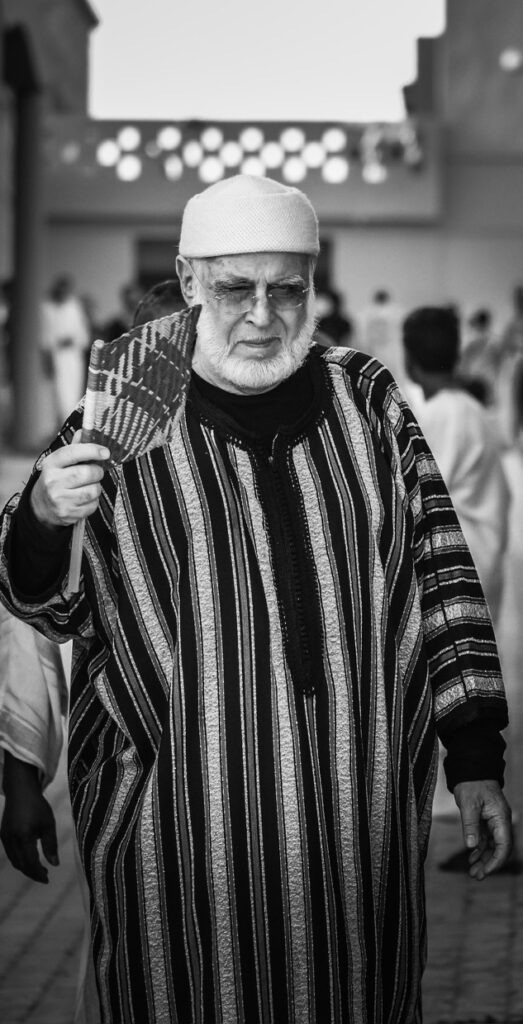
Those who were close to Sidi Jamal bear witness to an authentic master, present without weighing on others, firm without harshness, close to his disciples, absent to himself.
The main lines of his teaching
Retreat within the heart
Faithful to the spirit of the Way, Sidi Jamal recalled that the Sufi’s retreat is not a flight from the world, but a presence to Allah in the midst of the world. This retreat is not isolation. It is lived at work, within families, in carrying responsibilities. There, where dhikr never stops. Sidi Jamal often recalled it: the body in the shop, the heart in the Kingdom (al-jasad fi-l-hânût wa-l-qalb fi-l-malakût).
“This Secret (Sirr) does not settle in a heart until that heart is purified. And it is purified only through invocation and the repetition of the formula of oneness la illaha illa llah. Everything has a polishing stone, and the stone that polishes hearts is the invocation of Allah.”
Sidi Jamal

The union of the Sharia and the Haqiqa
For him, the Sharia (divine Law) and the Haqiqa (divine Truth) are not opposed, they complete each other. Without the Sharia, the inner quest loses itself in illusion. Without the Haqiqa, outward practice hardens and empties of meaning.
“The tarîqa is built on the Book and the Sunna. Accept whatever the Messenger gives you, and abstain from whatever he forbids you.”
Sidi Jamal
His teaching insisted on love of others, forgiveness, complete self-denial in the service of Allah’s creatures, not judging, attachment to the Sunna of the Prophet ﷺ, a life governed by what is lawful, the purification of the heart from pride, resentment and jealousy, and the pursuit of Ihsân (excellence): “to worship Allah as though you see Him, for if you do not see Him, He sees you”.
These virtues were not, for him, mere instructions to apply. They were the natural effect of his inner life. And he named this experience with an expression dear to him: the divine wine. A notion he liked to recall during evenings of invoking the divine names, of Sufi songs (samâ’) and of mudakara (spiritual exchanges) in the company of his disciples. The divine wine… These moments of communion were indeed moments of intense intoxication in which the divine presence and its effects on hearts could be perceived.

The path of the middle way
Sidi Jamal embodied the middle way of the Muhammadan path: firmness without fanaticism, openness without dilution, gentleness without weakness. He invited people to an Islam of mercy and of reverence (ta’zîm), made of the patient education of hearts rather than of judgement.
The garment of poverty
Sidi Jamal wore the garment of the faqir: no display of self, few public words. Much dhikr, many looks, hands laid on the shoulder or on the heart of his disciples, night gatherings of invocation and samâ’.
His spiritual authority came neither from an academic title nor from a filial inheritance, but from the transparency of his being in the service of the light he carried.
“This Secret is not known through discursive thought but through dhikr. You may read every book, give lectures, you will not discover this Secret in words or in written pages. This Secret is in the breasts of the Saints.”
Sidi Jamal

A living legacy
After his departure, the zaouïa of Madagh continues to welcome disciples and to hold dhikr, retreats and gatherings, under the guidance of Sidi Mouad, who carries on the spirit and the method of his predecessors.
But the deepest mark is to be read elsewhere.
In the secret of the heart of those he guided there remains a perception of the world entirely devoted to the Divine, a deep taste for the spiritual Secret of the masters of the Way, a permanent retreat of the heart in the very midst of life. This constant inclination to choose the divine paths despite trials bears his mark.
“Share this Way so that its benefits reach as many people as possible.”
Sidi Jamal

To continue the Way is to continue his message
To honour Sidi Jamal is not only to recall his name or his titles. It is to persevere in dhikr, to hold fast to the Qur’an and to the Sunna of the noble Messenger, to tend one’s character and to place oneself in the service of humanity. To remain in the middle way, far from excess, in gentleness and patience.
Each time a disciple chooses mercy rather than harshness, patience rather than anger, dhikr rather than forgetfulness, he extends something of his master’s presence, and honours, in the same breath, the chain of light which, from Sidi Hamza to Sidi Jamal, and from Sidi Jamal to Sidi Mouad, continues to pass through Madagh.
A disciple’s testimony:
On 8 August 2025, Sidi Jamal al Qadiri al Boutchichi left his body to return to God.
God, Love, our common Origin: Sidi Jamal never ceased reminding his disciples, throughout the world, to awaken the mention of God on the tongue and in the heart.
In the line of his father, Sidi Hamza al Qadiri al Boutchichi, who was also his spiritual master, Sidi Jamal embodied humility, sincerity and detachment from the world.
Sidi Jamal was an upright being rooted in an ocean of Compassion and Mercy.
A look, a smile, a silence, a gesture of the hand, everything was spiritual teaching.
Sidi Jamal recalled that the ego would never leave us until our last breath. In this way he recalled that he himself was only one poor in God: the definition of the faqir. It is surely here that the quintessence of his spiritual teaching lies: We are passers-by in this world
Let us become servants of Love in the service of all human beings, let us cultivate Love and welcome Universality.
His departure towards Allah and the continuity of the Way
On 8 August 2025, after a period of trials to his health, Sidi Jamal returned to his Lord at the age of 83. By order of His Majesty King Mohammed VI, he had been transferred to the military hospital in Rabat, a sign of the great esteem in which he was held.
The official tributes speak of a major figure of Moroccan and world Sufism, but those who knew him remember above all the inhabited silence, the gaze full of rahma (mercy) and the hand that guided without ever forcing.

Sidi Mouad, current guide of the Tariqa Qâdiriya Boutchichiya
FAQ :
Sidi Jamal Al‑Qadiri Al‑Boutchichi (1942‑2025) was a Moroccan Sufi master, guide of the Tariqa Qâdiriya Boutchichiya in Madagh. Son of Cheikh Sidi Hamza, he devoted his life to spiritual education, to the purification of hearts and to spreading an Islam of mercy, rightness and light.
His teaching invited people to keep a heart in dhikr in the midst of daily life, to unite Sharia and Haqiqa, to live gentleness, tolerance and the middle way, and to seek in all things the presence of Allah and conformity to the example of the Prophet ﷺ.
The zaouïa of the Tariqa Qâdiriya Boutchichiya is in Madagh, in the province of Berkane (Oriental, Morocco). It was there that Sidi Jamal grew up, was trained and guided generations of disciples.
After his departure in August 2025, his son Sidi Mouad Al‑Qadiri Boutchich took on the guidance of the Tariqa Qâdiriya Boutchichiya. Born in 1983 in Madagh, trained from childhood under Sidi Hamza and then his father, he pursues the Way in continuity with his predecessors.
His legacy shows itself in the continuity of the Way in Madagh and in the world, in the inner transformation of thousands of disciples, and in a way of living Islam in peace, mercy and humility.