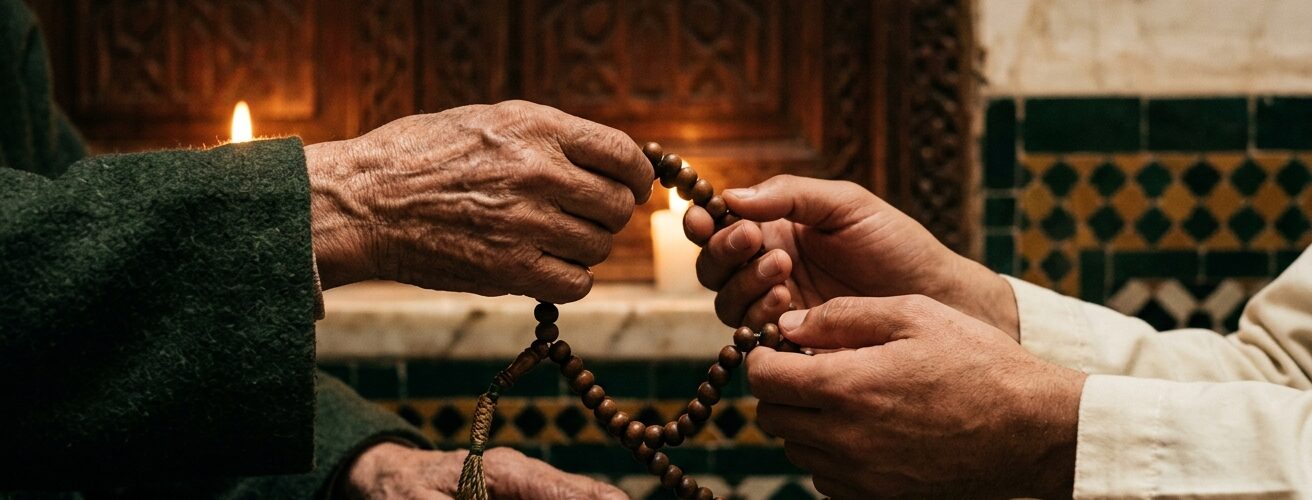
This Way is called the Tariqa Qâdiriya Boutchichiya, after the name of its present guide, Sidi Mouad al Qâdiri al Boutchichi. As in every true Sufi way, an unbroken initiatic chain links each authentic master to the Prophet of Islam. Sidi Hamza, both a direct descendant and the spiritual heir of Moulay Abd al Qâdir al Jîlanî, continues a lineage whose roots reach down into the light of twelfth-century Baghdad. To understand the spirit of this way, one must recall those who came before Sidi Mouad: Sidi Jamâl, Sidi Hamza, Sidi Hajj Abbas and Sidi Boumediene.
The Sirr (Spiritual Secret)
The essence of an initiatic way lies in this Secret placed by God in the heart of the guide: the Sirr. It is this that distinguishes a way that is simply blessed from a way that truly carries the spiritual Secret. For invoking God, multiplying one’s works, observing the law: all of this is good, certainly. But only the presence of a living guide, bearer of the Sirr, can transform a person from within and awaken that spiritual faculty lying dormant in the depths of every soul. We can forbid ourselves certain acts through willpower, but true healing is to no longer desire them. And that does not come from personal effort, but from an inner transformation, brought about by the light of the divine Secret.
Yet this Secret has not always resided in Sidi Mouad’s family. Like many other lineages, that of his ancestors had, over the centuries, turned into a way of blessings, beautiful but weakened, deprived of the inner fire.
Sidi Hamza Qadiri Boutchich
The Quest for the Spiritual Secret
Sidi Hamza (The reviver of contemporary Sufism) often recounts how his master, Sidi Abû Madyan, was led to seek this Secret. For many years, he had lived an intense piety, but one that was still outward. He belonged to a noble lineage of saints and founders of zaouïas (places of spiritual gathering). A Chérif, a descendant of the Prophet, he then believed that following the tradition of his forefathers was enough. Nevertheless, he liked to visit a few foqara (the poor in God) of the Darqâwâ brotherhood, in the region of Sidi al-Habrî. He went to see them expecting nothing from them, simply touched by their hospitality and their gentleness.
Over the years, his outlook changed. These simple men, sometimes illiterate, nonetheless spoke of the Reality of Being with a depth that shook him. One day, he suddenly understood that he was asleep. They lived awake, bathed in light, while he moved in a tranquil unawareness. Then a fire was kindled in his heart: he had to find a living master who could lead him into the land of Reality, into the Truth of Being. He searched for a long time, humbly, with no concern for prestige or lineage. All that mattered to him was nearness to the Truth.
Sidi Boumediene
From master to master, from encounter to encounter, he finally reached the heart of the Secret, the Sirr, and received the spiritual authorisation (idhn) to transmit it. He then brought together the teachings he had received and gave new life to the Qâdiriya Boutchichiya Way, which he rekindled from within with the flame of the Secret. He was not a man to seek out crowds. He often said:
“A handful of bees is better than a swarm of flies.” And also: “This precious Secret, I toiled to obtain it; I will entrust it only to those who truly deserve it.”
His disciple Sidi Hajj Abbas, father of Sidi Hamza, began his own quest with a singular encounter. In Oujda, he came across a majdhûb, one “enraptured in God” (these beings whose heart is absorbed in the divine Presence, but who seem detached from the world, sometimes considered mad, though they are feared and respected for their inspired words).
Sidi Hajj Abbas
This particular majdhûb spoke to no one. Some held out a few coins to him, which he refused. One day, burning with spiritual thirst, no longer knowing where to turn, Sidi Hajj Abbas approached him. The majdhûb raised his head and said: “What do you want from me?” “I wish to receive a dhikr,” replied Hajj Abbas (an invocation of the Name of God). “Why? Do you want to go mad?” the other retorted ironically. “Is he not already mad, the one who is a prisoner of his own self?”
The majdhûb burst out laughing and finally said: “Listen. Go home. Seek nothing, concern yourself with no one. When the time comes, the one who is to guide you will knock at your door.”
And that is what happened, thirty-five years later. One day, Sidi Abû Madyan came to visit him, accompanied by a few disciples. Throughout all that time, Sidi Hajj Abbas had kept faith. Those years of waiting were not lost: they were a time of purification, of stripping away, of silent ripening. When the master finally came to him, he was ready to receive the spiritual Secret.
Sidi Boumediene and Sidi Hajj Abbas
Sidi Hamza recounts:
“My father had placed himself entirely at the service of Sidi Boumediene. Many find it hard to serve, even among the foqara. Yet it is through serving that the soul is set free. My father, a respected man, a notable of his region, did not hesitate to rise and serve tea to the disciples. Some murmured: ‘Look what they make him do!’ But the master replied: ‘I do it to educate him, to free him from his ego. No one is purified of his vices without spiritual education.’”
And he added:
“The scholar takes pride in his knowledge, the rich man in his fortune, each remains a prisoner of what defines him. Only spiritual education breaks these chains.”
Sidi Hajj Abbas invoked a great deal, but he stood out above all for his luminous generosity: he anticipated the needs of the master and the disciples. It was through this generosity, it is said, that he inherited the Sirr.
Sidi Hamza was born in 1918 in Madagh, a small village in eastern Morocco. He followed the traditional Islamic course of study (sixteen to seventeen years of study) and, at a very young age, showed signs of sainthood.
“Sidi Abû Madyan,” he recalls, “loved me deeply. He would sometimes come and knock at my door just to see me for a moment. He said that my time would come, and that I would have a spiritual role to play in it.”
In 1942, he took the spiritual pact with Sidi Abû Madyan, one month after his father.
“For fourteen years,” he recounts, “we lived beside him, in devotion, in reading the Qur’an, in dhikr. Together, we passed through the stages of the Way. Sometimes, he spoke to us of future events that he saw through unveiling.”
On the death of Sidi Abû Madyan, in 1955, the mystery remained complete: no one knew with certainty to whom the guidance of the tarîqa fell. In reality, the master had entrusted the spiritual direction to his own son, but the true bearer of the Sirr, the divine Secret, was Sidi Hajj Abbas. Out of humility, he kept silent, preferring to remain in the shadows until the day when, moved by divine inspiration, he openly revealed the transmission entrusted to him.
“I saw in myself no aptitude for teaching,” he said. “I thought I was the weakest of his disciples. But God willed otherwise. Five years later, during a circle of dhikr, I understood that I had to take on this responsibility.”
In 1960, he began to guide the disciples, revealing his master’s spiritual testament. Later, he transmitted the Secret of the Sirr to his son Sidi Hamza, and the Way took on its present form:
“A way of spiritual states, of knowledge and of renewal.”
With Sidi Hajj Abbas and then Sidi Hamza, the method of education changed: rigour gave way to gentleness, majesty to beauty.
“God,” said Sidi Hamza, “has had mercy on us. We are no longer obliged to toil like those of old, whose will was powerful. He has summed up the Way for us in dhikr and prayers.”
Their approach placed less emphasis on struggle and asceticism, and more on presence and light.
“In the past,” he explained, “we had entered through the door of Majesty; now God has opened for us that of Grace and Beauty.”
Thus the Boutchichiya Way has become a way of gentleness, where the heart is illuminated even before it is purified. It is this light that then moves the disciple to strip himself bare. Like a dark and cluttered room: before putting it in order, one must first light a lamp in it.
The renewal of the method does not contradict tradition: it extends it. Sidi Hamza often recalled:
“In the time of Sidi Abû Madyan, he forbade his disciples any reading on Sufism, except the Hikam of Ibn ‘Ata Allah. It is better to taste reality than to read about it. True knowledge does not come from books: it springs from the heart.”
And he added further:
“Divine knowledge is like the water of a stream: to drink it, one must bend down. Be like water.”
His machyakha lasted 45 years, from 1972 until his death on 18 January 2017. This period was a major stage in the history of Sufism, marked by a renewal and by a wide-ranging expansion, both in Morocco and abroad.
After him, Sidi Jamal al-Qadiri al-Boutchichi took up the task of guiding the Tariqa. Continuing his father’s work, he devoted himself to preserving this spiritual heritage while adapting it to the challenges of the modern world, placing emphasis on the values of peace, of the middle way and of the education of the heart.
Testimony of a disciple:
On 8 August 2025, forty days before these lines were written, Sidi Jamal al Qadiri al Boutchichi left his body to return to God.
God, Love, our common Origin: Sidi Jamal never ceased to remind his disciples, throughout the world, to awaken the remembrance of God on the tongue and in the heart.
In the line of his father, Sidi Hamza al Qadiri al Boutchichi, who was also his spiritual master, Sidi Jamal embodied humility, sincerity, detachment from the world.
Sidi Jamal was an upright being, rooted in an ocean of Compassion and Mercy.
A look, a smile, a silence, a gesture of the hand: everything was spiritual teaching.
Sidi Jamal reminded us that the ego would never leave us until our last breath.
It was in this way that he recalled that he himself was only a poor man in God: the definition of the faqir.
It is surely here that the quintessence of his spiritual teaching lies:
We are passers-by in this world Let us become servants of Love in the service of all human beings, let us cultivate Love and welcome Universality.
That is the whole spirit of the Qâdiriya Boutchichiya: a living way, anchored in the transmission of the spiritual Secret, nourished by beauty, generosity and presence of heart. A way where one learns less to want to change than to let oneself be transformed, until light becomes within us the very source of life.