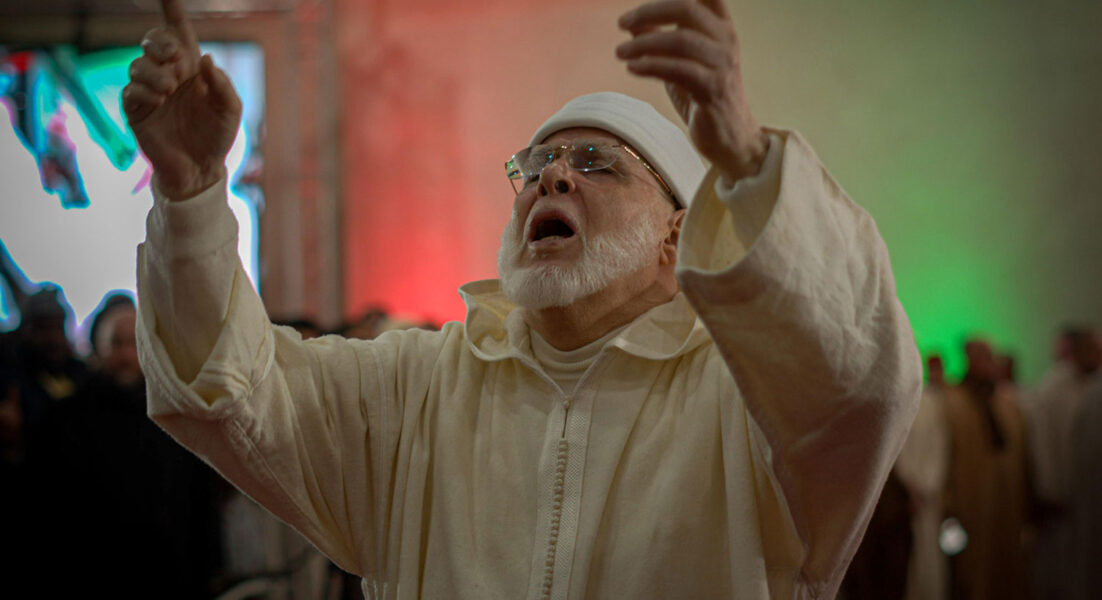
This article is a translation of “الجهر بالذكر”, published by Dr Smaail Radi on the portal of the Rabita Mohammadia of Ulema on 2 January 2012. Translation and additional notes: the editorial team. We thank the author and the Rabita portal for this material.
Invocation aloud, jahr bi-dh-dhikr, is an established practice that was current in the time of the Prophethood. This is attested by what Bukhârî reports from ‘Abdallâh ibn ‘Abbâs, may God be pleased with them both, who said: “Raising the voice in invocation, when people were leaving the obligatory prayer, was current in the time of the Prophet, peace and blessings be upon him.” And he added: “I knew they had left when I heard it.”1
Likewise, the two Sahîh collections contain more than twenty hadiths establishing that the Messenger, peace and blessings be upon him, and his companions invoked aloud. This is not the place to report them all. It is enough to observe that those who yesterday condemned it, and declared forbidden what God has made lawful, have turned away from that position: we now see invocation aloud on their own satellite channels, in gatherings and in vigils of praise and spiritual audition.
Imam as-Suyûtî set out to answer those who rejected invocation aloud by gathering nearly twenty-five hadiths,2 from which it emerges that raising the voice is recommended in certain states, and that the balance between the voice raised and the voice lowered varies according to states and according to persons.
Imam an-Nawawî, may God be pleased with him, established this in his fatwas in these terms:
Invocation aloud, where no legal impediment stands against it, is permitted and recommended. It is even preferable to silent invocation in the school of Imam ash-Shâfi’î. It is also the apparent view of the school of Imam Ahmad, and one of the two transmissions reported from Imam Mâlik, according to what the hâfiz Ibn Hajar reports in Fath al-Bârî.3
Thus the Law has encouraged invocation in both its forms, the secret and the manifest. The scholars of the first generations nevertheless established the preference for invocation aloud, provided it is free of ostentation and of everything that corrupts it.
Notes
- Ibn Hajar al-‘Asqalânî, Fath al-Bârî, Dâr al-Hadîth, Cairo, 2004, 2/375. The hadith is reported by Bukhârî, Sahîh, no. 841. The meaning of Ibn ‘Abbâs’s words is: “I knew they had left on hearing the invocation”, as the author of Fath al-Bârî explains.
- As-Suyûtî, Al-Hâwî li-l-fatâwî, Dâr al-Kutub al-‘Ilmiyya, Lebanon, 2000, 2/298.
- Al-Âlûsî, Rûh al-Ma’ânî, Dâr al-Hadîth, Cairo, 2005, 16/668.