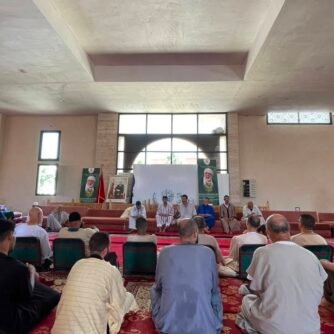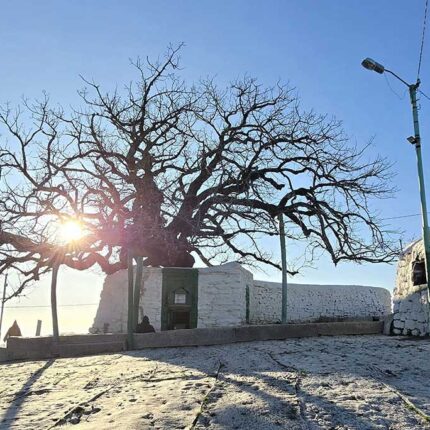
First instalment of the series “Men of Light”, devoted to the figures of Moroccan Sufism. Translation from the Arabic and notes: the editorial team. The original source is available at the end of the article.
A chérif asked God that people turn away from him. Abû al-Hasan ash-Shâdhilî carried his Secret to the ends of the world.
At a time when nobility of descent had become a capital on which chieftaincies were built, an Idrisid chérif, sprung from the very heart of the Prophet’s house, chose the opposite: he climbed to the summit of an isolated mountain and implored his Lord to turn the faces of men away from him, so that he would have no refuge but in Him. His self-effacement was such that the books of his contemporaries almost failed to mention him.
Yet he became “the Pole of the Maghreb”. A path has claimed descent from him, and it has spread from East to West. A prayer bears his name and is still recited today. And all of this, a single disciple carried from him.
He is Abû Muhammad ‘Abd as-Salâm Ibn Mashîsh al-‘Alamî al-Idrîsî (c. 559-622 AH), the master of Abû al-Hasan ash-Shâdhilî.
How does the most self-effacing man of his age become the most famous of the Poles, before being treacherously murdered at the hands of an impostor who claimed to be a prophet?
A chérif who ploughed his land among the Banû ‘Arûs
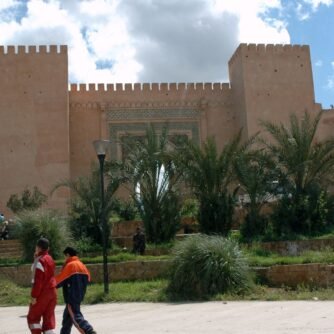
He is a Hasanid Idrisid chérif whose lineage goes back to Idrîs the Elder, a descent established by at-Talîdî in al-Mutrib. His epithet, al-‘Alamî, comes from Jbel al-‘Alam, in the tribe of the Banû ‘Arûs, in the north of Morocco.
Born around 559 AH, he memorised the Qur’an before the age of twelve. He lived as a cultivator, toiling on his land without depending on anyone, married his uncle’s daughter and had Muhammad and his brothers.
So he was neither a prince nor the master of a zaouïa, but a man from among the ordinary chérifs, who preferred labour and retreat.
A hidden master, absent from the record of his century
He received knowledge from Ahmad, known as “Aqtarân”, and was trained by ‘Abd ar-Rahmân al-Madanî az-Zayyât. As for what is related of the latter coming to him “by the folding of space” from Medina, it belongs to the hagiographical genre, not to history.
He founded no order, so much so that it was said of him: “he has a path, but he has no brotherhood”. His self-effacement was extreme, and he prayed thus:
“My God, I ask You that creatures turn away from me, so that I have no refuge but in You.”
His withdrawal was such that his contemporaries devoted no entry to him: not at-Tâdilî in at-Tashawwuf, nor Ibn ‘Arabî, nor al-Bâdisî in al-Maqsad ash-sharîf, although that work is devoted to the righteous men of the Rif and the north of Morocco, the very region of Ibn Mashîsh.
The disciple who carried the Secret
Abû al-Hasan ash-Shâdhilî was seeking a master. He set out for the East, and he was told that what he sought was in his own country. He came back, and found him in a cave at the summit of Jbel al-‘Alam.
The master welcomed him with these words:
“You have come up to us poor in your knowledge and your works, and you have taken from us the wealth of this world and the next.”
He taught him to replace the request for mastery over things with the request for presence:
“Say: Lord, be mine. Do you see? If He is yours, can anything be lacking to you?”
And he counselled him:
“Turn your steps only where you hope for God’s reward. Keep company only with one whose help leads you to obey God. And choose for yourself only one through whom your certainty grows.”
Through this disciple, the Shâdhiliyya path spread across the Maghreb, Egypt and the Hijaz, so much so that it was said: “his rank in the Maghreb is that of ash-Shâfi’î in Egypt”.
A prayer that became the heritage of the Community
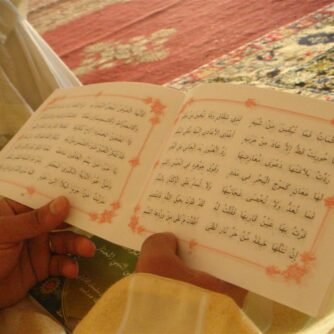
The most famous work attributed to him is the Salât Mashîshiyya, one of the loftiest texts on the Muhammadan Reality. It opens thus:
“My God, pray upon the one from whom the secrets burst forth, from whom the lights gushed out… He is Your secret that gathers and that points towards You, and Your supreme veil that stands before You.”
It has become one of the most widespread prayers upon the Prophet ﷺ in the Shâdhilî paths and their branches. Scholars have handed it down through commentary and teaching, generation after generation, until its commentaries reached twenty-five in number, among them that of Ibn ‘Ajîba.
The witness against the impostor
He remained at the summit of the mountain. In his time there rose up, in the land of Ghumâra, Muhammad ben Abî at-Tawâjin al-Kutâmî, who practised alchemy and laid claim to prophethood. Many let themselves be seduced by his call.
Ibn Mashîsh set the proof against him and warned the tribes about him. The impostor then sent men who killed him treacherously: they lay in wait for him as he came down, at dawn, to perform his ablutions for the morning prayer. This was around the year 622 AH, as Ibn Khaldûn and the author of al-Istiqsâ report.
And here the paradox reaches its end: the chérif who had asked for effacement was killed by an impostor who had exhausted himself in seeking to be seen, to the point of claiming prophethood for himself.
His tomb then remained unknown, until al-Ghazwânî al-Jazûlî had it recognised nearly three centuries later.
In conclusion
Of ‘Abd as-Salâm Ibn Mashîsh there remains the most accomplished example of the hidden saint: a chérif whose descent was enough to place him in the front rank, and who asked for oblivion. A single disciple knew him, and carried his Secret to the ends of the world.
Fairness requires us to distinguish, in his legacy, what is established, the man of renunciation, the martyr, the master of ash-Shâdhilî, from what was added to it later, in tales of virtues and as a late popular phenomenon.
It is through this distinction that he remains the Pole of the Maghreb, the one who reached the ends of the world from a mountain cave, and whom people came to know in the very place where he had wished to be forgotten.
Sources and references
- ‘Abdallâh at-Talîdî, al-Mutrib fî mashâhîr awliyâ’ al-Maghrib: the Idrisid descent and the biography.
- The traditions related from Abû al-Hasan ash-Shâdhilî, by Ibn as-Sabbâgh, Durrat al-asrâr, and Ibn ‘Atâ’illâh, Latâ’if al-minan: the meeting, the counsel and the saying “be mine”.
- Ahmad Ibn ‘Ajîba, Sharh as-Salât al-Mashîshiyya: the prayer and its commentaries.
- Ibn Khaldûn, al-‘Ibar. an-Nâsirî, al-Istiqsâ: his martyrdom and the context of Ibn Abî at-Tawâjin’s sedition.
- On his absence from his contemporaries: at-Tâdilî, at-Tashawwuf. al-Bâdisî, al-Maqsad ash-sharîf. Ibn Qunfudh, Uns al-faqîr.
Original article: عبد السلام بن مشيش: القطبُ الخفيّ الذي عرفه تلميذٌ واحد, published on 29 June 2026 on Mishkât an-Nubuwwa (مشكاة النبوة). Translation and notes: the editorial team. We thank the author.