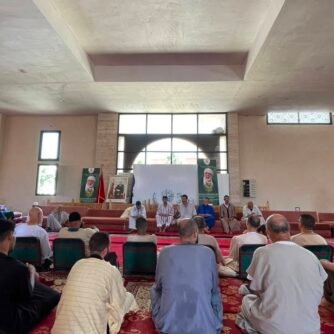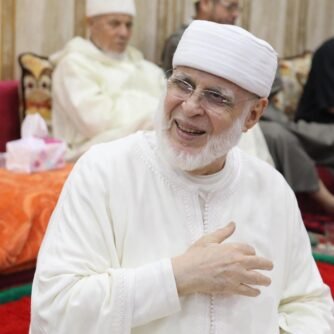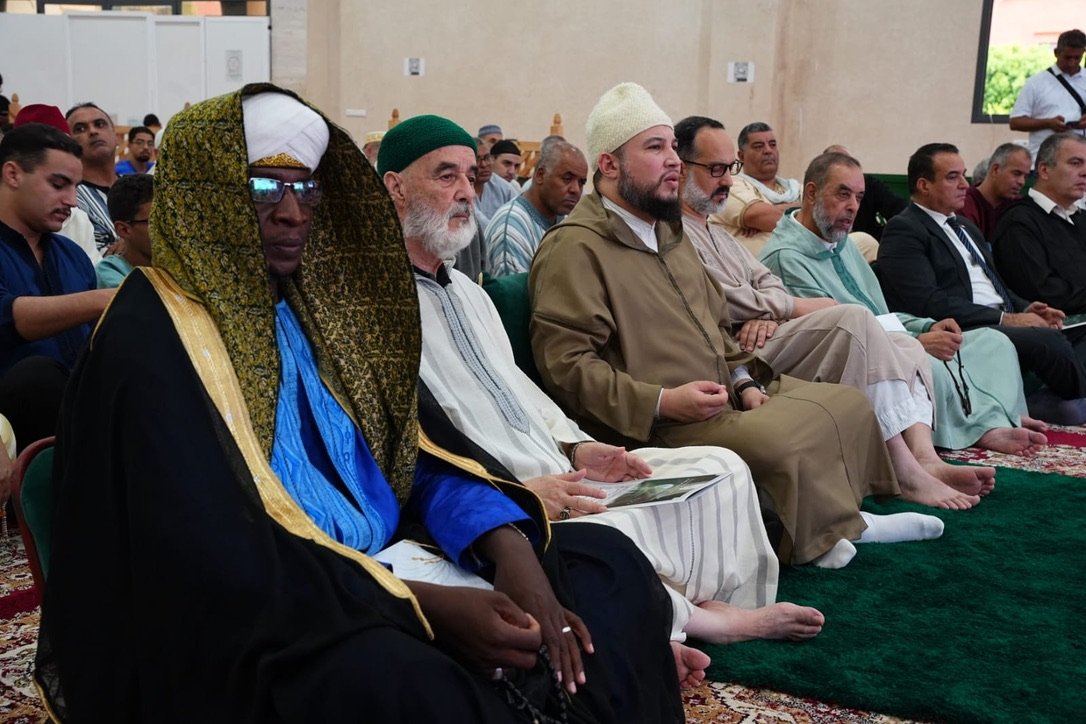
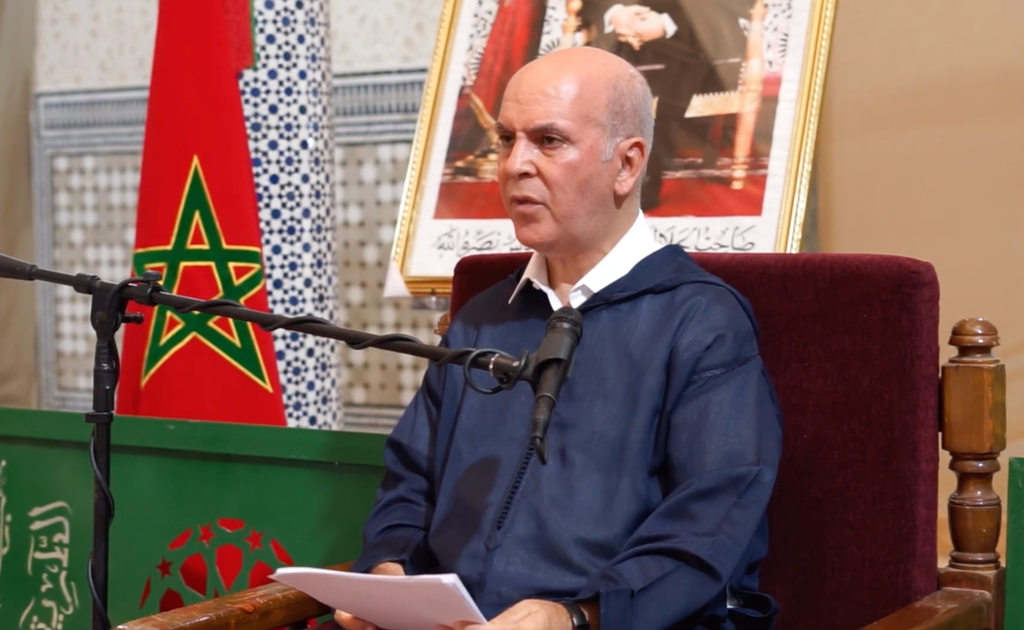
Transcript of the talk given on Tuesday 11 August 2026 as part of the dourous al-‘asr, the afternoon lessons that the Tariqa Qâdiriya Boutchichiya has organised since the time of Sidi Hamza, may Allah sanctify his Secret, continued with Sidi Jamal Eddine, may Allah sanctify his Secret, and held today with the blessed idhn1 of Sidi Mouad al-Qâdiri Boutchich, may Allah prolong his life. The text follows the living words of the speaker, delivered in Arabic. Translation and adaptation: the editorial team.
The real question is not how Islam entered Africa
What I present here is no more than the thoughts of a learner, the meditations of a man who hopes to perfect himself before speaking and to benefit before being of use. Our talk concerns Muslim Africa and the building of the spiritual field, with the Tariqa Qâdiriya as a model of the Moroccan Sufi extension across the continent. God says in His revelation: ‘[Prophet], call [people] to the way of your Lord with wisdom and good teaching’ (Qur’an 16:125). When God wills the permanence of His religion, He raises up for it men who carry knowledge and men who carry education and ihsân2, so that the religion remains alive in hearts just as it is preserved in books.
Islam did not enter Africa on the points of spears. It made its way in along the caravan routes, through the good word and through the conduct of the people of the Way: the truthful and trustworthy merchant made Islam loved there before any speech, and the tribes came to it of their own free will, called by the spiritual state before the word. But the deep question is not how Islam entered Africa. It is why it has remained alive there for more than a thousand years, in the markets, in the homes and in the schools. The answer lies in one institution: the zaouïas, which were not content to call people to the religion but built the whole spiritual field. They built the master, the study circle, the family and the market, until faith was woven into the details of daily life.
The spiritual field: when one man’s faith becomes the space of a people
What is the spiritual field? It is neither individual piety nor rites alone. It is the space in which a community’s relationship with God, with values and with the unseen takes shape, so that faith becomes a lived collective experience. The religion is one. Religious practice is the way each person brings it down into their conduct. And the spiritual field turns both into a living experience that embraces the heart, morals and baraka3. When this field expands, it bears fruit as a civilisation of the heart. The zaouïa is precisely what converts the individual’s piety into a collective field, then raises that field into a civilisation.
This field has three dimensions. It transforms the desert into a space of dhikr4 and of security. It narrows ethnic divides in the strength of faith: in a single rank stand the Arab, the Fulani and the Hausa, of a single heart, in fulfilment of the divine word: ‘People, We created you all from a single man and a single woman, and made you into races and tribes so that you should recognize one another. In God’s eyes, the most honoured of you are the ones most mindful of Him’ (Qur’an 49:13). And it links the science of the Law to spiritual taste: no knowledge without conduct, no conduct without knowledge.
The zaouïa, a total institution
The zaouïa has never been a building of stone. It teaches the Qur’an, fiqh5 and the creed: it is a university. It settles disputes and gives justice to the oppressed: it is a court of peace. It heals broken hearts: it is a remedy for souls. It feeds the hungry and lodges the traveller: it is the refuge of the poor. It keeps books and copies manuscripts: it is a library and a centre of influence. It reconciles tribes and stops bloodshed: it is a safety valve. And the master adds to it what is found in no book and on no minbar: the living example, the gaze that educates, the unbroken chain of transmission.
Why did society need the zaouïa when it had the mosque, the school and the judge? Because the zaouïa did not compete with the mosque: it inherited its original function. The mosque of the Prophet ﷺ was at once a place of prayer, a school, a refuge for the people of the Suffa, a gathering for education. Then civilisation spread and institutions became specialised: the mosque for prayer, the school for knowledge, the court for justice. The school instructs but does not purify the heart. The jurist gives the ruling but does not accompany the wayfarer through the stations. The zaouïa came to bring together again what had separated: worship, knowledge, purification and spiritual companionship. Where the family, the market and the tribe bind people by blood or by interest, the zaouïa binds them by love and by the sacred, and turns them all towards a single end: God.
One secret of its permanence deserves reflection: the zaouïa has never been a burden on anyone. It built its own economy, on awqâf6 whose revenue never ceases, on fields worked by the murids7 that feed the poor and students, on gifts that it redistributes to those in need. This financial independence was the condition of its moral independence: it could counsel rulers and remonstrate with them without fearing for its livelihood. That is why it survived the fall of states: the state governs bodies, the zaouïa builds hearts, and hearts do not fall with thrones.
Four stations of a history
The ribât of the beginnings
The planting is old. In the fifth century of the Hijra, ‘Abd Allâh ibn Yâsîn raised his ribât8 in southern Morocco, the dwelling of the murâbitîn: from this ribât came a project of Islamisation that took the desert road. The ribât became a zaouïa, and the zaouïa became a capital of learning. Its framework was Sunni and unifying, the one Ibn ‘Âshir would sum up: the creed of al-Ash’arî, the fiqh of Imam Mâlik and the way of Junayd the wayfarer. The Islam of West Africa was therefore neither rigorism nor dissolution: a religion of the middle way, averse to excess as to laxity, carried by conduct and example before being carried by controversy.
Fez and Timbuktu
Then the capitals of learning answered one another. In 1324 the pilgrimage of the ruler of Mali, Mansa Moussa, made the wealth of Sudanese Islam known to the world. Timbuktu and its Sankoré mosque became centres of study where the madhhab9 of Mâlik was taught. But the sap that nourished this learning was of Moroccan origin: books, copies, chains of transmission and ijâzas10 circulated between the Qarawiyyîn of Fez, the oases of Touat and the cities of the Niger bend. Fez was the spiritual capital towards which the students of Africa turned their steps, and from which they brought back chains and books.
The men of the desert
Over these bridges the Qâdiriya passed. Imam al-Maghîlî, setting out from Tlemcen, carried the word of truth to the Songhai ruler, reforming religion and government together. Cheikh Sidi al-Mukhtâr al-Kuntî, in the twelfth century of the Hijra, united the Kunta tribes from the Azawâd, revived the Maliki madhhab and sent his murids out with the caravans, merchants and scholars at once: through them the Qâdiriya spread from Mauritania to Nigeria and Guinea. Cheikh ‘Uthmân ibn Fûdî founded at Sokoto a community built on knowledge and education. His daughter, Nana Asmâ’u, raised in the house of the zaouïa, became a scholar who instructed women and organised their teaching. And Cheikh Mâ’ al-‘Aynayn raised the ribât of Smara, in constant loyalty to the Sultan of Morocco. Everywhere the same model: the zaouïa as school, as economy and as refuge, and knowledge travelling with dhikr.
Madagh, the era of continuity
In the twentieth century this ancient river found a new bed at the zaouïa of Madagh. Tried by colonial penetration, which attempted to demolish it in 1907, the zaouïa recovered its momentum, and the Tariqa Qâdiriya Boutchichiya, heir to this lineage, knew under Cheikh Sidi Hamza, may Allah sanctify his Secret, an influence that spread towards Africa and Europe. Cheikh Sidi Jamal Eddine, may Allah sanctify his Secret, continued his father’s work in education and ihsân. And the mashyakha11 has passed today to our master Cheikh Sidi Mouad al-Qâdiri Boutchich, may Allah prolong his life, who continues the path of education and ihsân in the way of his forebears, with particular care for the African extension: Madagh has become a point of attraction for the whole continent, to which delegations and murids from all over Africa flock. This summer’s gatherings bear witness to it.
Africa speaks, it does not repeat
And Africa did not remain an echo of the Moroccan voice: it produced its own texts. The libraries and archives of the continent still preserve entire bodies of writing in Arabic. Fulani and Hausa scholars composed, in their own languages, poems in praise of Cheikh ‘Abd al-Qâdir al-Jîlânî, and the scholarly houses of Sokoto left entire diwans in which the Way is sung in verse. Two complementary routes thus carried the Qâdiriya across the continent: a Moroccan and Saharan route, the wider one, whose heart beat in Fez and in the Sous, and a parallel eastern route, coming from Baghdad towards the Nilotic Sudan. The ways multiplied on a single Sunni, Maliki, Ash’ari and Junaydi foundation: the awrâd12 differ, the end is one.
Spiritual security, the fruit of a well-built field
When colonisation came, the zaouïas held firm, because their resistance was not first a matter of arms: it was spiritual. The coloniser knew that occupying a land is easier than occupying a soul. He tried to demolish the zaouïas, as he did with the Boutchichiya zaouïa in 1907, but what was rooted in hearts remained beyond the reach of his administration. And it is the same secret that today makes this heritage a bulwark: where the heart is inhabited by meaning, piety and belonging, the ideologies of violence find no void to rush into. Extremism thrives on the void, and the zaouïa fills the void with dhikr and companionship. Proximity to tasawwuf13 is a safeguard against deviation: this is a reality that the Sahel region lives today, in fulfilment of the divine promise: ‘with which God guides to the ways of peace those who follow what pleases Him, bringing them from darkness out into light, by His will’ (Qur’an 5:16).
The relationship between Morocco and Africa has therefore never been merely geographical. It is spiritual, woven of ijâzas, journeys and chains of transmission, and this bond of spiritual kinship is stronger than many bonds of embassies. What can be seen today of Morocco’s religious care for the continent, the training of African imams, scholars and preachers, is not a novelty of circumstance: it is the natural extension of a spiritual reference that has watered the continent for centuries, and whose true name is Morocco’s African depth.
At the niche of the prophetic light
How does such a field grow wider? Through the patience of its men and their mercy towards creatures, as described by the master of the spiritual community, Imam Junayd, may Allah have mercy on him: the Sufi is like the earth on which both the pious and the wicked tread, like the cloud that shades everything, and like the rain that waters everything. And Imam al-Ghazâlî described the people of this way as drawing their light from the niche of the light of prophecy, echoing the verse: ‘God is the Light of the heavens and earth. His Light is like this: there is a niche, and in it a lamp’ (Qur’an 24:35). From this niche the zaouïas took their light and passed it on to hearts, until in every breast there was a lamp that does not go out.
This lesson is only a breath from this blessed majlis. What the tongue has conveyed of it comes from the grace of God, and what it has missed comes from my own inadequacy, for the people of God are not reached through expression: one can only breathe the fragrance of their states and the baraka of their companionship. May Allah assist the Commander of the Faithful, His Majesty King Mohammed VI, and through him strengthen the security and concord of Morocco and Africa. May Allah preserve our Cheikh Sidi Mouad al-Qâdiri Boutchich, grant us the benefit of his companionship and his gaze, and through him perpetuate the influence of this blessed Way.
Notes
- Idhn: the spiritual authorisation given by the master of the Way, which grounds the legitimacy of a practice or a transmission. ↩
- Ihsân: spiritual excellence, ‘to worship God as if you saw Him’, the third degree of religion after islâm and imân. ↩
- Baraka: the influx of grace and blessing transmitted through blessed places, persons and acts. ↩
- Dhikr: the invocation and remembrance of God, the central practice of the Sufi way. ↩
- Fiqh: Islamic jurisprudence, the science of the practical rules of religion. ↩
- Awqâf (singular waqf): inalienable pious foundations whose revenue provides lasting funding for a religious or social work. ↩
- Murid: the disciple committed to the way, literally ‘the one who wants’ God. ↩
- Ribât: a frontier establishment combining guard duty and devotion. Its inhabitants are the murâbitîn, from which the name of the Almoravids comes. ↩
- Madhhab: a legal school of Islam, here the school of Imam Mâlik. ↩
- Ijâza: a licence of transmission issued by a master, attesting the chain through which a body of knowledge was received. ↩
- Mashyakha: the office of master of the Way, the function of Cheikh. ↩
- Awrâd (singular wird): daily litanies specific to each way. ↩
- Tasawwuf: Sufism, the science of inner purification. ↩