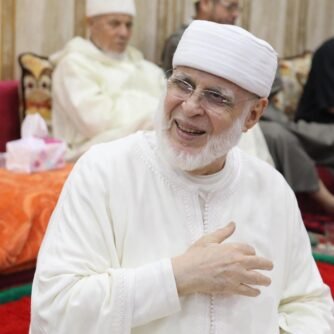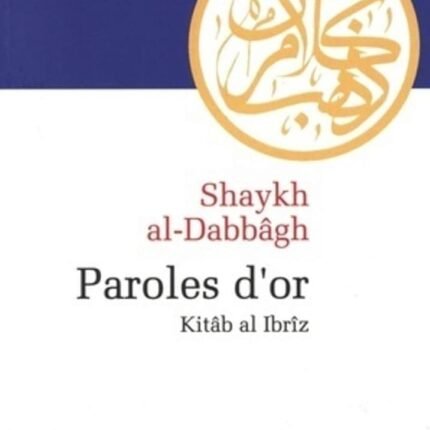
Senegalese television welcomed Lalla Zakia Zouanat, may Allah receive her into His mercy, onto the set of the programme “Studio Serigne Babacar Sy” for an interview devoted to her translation of the Kitâb al-Ibrîz, the words of the Fez master Sidi ‘Abd al-‘Azîz ad-Dabbâgh, published in 2001 by Le Relié under the title “Paroles d’or”. The work is venerated as far as Senegal, where Seydi Hadji Malick Sy had studied it to the point of naming his son after the Saint, Serigne Abdou Aziz Sy. The interview, recorded before her passing in 2012, was put online in October 2024 by the channel Canal Fréquences Média. We are publishing it posthumously, in tribute to the anthropologist of the “Kingdom of Saints”. The transcription follows her spoken words. Adaptation: the editorial team.
Why were you the one chosen to translate this book?
That is an excellent question, because in the field of Sufism one does not choose of one’s own free will: rather, one is chosen. I had previously carried out, as part of a thesis in social and cultural anthropology at the Sorbonne, a study of the great saint of Morocco, ‘Abd as-Salâm ibn Mashîsh, founding father of the Tariqa Shâdhiliyya, which is alive today throughout the world. And then one day, quite naturally, I came across the Kitâb al-Ibrîz, a foundational text of Sufism, known in the Muslim world and above all among the masters, because it is a model of initiation and transmission. The book is written by the disciple, Ibn al-Mubârak, who in his time was at the head of the Qarawiyyîn mosque-university, and who questions his master: an unlettered man, granted direct knowledge, infused science, al-‘ilm al-ladunî. He was putting his knowledge to the test, and he found himself before a man whose knowledge was, as he himself puts the comparison, an ocean without shore. I began to read it, and I was seized by more than a desire: an irrepressible need to translate it, to play this role of conveying a text that carries a magnificent Islam, in its finest light, an Islam of tolerance and love, whose key, from beginning to end, is the person of the Prophet ﷺ, the excellent model for the Muslim. Without any contact with a publisher, I began to translate. The publisher came afterwards. And he was not a Muslim: an open man, a man of spirituality, who was seeking to drink from the lights of the Kitâb al-Ibrîz.
How did you arrive at a translation so unanimously acclaimed?
My work on Ibn Mashîsh had made me familiar with the vocabulary, the wisdom and the doctrine of tasawwuf: as if I had been prepared and led quite naturally to this work. A text of this kind would not have tolerated being mistreated, having its neck wrung. I stayed very close to the letter of Dabbâgh. It is said that every translation is a betrayal: I tried not to betray, because here, where this space of the heart, of purification and of light is concerned, it would have been a double betrayal.
What is Sufism?
There are a great many definitions. To be clear and precise: Sufism is the inner aspect of Islam. It is a quest for the purification of the being, the kernel of our religion, the quest for truth according to the saying “whoever knows himself knows his Lord”. And I can give a definition of the Sufi: the Sufi is the one who possesses nothing and who is himself possessed by nothing. Sufis have too often been confused with ascetics in rags. But there is no attachment other than inner attachment, and no detachment other than inner detachment. Everything is inward in Sufism: it is the quest for inwardness and the knowledge of oneself. And it is perhaps also a response from people today to a complicated world, a solution to the problems we face.
How do you see Sufism amid the difficulties that the image of Islam is going through?
Islam in itself is beyond and above all human dissensions. The view of it that the West has spread is often biased. All religions have known fundamentalisms in the history of humanity, and Islam knows its own. But Sufi values can open people’s eyes, and this is happening more and more: one cannot remain unmoved by the wisdom that this spirituality carries. Westerners take the path of Sufism in order to understand Islam, and often they find themselves in love with it, and Muslims themselves. That, essentially, is the letter of Islam: that man should return to his original fitra, that he should recall the pact made with his Creator on the day when, while we were still in the back of Adam, He asked us: “Am I not your Lord?”, and we answered: “Yes, indeed!” (Qur’an 7:172). Sufism is remembering this primordial pact.
Who was Dabbâgh?
Sidi ‘Abd al-‘Azîz ad-Dabbâgh is a spiritual master of the seventeenth and eighteenth centuries in Fez. At that time, Fez was teeming with saints. Sanctity reigned, to such an extent that it was said of the small shopkeepers: the body is in the shop, and the soul in the heavenly spaces. Dabbâgh was a man of that period, unlettered, who could neither read nor write, but granted divine knowledge coming directly from God. It was the colleagues at the Qarawiyyîn who said to the disciple: you who are close to this extraordinary master, you ought to record this magnificent case in the history of Sufism. He set about it late, and he himself says that had he recorded everything, he would have filled fifteen works like the Kitâb al-Ibrîz. Dabbâgh is what is called a “maftûh ‘alayh” man, illuminated, and he lives the illumination in an almost physical way: in the book he describes this experience of opening in which he feels that his whole body sees. Not only the inner eye, the basîra: his whole body sees the divine and earthly lights, the realities of this world and of the next. He even states that he saw Mary with Jesus in her lap. Then he grew accustomed to this permanent vision, and he was able to take disciples to whom he communicated his lights.
During the translation, did you go through intense moments?
Your question is amusing. A special setting, a retreat, was needed to grasp the allusions of this book. And at times I would be carried into spiritual states, when I was touched by one of Dabbâgh’s lights. At times I would cry out the name of God, Allah, literally scream it, to such a point that the lady who looks after the house would come running: whatever is happening? What was happening was that I was seized by the spirit of Dabbâgh, which struck me, and I could not remain unmoved.
Esoteric sciences, exoteric sciences: can you shed some light?
René Guénon, the greatest French metaphysician of the twentieth century, himself a Sufi in the Shâdhiliyya, defined Sufism as the esoterism of Islam. Exoterism is the outer aspect, the sharî’a. Esoterism is the inner aspect, the haqîqa. The one does not go without the other: neglecting the sharî’a for the haqîqa is incomplete. How can one reach the kernel without tending to the shell? The shell and the kernel are complementary. Dabbâgh says so himself, in a saying of extreme wisdom that I chose to place as the epigraph of the book: esoteric science is comparable to ninety-nine lines written in letters of gold, and exoteric science to the hundredth line, written in ink. Notwithstanding that, if this black line were absent, esoteric science would be of no use, and whoever contented himself with it would run great risks.
The book relates stories about the Secret. Which one struck you most?
The disciple says he received from his master eight stories concerning the keeping of the Secret, and he relates five of them. What struck me is that there is a fundamental ethic in the presence of a master: keeping what he communicates to us. These are pearls, lights. The Secret cannot be divulged to people who would make bad use of it, and whose first act is to turn against the one who carries it. Al-Hallâj, the great Hallâj, was one of these: he divulged the Secret and ended up on a gibbet. And on the gibbet, one of his companions, ash-Shiblî, came to say to him: “Why did you violate the Secret of the arcanum?” The Secret, as its name indicates, must be safeguarded, all the more so when it is transmitted by your master. That is the moral of the five stories.
And his spiritual virtues?
The spiritual virtues of the masters are to the saints what miracles are to the prophets: the prophets have mu’jizât, and the masters have karâmât, the compression of space, the compression of time, ubiquity. Those of Dabbâgh run through the book from page to page, and his great karâma is this very illumination. The first sixty pages speak concretely of these wonders with his disciples, whom he could see in their homes. When one of them strayed, he knew it, and the next day, in the circle of companions, he would put the question to the room at large, without naming anyone: the disciple concerned understood immediately. That is how he educated.
What place did dreams and visions hold for Dabbâgh?
It is part of his doctrinal corpus: in the Kitâb al-Ibrîz he puts forward a genuine science. I would say that he is, before Carl Gustav Jung, a precursor of depth psychology, truly. He explains what a dream is: a canvas laden with symbols that must be interpreted. And what a vision is: clear, sharp, precise, bearing a teaching. When we go to bed in a state of inner purity, what we see is a vision, and the next day proves it to us. When we are in mixed states, what we see is what Arabic calls adghâth ahlâm, disjointed and dark dreams, where the truth hides beneath veils. He stressed the importance of vision in Sufi education, and it is the whole modern school of depth psychology that is rediscovering it.
What relationship is there between Dabbâgh and the Tijânis?
He predates Sidi Ahmad at-Tijânî, and what is becoming clear to me is his renown in the countries of sub-Saharan Africa. Recently I met a Mauritanian man who told me that his mother, in the far north of Mauritania, constantly had “Fath ad-Dabbâgh”, the illumination of Dabbâgh, on her lips, like a prayer. Anthropologically, this means that there is a deeply rooted transmission: for an expression to settle in this way into a woman’s language, the work must have gone on for centuries. An investigation would be needed to find out what the paths of this transmission were. It will be fascinating to do, in shâ’ Allâh.
What role for the Muslim academic in a world of globalisation?
To give a soul to this globalisation. But before that, he would need to free himself from the tattered trappings of colonialism, still clinging to our shoulders, in order to know himself and recover this identity that is ours. As long as one is swallowed up by complexes, one has little to give. To give is to fertilise one’s own land so that things emerge in a healthy way. As our Islam says, what one gives must be the best of gifts, and the best of gifts is the gift of self: a Self with a capital S, an identity fully recovered. This is neither chauvinism nor nationalism. It is simply the philosophy of tasawwuf: to know ourselves first, before opening ourselves to the other.