Bismillâh ar-Rahmân ar-Rahîm, wa-s-salât wa-s-salâm ‘alâ sayyidinâ Muhammad wa ‘alâ sahbihi wa âlihi ajma’în.
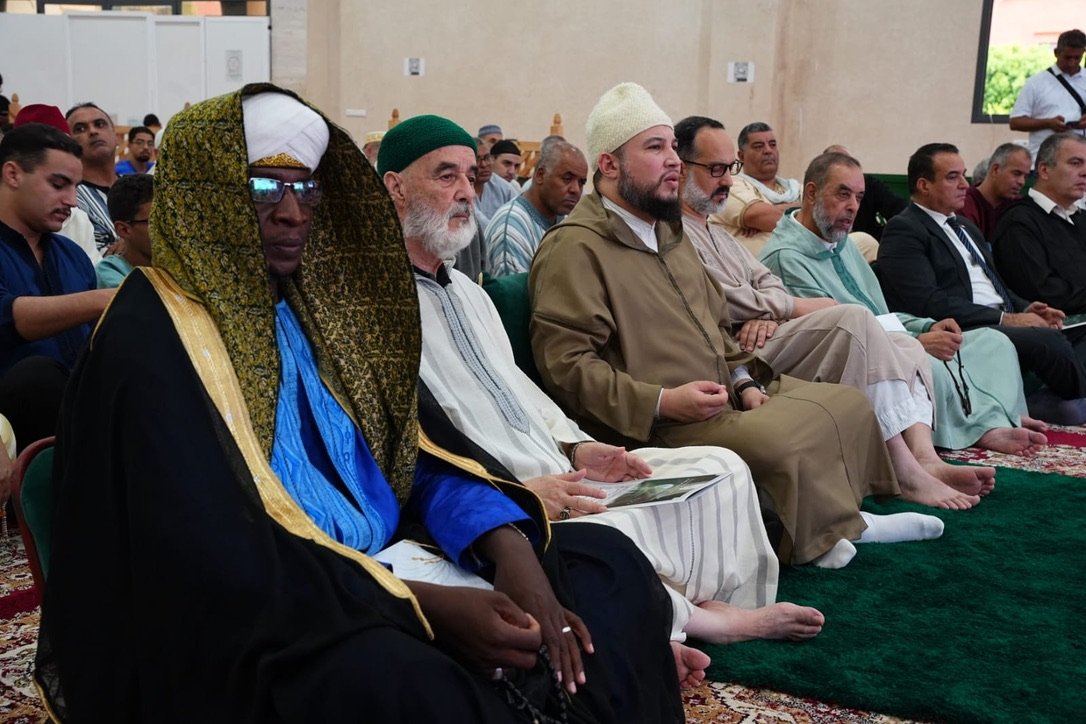
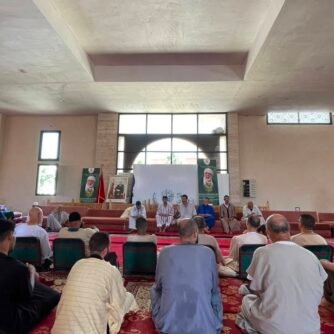
Second part of the lecture by Daniel Abdel Haq Roussange on the descent of the Qur’an, given during the month of Ramadan: the exchange with the audience, condensed and edited for reading by the editorial team. The first part is published separately.
Before the revelation: al-Amîn
Before the revelation, no one wrote down what Muhammad said: he was not a prophet. But he enjoyed a certain renown in Mecca, to the point of being called al-Amîn, the trustworthy one: people saw his integrity, the fact that he entered into no conflict and that he always kept away from the worship of idols. At the rebuilding of the Kaaba, while still young, he was called upon to settle the dispute between the tribal chiefs. Those who practised the pure religion of Abraham, the hanîfs, like certain Christians, were astonished by his conduct and regarded him as one of those men attached to Abrahamic monotheism who took no part in the worship of idols without, for all that, picking quarrels over them.
Language, the foremost value
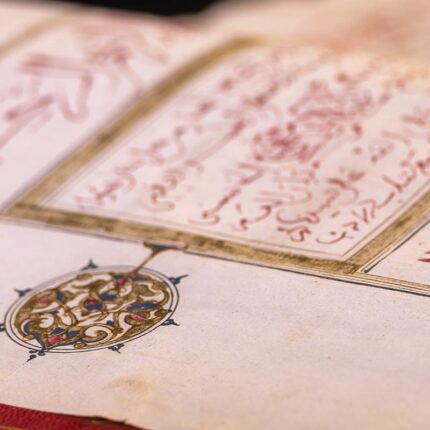
In the early days, the first written records of the Qur’an did not bear the marks that distinguish the letters: the consonantal skeleton was completed after the Prophet’s death, when a real need for it arose, with the new believers who came from Yemen and elsewhere and whose Arabic was weak. But what we do know is that these Bedouin Arabs were never mistaken about the meaning of words: for them, language was the foremost value, the very bond. A slip of the tongue was no joking matter there: it could cause considerable incidents. This needs recalling in our time: language is the tool of thought. If words are emptied of their meaning, thought itself will be flattened like a pancake, without substance. At the start of my career at the Bibliothèque nationale, I knew a milieu where language was precious, where there was no question of using vulgar words or making gross errors without being corrected at once. These values are being lost, and what is happening to language is rather worrying.
A mercy no one may limit
For those who received the Qur’anic revelation, as for any human society, there are constants and variables. The constants are the truths and the wisdom contained in the Qur’an, as well as the legal rulings, the Sharia being nothing at all like what many proclaim as such today. And one must beware of the one-upmanship in which we hear “the Qur’an says this, the Qur’an says that”, made worse by translations that are sometimes biased, in which fragments of verses are quoted without any concern for anything.
Who sets limits on things? Men. It is related that Iblîs, in a conversation with a Sufi, asked for the commentary on the verse:
“My mercy encompasses all things.”
Qur’an 7:156
Iblîs claimed that he himself was included in this mercy. The Sufi denied it to him, and Iblîs replied: I did not think you capable of placing a limitation on things as you do. Ibn ‘Arabî would write much later: in this matter, Iblîs was the master of Sahl at-Tustarî. It is a question of having a good opinion of the Lord: mercy encompasses all things, and a hadith teaches that mercy precedes rigour. Rigour itself is included in mercy: if I correct my son, I exercise rigour for his good, not to harm him. Believers often forget this: they want nothing but caresses.
This breadth of vision is one the scholars of Islam had towards other traditions. I once had occasion to talk about it with Professor Muhammad Hamidullah, a truly interesting scholar, who considered the Brahmins to be People of the Book, since their corpus proclaims the divine oneness. He had even written a very enigmatic article suggesting a common root between the names of Râma and Abraham, and he urged researchers to follow this lead. It is also known that Dhû-l-Kifl, who is named in the Qur’an and whose identity is the subject of many differing views, has been considered by some to designate the Buddha. Generally speaking, a revelation is addressed to a people, it is made for a community, and is therefore contextualised. But all human beings have received the message, and there is in the rites, such as those of the pilgrimage where Adam finds Eve again at ‘Arafât, something that goes beyond all historical contexts and reaches the domain of universality.
Exegesis: a door one does not close
The exegesis of the Holy Scriptures is of considerable difficulty, and there is not one exegesis: there is a multitude of interpretations. There is the classical tafsîr of the scholars, which first explains, for a practical purpose, the legal rulings concerning worship and social acts: the family, inheritance, transactions. Yet these verses with a legal scope number barely five hundred, out of more than six thousand verses in the Qur’an: contrary to a rumour going around, the Qur’an is not a code of law. There is the exegesis that relies on grammar and lexicology. There is the one that relies on the Sunna, the Prophetic conduct, which is said to be the living commentary on the Qur’an. There is theological exegesis, which comments on the verses concerning divine oneness, predestination and acts. There is exegesis by spiritual allusion, the ishâra, that of the Sufis. And the most excellent: the commentary of the Qur’an by the Qur’an, bayân al-Qur’ân bi-l-Qur’ân, for the best commentator is God. Certain texts cannot be taken without relating them to others found further on: on wine, for example, three verses follow one another in a chronology leading up to the prohibition. No one has the right to extract a verse to make a biased commentary aimed at imposing a rule on the community: that is not done.
In the Qur’an there are muhkamât verses, clear, which rule without interpretation, and mutashâbihât verses, with multiple meanings, where an interpretation must be exercised that is never single, for it depends on a person’s formation and on the aspect he favours:
“It is He who has sent down to you, [O Muḥammad], the Book; in it are verses [that are] precise – they are the foundation of the Book – and others unspecific. […] And no one knows its [true] interpretation except Allāh. But those firm in knowledge say, “We believe in it. All [of it] is from our Lord.””
Qur’an 3:7, tr. Sahih International
This verse itself can be read in two ways: one can pause after “no one knows its [true] interpretation except Allāh”, or read on without pausing: “…except Allāh and those firm in knowledge”. Even in the reading itself, the science is vast: there are several canonical readings, the qirâ’ât. The most widespread today is that of Hafs, and in Morocco that of Warsh. The pauses are not placed in the same spots, but the meaning changes neither grammatically nor contextually.
Every believer, moreover, has a duty of tadabbur: to meditate on the Qur’an, to meditate on the signs of the universe, the alternation of day and night, of life and death, all those great signs of the cosmos that point to the divine power and to the One who is their origin. The verses are called âyât, signs. This includes, if one wishes, the discoveries of present-day science: certain verses are today being examined by scientists, sometimes non-Muslims, for their accuracy regarding processes that science is bringing to light, in geology or on the development of the embryo. For a believer, this should serve only to confirm that nothing has been omitted from this Book. But faith does not rest on it.
There remains ta’wîl, the interpretation that leads back from the apparent meaning to the spiritual meaning. The warning is an old one: certain verses, misunderstood, can lead to wild speculation. And never, never does exegesis throw away the letter like a husk. The letter, says the Arabic saying, is the house of meaning: one does not detach oneself from it. The greatest of the mystics, the one most attacked for his interpretations, Ibn ‘Arabî, is also the strictest in respecting the letter and the greatest expert in grammar of his time: when a verse contains a particle that the commentators skirt around because it embarrasses them, he takes it into account and shows why it is there and what meaning to draw from it. He has an interpretation of his own, supreme, which goes further than anyone else’s, to the point of scandal. But he also accepts all the other interpretations. For what is grave, in matters of exegesis, is to close the door.
Sufi exegesis, for its part, is nourished by inspiration: it has no limits. A Sufi once passed through a town whose jurists, hostile to Sufism, wanted to trap him: after the dhuhr prayer, they asked him for a commentary on the basmala, the first words of the Qur’an, Bismillâh ar-Rahmân ar-Rahîm. He began. The time of the next prayer came, and he had not finished. They were taught a good lesson. When one reads the Qur’an, one must be in this perspective: read the Qur’an as if it had been revealed for you yourself. One does not read for others. Just as the universe, the Sufis say, is created anew at every blink of an eye, the Qur’an is new at every moment for the one who reads it.
A book that edifies, not a chronicle
Look at the Old Testament: a chronological history, historical narratives, extraordinary wisdom, but a book that follows a chronology. The structure of the Qur’an is different, and deliberately so: narratives that arise, break off and resume twenty suras later. The Qur’an is not a historical narrative: it does not tell stories, it summons the prophets. As in a samâ’ circle where all the figures were present, the divine discourse addresses Moses, Abraham, Noah, without any regard for chronology, and speaks in order to edify man. Islam, children are told, is built on five pillars: man builds himself up like a building, and that is the main aim of the Qur’an. The finest example of this is Sura Yûsuf:
“We tell you [Prophet] the best of stories in revealing this Qur’an to you.”
Qur’an 12:3
Compare the Qur’anic text and the biblical text of Joseph: common elements, but not at all the same aim. One must be careful and not say that the Qur’an borrowed its narratives from here and there: a prophet never borrows anything. The theory of borrowings, which is valid in ethnography, has no value in matters of revelation. Those who deny revelation are naturally driven to look for this kind of theory to support their arguments. The Prophet himself said that if he had had to have a brother, it would have been Jesus, the prophet who preceded him and to whom he is closest. As for the frequent allusions to the Jewish people, they stem from the very perspective of Abrahamic monotheism, and from the fact that this people received prophets in every generation, a wholly exceptional case. And the Qur’an calls the People of the Book to the common word:
“Say, ‘People of the Book, let us arrive at a statement that is common to us all: we worship God alone, we ascribe no partner to Him…’”
Qur’an 3:64
“I have read the Qur’an, I know what is in it”
I am always worried by certain public stances. A politician, more or less in charge of interfaith dialogue, said in a debate something that cannot be said: “I have read the Qur’an, I know what is in it.” First, he read it in French, second, he read it very quickly, third, he claims to know. I, who have been reading this text for a long time, do not know what lies in store: every day I discover things. When I began learning a simple little sura from the end, al-Kâfirûn, I studied it with a Palestinian friend. And he, who had known it for thirty years, told me: it is in studying it with you that I am discovering what this sura of a few verses holds. One must enter this ocean. Whoever claims to have gone all the way round it is simply saying that, in him, the passions have taken precedence over reason. Public debate is then no more than a battle of hatreds and passions colliding.
A final word on the Sharia, since it is brandished so often. Strictly speaking, it is the rulings that emerge from the Qur’an, made explicit by the Prophetic conduct. Then comes the work of the fuqahâ, the jurists, and behind it the methodology, the usûl, that set of logical and linguistic tools that make it possible to find the application of a ruling in a given era and a given situation. Eras change, life is movement, and that is why there are schools. To say “the Sharia must be applied” therefore means nothing: application varies according to peoples, times, psychologies and cultures. What those who say it are after is applying the verses that seem harsh to them in order to constrain people, with a hidden intention, which is power. Know this well: the last thing to leave the human heart is the taste for power, whether in a politician, an administrator or a religious figure. Those who do not seek power, God sometimes grants it to them, and it is then a mercy for the world. But that is rare.
There remains the question of the recension: how the revelation, recited by the Prophet, was recorded up to the single text. Let us keep this in mind: it was the Messenger himself who arranged the suras as they are. We see him having the last revelations inserted at a precise place in the text. It did not come afterwards. And to conclude: we are living through a difficult period, in which the debates on Islam are biased and in which the rationalists themselves are losing their reason. When I came to know Islam, nearly thirty years ago, no one talked about it. Now it is talked about constantly, and I have good hope that by dint of talking about it, something will eventually come of it. May God bless us.
Lecture by Daniel Abdel Haq Roussange. First part published separately.