Bismillâh ar-Rahmân ar-Rahîm, wa-s-salât wa-s-salâm ‘alâ sayyidinâ Muhammad wa ‘alâ sahbihi wa âlihi ajma’în.

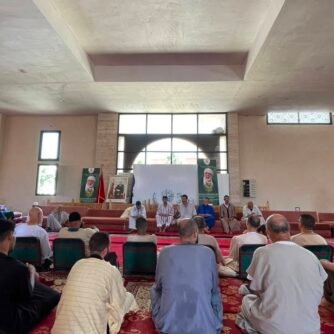
Lecture given by Daniel Abdel Haq Roussange on the notion of jihâd, spiritual combat. Transcription edited for reading by the editorial team.
Dear friends, I am glad to welcome you for an exchange on a somewhat contrary theme: the notion of jihâd, that is, of combat, and above all of its aspects. Before beginning, I would point out that in a spiritual path such as Sufism, there is no such thing as the one who teaches and those who are taught. The Sufi is the one who receives teaching from all things and at every moment. To all appearances, I speak and you listen, but the deeper truth is that every relationship must be an exchange. A relation of the one who knows to the one who does not know does not exist in a spiritual path. It is even said at times that one should ask the youngest for his opinion, for he is the most inspired.
One word, several meanings: effort
The term jihâd denotes combat, struggle, and above all effort. The root occurs some thirty times in the Qur’anic revelation: in about twenty cases, the meaning is general, that of an intense effort made towards a set purpose. This effort runs in every direction: spiritual, social, and also outward, that is, military, since this is a reality that ought not to be concealed. Three or four verses give the term a properly spiritual meaning: what in Islam and in the Sufi path is called jihâd an-nafs, the combat against the soul, of which we shall speak first and foremost. One may speak of jihâd through deeds, of jihâd through knowledge, of jihâd through the tongue when it is a matter of denouncing error or injustice, of jihâd through the heart. Finally, the same root gives ijtihâd, that effort of interpretation by which the scholar, in the science of fiqh, draws from the Qur’anic rulings a norm suited to the needs, the demands and the circumstances of each age.
Martial jihâd: verses set within their circumstances
About ten verses speak of what is commonly called war. The Qur’an then rather uses the term qitâl, combat. How is this conveyed to us by the Book of Allah, by the Sunna and by the sîra, the detailed biography of the Prophet? The revelation lasted twenty-three years, coming down verse by verse or in groups of verses. Now one must be aware that the divine discourse is not an abstract discourse: it is always set in a context, it always answers an expectation, a need. The divine word is a precious pearl set in its bezel.
In Mecca, the Muslims, very few in number, suffer the persecutions of Quraysh and its associates, to the point that some are permitted to leave and seek protection in Abyssinia, with the Negus. Then comes the emigration to Medina the Radiant, where the Ansâr welcome the emigrants: some come out of their homes to offer the Muhâjirûn their goods and their houses. The Qur’an says it in one word, îthâr, preferring others to oneself:
“…They give them preference over themselves, even if they too are poor: those who are saved from their own souls’ greed are truly successful.”
Qur’an 59:9
The nascent community organises itself. The Prophet establishes the constitution of Medina, seventy-two points that also govern relations with the Christians and the Jewish tribes: a charter for the whole city, not for the Muslims alone. Then come the expeditions, some twenty of them, from Badr, in year 2 of the Hijra, to Tabûk. At Badr, the Prophet goes out with only three hundred and thirteen fighters against some nine hundred and fifty men of Quraysh, who still hope to annihilate the nascent religion. Miraculous events occur, among them the handful of earth thrown by the Prophet, about which the Qur’an says that it was not he who threw when he threw, but Allah who threw (cf. Qur’an 8:17). Every event, every question, that of the spoils, that of the prisoners, who must be treated properly, fed and clothed, becomes the occasion for building up the body of believers: each revelation has its circumstance, its asbâb an-nuzûl, which must be known in order to interpret the Qur’an.
It must be said: almost every command to fight given to the Prophet comes with a restriction, that of not opening hostilities, of fighting only those who fight:
“Fight in God’s cause against those who fight you, but do not overstep the limits: God does not love those who overstep the limits.”
Qur’an 2:190
On the human plane, combat must be just: one kills neither the old, nor women, nor children, nor monks. Prisoners are owed food and clothing. At Badr, the Prophet had even the dead of the polytheists buried. And the purpose, always, is to restore justice and peace: war is an imbalance, even when defensive, which aims to restore a broken balance.
As for the verses of harsher tone, revealed at the time when Quraysh, the very milieu God had chosen for the revelation, had to cease its opposition, two things should be kept in mind. The first: all these verses are linked to circumstances. If the circumstances cease, one must look at what is happening. The second concerns a subtle science, that of abrogation: a revelation that came in a given situation may be effaced by a later verse. Now an interpretation sometimes called Islamist, without seeking to know this science, uses abrogation as a pretext to give the most bellicose verses a validity without limit in time and space. One may rightly think that these verses have a limit in time and space, and in particular that when Islam leaves the Arabian peninsula, things change entirely in nature. Finally, to whoever raises the peaceful character of Jesus as an objection, one must recall that it is not the same milieu: Jesus came into a world that was already monotheistic. Islam came into a milieu marked by idolatry and, despite the acknowledged qualities of the Arabs, honour, courage, hospitality, by practices of great barbarity. The combat aimed at restoring justice where deep injustices reigned, and at the return to monotheism, to the doctrine of tawhîd, divine unity.
From the lesser to the greater holy war
All this sheds light on the words of the Prophet on returning from an expedition: we return from the lesser holy war to the greater. The lesser war waged outwardly was to be followed by the greater, waged inwardly, and there is a relationship between the two, symbolised by the battlefield as by the game of chess: outward combat serves as a support for conceiving our own inner jihâd, against our inner enemies. For one knows only through opposites, and man is inhabited by powers in disharmony: the struggle against the inner enemies consists precisely in re-establishing an order, a harmony, among all these powers. It is the only way to bring man to rest, to pacify the soul, just as the unification towards which a society tends is to reconcile its parts. When this effort of inner unification succeeds, man attains sincerity: the accord between deeds, speech and what is in the heart. Thus do the Sufis define the combat of the path: to purify the soul and illuminate the heart.
The mujâhada: the combat against the soul
Spiritual combat rests first on deeds. The Qur’an says:
“The true believers are the ones who have faith in God and His Messenger and leave all doubt behind, the ones who have struggled with their possessions and their persons in God’s way: they are the ones who are true.”
Qur’an 49:15
Striving with one’s wealth is mentioned first: one’s time, one’s money, help, counsel, the support of all who are in need. This verse is interpreted as meaning: spend your efforts and your energies in the search for divine knowledge, and make of your surplus the good of God’s servants and of the destitute. Yet this is difficult: it is often easier to deprive oneself, to fast a great deal, than to spend one’s wealth. For the Qur’an teaches us this: the soul is greedy, its deep nature is greed, it is predisposed to receive, not to give. “Those who are saved from their own souls’ greed are truly successful.” That is why the path gives so much importance to khidma, service: placing oneself at the service of others educates the soul, teaches it to renounce its own will and the taste it has for command and domination. A cheikh said these fine words: the men attached to the world compete because each wants to be served by the other, and that is what debases them. The people of God compete too, but to serve one another, and that is what ennobles them.
A digression on asceticism: its aim is not asceticism itself, but to predispose the soul to renounce, in particular the wish to dominate. It has always been advised to do things in due measure and not to bind oneself to overly demanding practices, for the result is always discouragement, or else attributing one’s deeds to oneself with self-satisfaction. And self-satisfaction is the root of all evils.
The soul is at once a veil, the supreme veil, the Sufis say, that which cuts us off from God who is so near, and at the same time a means, some would say a mount. That is why it is not to be understood that the soul must be killed: what must be effaced are the vices it bears, that dark tendency. There is nothing truly to kill. Such is the meaning of mujâhada, a word from the same root as jihâd: the combat to purify one’s soul. Its framework, in Islam, is respect for the obligations prescribed by the Law, the Sharia: that is the beginning of the combat. Its end is contemplation, unveiling: a famous Sufi saying states that mujâhada, combat and effort, has as its end mushâhada, contemplation. That is why Imam Ghazâlî called Sufism the science of unveiling, ‘ilm al-mukâshafa. Whoever attains this contemplation attains rest.
What is the soul, the nafs? It is said to have several names, and that these names do not reach its essence: one speaks only of its functions. As long as it animates the body, it is called soul. When it examines, mind. When it desires, passion. When it judges uprightly, reason. When it perceives, sense. When it recalls, memory. When it wills, will. And when it is drawn by love or by the heavenly lights, spirit. The Sufis call it latîfa rabbâniyya, a subtle and changing entity, because of its capacity to change attributes. The Qur’an enlightens us on its degrees: the soul that commands evil, the soul that reproaches itself, the soul at peace, up to the notion of the perfect soul found in ‘Abd al-Qâdir al-Jîlânî, who says of the perfect soul that it is the one that knows unity in multiplicity and multiplicity in unity.
“I do not pretend to be blameless, for man’s very soul incites him to evil unless my Lord shows mercy.”
Qur’an 12:53
The combat begins with the struggle against this soul that commands evil, because its attributes are greed, covetousness, jealousy, vanity, ignorance. That is why we say that the spiritual path, spiritual combat, is the passage from natural hypocrisy to spiritual sincerity: for sincerity is never natural, it is always spiritual. Ibn ‘Arabî writes that the conviction of the Sufis is that the soul is nothing other than blameworthy thoughts, al-khawâtir al-madhmûma: those bad thoughts that dwell in us, shut us within what the Qur’an calls the abode of illusion, and make us judge and press forward with all our prejudices, always convinced that we are right. To follow a spiritual discipline is to break with these predispositions, with these worldly attachments, and first of all with habits, not only outward ones: mental habits, on which are built the prejudices and judgements, almost always negative, passed on others. For the individual soul always wants to assert itself at the expense of others: as someone rightly said, it carves out its share of being at the expense of the being of others.
This combat is not waged by choosing for oneself how to wage it. A framework is needed, and the framework in Islam is the Muhammadan path: conformity to the prophetic model as regards inner orientation, conformity to the divine Law as regards the outward. When the soul is purified, it reaches the divine light: it is then like the full moon, which has no light in itself but perfectly reflects the light of the sun in the night. And one of the names of the Prophet is the full moon, for such is his function: to reflect the divine light in the night of existence. A line of poetry expresses this purification: do you seek Laylâ, while she manifests within you? You take her for another, and yet she is none other than you. Laylâ, in poetry, symbolises the Truth.
The conditions of the combat
“You who believe, be mindful of God, seek ways to come closer to Him and strive for His cause, so that you may prosper.”
Qur’an 5:35
This verse indicates the indispensable conditions of the path. The first is taqwâ, piety: submitting to God, respecting the Law, and turning towards what is truly the aim of the combat, not towards a diverted aim such as acquiring prestige. The Qur’an speaks of putting on the garment of piety (cf. Qur’an 7:26), and the root of the word taqwâ also carries the sense of protecting oneself: to wage a combat, one needs armour, and the garment of piety is the inner armour of the knight. The aim of the combat is expressed by an essential idea in Islam: servanthood. In a hadith, the Prophet hears the divine voice ask him, through Jibrîl, whether he wishes to be a servant prophet or a king prophet, like Solomon. And the Prophet, inspired by Jibrîl, answers: a servant prophet. For in the attributes of servanthood, humility, sincerity, generosity, the attributes of Lordship lie hidden. Ibn ‘Arabî says of the perfect saint that he is a servant in the form of a lord, or a lord in the form of the servant. And an echo of this is found even in Saint Bernard, in The Degrees of Love, where divine lordship can manifest only in the attributes of the servant.
The second condition is to place oneself under the direction of a living spiritual master, or better: of a companion, a guide, the one who accompanies. The means, the wasîla, denotes of course first and foremost the Prophet, and it is legitimate also to see in it the Qur’an. There is no contradiction in any of this. The truthful, heirs of the prophets, educate not only by words but by example and by powerful spiritual aspiration, the himma. They are called the physicians of hearts (the expression comes from Imam Ghazâlî): they know the diseases of the heart and their remedies. Our master Sidi Abbas, the father of Sidi Hamza, may Allah sanctify his Secret, one day received great scholars who had come from afar. Elderly, head bowed, almost never speaking, he let them wonder within themselves: what can all these people possibly find in this man? Without having heard their words, Sidi Abbas raised his head and said to them directly: I hold the remedy of hearts. They were astonished. For the cheikh is marked by his presence, which is the presence of the Spirit. He educates more by his presence than by his speech, and it is said that if his speech were addressed to dry branches, green leaves would be seen springing from them. And when you are with him, he speaks only of what is in the hearts of his listeners. A word may strike you and you may understand its meaning only years later. A disciple once said to his cheikh: for fifteen years I have followed you. I see my brothers progress, and I have not moved from my place. The cheikh replied: you, if you had changed in an instant as much as in these fifteen years, your soul would not have borne it. On this path, one cannot judge for oneself where one stands. If one were able to, one would not need a master.
The third condition is to attach oneself to the guide as, in a trade, one attaches oneself to the one who knows it: to be imbued with his spiritual qualities, entirely, as dye takes in a carpet. And the last is the practice of dhikr: on entering a path, you are given a set of invocations, the awrâd, to be recited at precise times and rhythms. Their function is to purify, to drive away the bad thoughts that habitually invade you, as one drives the clouds from the sky to see its clearness. This is done in accordance with the Book of God: “You who believe, be mindful of God: stand with those who are true” (Qur’an 9:119). Dhikr is the backbone of the wayfarer: the recitation of the divine Names carries an energy, a light, which transforms the soul and orients it towards the heavenly, and its function is to open the heart, that eye of the heart which the Sufis call the basîra, inner vision. It alone allows you to realise, all of a sudden, that everything you thought you had understood, all the judgements you have made, all the prejudices you were sitting on, all of it is illusion. It is difficult, and that is why it is a combat. But it is accompanied by a real beatitude, and perhaps there is no other joy in life than this. Dhikr transforms the inner gaze: this is the meaning of the hadith according to which the believer sees by the light of God. Sidi Hamza said: defect and ugliness are not in things nor in beings, but in the impurity of our gaze upon them. And he also said: he whose gaze is purified perceives that the universe and all creatures are nothing but an increase of beauty. It is a degree of contemplation, an extraordinary opening of the heart, through which one no longer has any difficulty in placing oneself at the service of others and in exalting creatures. At the end of this combat, the enemy has vanished, and only rest remains.
The takhalluq: adorning oneself with noble character
I want to end on the notion of takhalluq, this process of permutation, of substitution. Sufi poetry says, with amorous symbolism, that it is the penetration of the attributes of the Beloved by permutation with the attributes of the lover: the creature adorns itself, clothes itself with the qualities that are called the divine Names. Its foundation is the hadith in which the Prophet says: I was sent to perfect noble character. It is a theomorphosis, as one says in French. And that is why the Sufis once conferred the khirqa, the cloak, on the one who had realised these noble qualities, never on another. It is said that Sufism lies wholly in the practice of noble character and in the observance of spiritual courtesy, outwardly and inwardly: spiritual realisation is nothing else. And this adornment comes about only by being in the attributes of servanthood. In these men, lying has given way to truthfulness, treachery to loyalty, judgement to forgiveness, injustice to justice, greed to generosity, hypocrisy to sincerity. Sufism has no other purpose than this purification of character, by repelling the solicitations of the carnal soul and attaching the soul to the attributes of the Spirit, which is none other than what the Sufis call the Muhammadan light, the essence of all virtue.
In Islam, the quality that sums all this up is the attitude of mercy, echoing the verse:
“It was only as a mercy that We sent you [Prophet] to all people.”
Qur’an 21:107
And know that there is no limit to be imposed on mercy. As for summing up in three acts this qualification by noble character, a Sufi did so thus: forgive those who have wronged you, give to those who have deprived you, reconnect with the one who has cut the ties.
From the exchange with the audience
Asked about sincerity, the speaker explains that it is also called ikhlâs, purity of intention, which gives its name to a sura of the Qur’an: the one that proclaims divine unity is called the sura of Sincerity, for truly proclaiming the divine oneness is done not only with the tongue but with the heart and in deeds, at every moment. The ancients possessed what is called the science of intention. One may think of the martial arts as the masters practised them, where intention, arrow and target are one: the one who shoots is already in the target, which is why he always hits it. Generosity obeys the same law: whoever gives while still awaiting a return, a reward, is not in generosity but in a subtler form of egoism. The truly generous one is he who has contemplated the Generous, and who knows that there is none generous but Allah: it is He who acts. Such was Abû-l-‘Abbâs as-Sabtî, the Moroccan Sufi who said that the whole universe rests on generosity, and who immediately gave away everything that came to him. Finally, one does not enter this combat on personal initiative: when one effaces something, something must replace it, and losing one’s illusions without a guide can be gravely destabilising. It is little by little that the cheikh leads the disciple to renounce his individual will. And whoever achieves this opens to an immense knowledge: there is only one will in the universe, that of Allah, and there is only one agent, God. What is immense on the path is to join the two points of view, that of the Law and that of the Reality, without conflict and without confrontation.