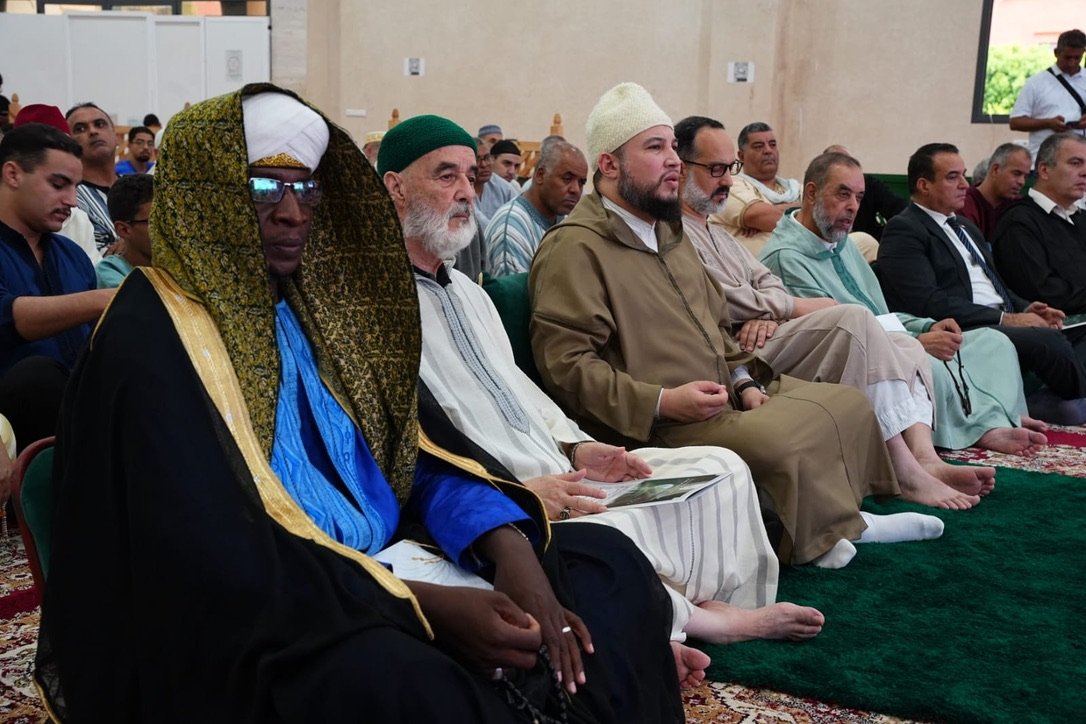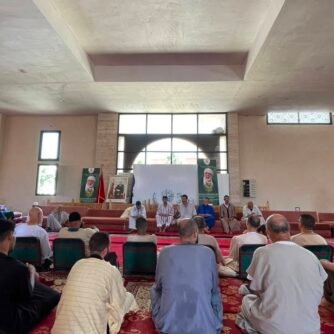
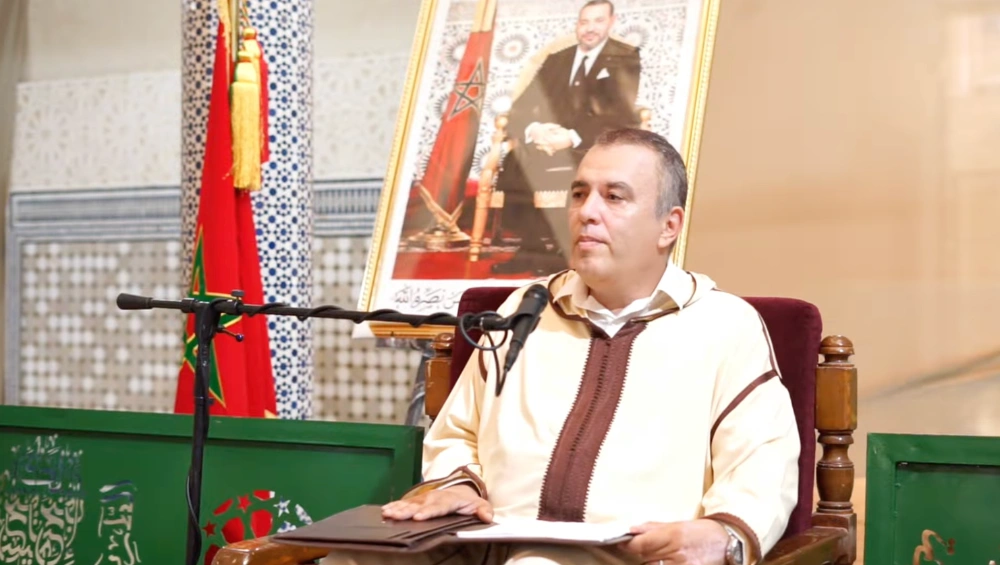
Transcript of the lesson given on Monday 17 August 2026 as part of the dourous al-‘asr, the afternoon lessons that the Tariqa Qâdiriya Boutchichiya has organised since the time of Sidi Hamza, continued with Sidi Jamal Eddine, may Allah sanctify their Secrets, and which are held today with the blessed idhn1 of Sidi Mouad al-Qâdiri Boutchich, may Allah prolong his life. The text follows the living word of the speaker, delivered in Arabic. Translation and adaptation: the editorial team.
Two qasidas, two readings
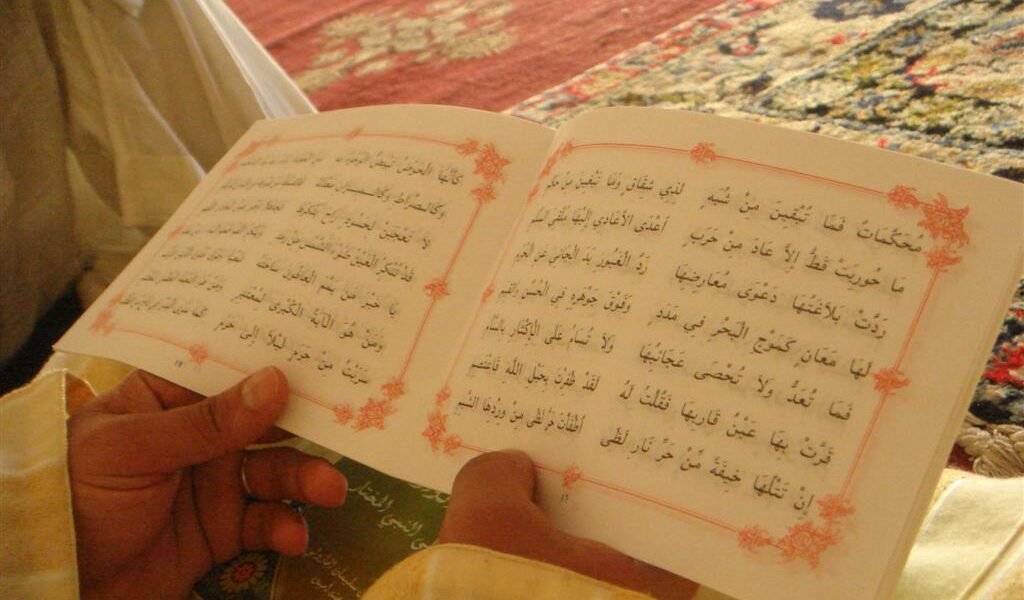
It is an honour to speak at this gathering, which unites, as our Way likes to do, thought and dhikr2. The subject I have chosen is a condensed version of a wider study of prophetic praise in the Moroccan heritage and its African extension. I have centred it on two poems, the Burda and the Hamziyya of Imam al-Busîrî, because they are among the qasidas3 authorised in our blessed Tariqa. The Burda opens with the memory of the neighbours of Dhî Salam and tears mingled with blood. The Hamziyya opens with an admission: how could the prophets attain your elevation, O heaven that no heaven surpasses?
Now, there are two ways of reading these poems. In books of literature, madîh4 is weighed by the measure of art: metre, rhyme, figure. In the zaouïas and gatherings of Morocco, the qasida is something else: a map of the journey, weighed by the deep educative effect it leaves in the one who carries it. The difference between the two readings is the difference between the man who looks at a map and admires its drawing, and the man who actually walks its roads and its lanes. And the call I bring is that the two readings complete each other. The Burda educates through the spiritual state: it makes the murid5 journey through the stations of his own path. The Hamziyya educates through the model: it makes him journey through the stations of the life of the Chosen Prophet ﷺ.
This is why the Burda was not read in order to be known, but in order to transform. It was read in gatherings, in the circles of dhikr, because it accomplishes its inner work in the murid, and the virtuous drew from it a purification of the soul. And all of this remains under the prophetic measure itself, for the Prophet ﷺ said: “Do not praise me excessively as the Christians praised the son of Mary. I am only a servant. Say: the servant of God and His messenger.” Moroccan madîh stands within this balance: he is a man, and he is the best of all creation.
The Burda, a map of the inner journey
Let us follow the Burda through its great stations. It begins with the memory of the beloved and with tears: this is not a poet’s ornament, it is the first step of love, to love the trace before being seized by the One who leaves it. Ardent longing and emotion are addressed to the place for the sake of the one who dwells there, and the journey is not set right by proof but by wajd and shawq6.
Then the poem turns to self-examination. The soul is like a child: if you let it be, it grows up loving the breast, and if you wean it, it is weaned. The soul, at the start of the path, is a child that does not know. Whoever wants to reform it all at once fails, whoever educates it by degrees masters it: such is the method of Imam al-Busîrî, a gradual education of the soul, degree after degree. And let us note the order: madîh comes after mujâhada7. This is a vital rule, for whoever places praise before the purification of his soul receives it in a soul still cluttered with its passions, and everything goes astray.
Then comes the Mawlid, symbol of the second birth that every wayfarer hopes for after his weaning: the spiritual birth of the faqîr8. Then the verses of the noble Qur’an, which bring the text back to the Book after emotion and state. This stage is the safety valve: spiritual experience must remain bound to the Text, and that is why Moroccan tasawwuf9 is a Sunni tasawwuf, which always brings the murid back to the source of the Qur’an. Then the night of the journey: I travelled by night from one sanctuary to another, as the full moon crosses a night of thick darkness. The lesson is that elevation is a gift one carries, not an acquisition one conquers: what first protected the soul from covetousness here protects it from pretension.
And if the poem stopped at the mi’râj10, it would end in extinction. But it comes back down, towards the battles and the history of men, and this is its deepest teaching: the end of the journey is not absence from creatures, it is action among them. The knower climbs the degrees of perfection in order to come back down and take people by the hand towards their Lord. Finally the close: O noblest of creatures, to whom shall I turn for refuge, if not to you, when the all-embracing event comes? This verse, placed at the end and not at the opening, after the poet has established that the Prophet is a man and has given the grace back to God, makes many controversies unnecessary. And the poem ends in a plea for forgiveness, not in triumph. The Burda thus goes from “not I” to “we”: from purification and the inner struggle to extinction, and from extinction to permanence, to service and to building.
The Hamziyya, a map of the prophetic model
The Hamziyya, for its part, opens with an admission of powerlessness, and this is the maqâm11 of adab12: spiritual courtesy before knowledge. Then it leads through the stations of the sîra13. The origin and the first light: the edifice rests on a reality prior to creation, and some books of tafsîr14 report, concerning the verse “Then Adam received some words from his Lord and He accepted his repentance” (Qur’an 2:37), that our father Adam implored God through the Prophet ﷺ, whose name he had seen joined to the Name of God. The birth and the glad tidings: love does not grow in ignorance, and the more one knows the worth of a thing, the more love for it grows in the heart. Virtues before wonders: character comes before stations. Trial and patience in adversity, which is at times purification and at times elevation. The Hegira and detachment: through hijra and renunciation comes inner adornment, then unveiling, as it came to the noble Companions in their outward hegira and their inner hegira. Victory and forgiveness: the true maqâm of strength is forgiveness at the moment one is able to punish. And the wafât15 and the inheritance, from which come the silsila16 and the ijâza17, among the scholars as among the Sufis.
The Burda asks: how is the soul to be purified? The Hamziyya asks: how is one to be connected to the model? And together they ask the only question that matters: how does one become Muhammadan?
The African reach of Moroccan madîh
These two maps have travelled, and West Africa received them not as texts to recite but as methods to live. Cheikh Sidi al-Mukhtâr al-Kuntî made them into chains of ordered stations, in which talqîn18 and adab come before everything. Al-Hâjj ‘Umar al-Fûtî, the author of the Rimâh, made them into a guide for the journey: one takes the authorisation, one practises dhikr regularly, one keeps company, one works within the community, and service becomes the fruit of the way. In Senegal, al-Hâjj Mâlik Sy composed his Khilâs adh-dhahab on the life of the best of the Arabs, which the continent still chants. Cheikh Ahmadou Bamba left entire works in praise of the Prophet, foremost among them the Mawâhib an-nâfi’. Cheikh ‘Uthmân ibn Fûdî, in Nigeria, wrote his Ihyâ’ as-sunna: knowledge first, then action, then reform, for emotion without knowledge is a danger for the murid, and from this comes the necessity of suhba19. And Cheikh Ibrahim Niasse brought the broadest shift: the opening to the greatest number of what had been reserved for the elite, the author of the Kâshif al-ilbâs making the dhikr of praises an instrument for educating ordinary people, to the point of bringing the teaching down into local languages.
And one thing never changes from one end of this heritage to the other: the close in poverty before God. Just as the Burda ends in iftiqâr20, the African diwans21, even in the Yoruba language, always end on the same admission: I am a poor servant before God.
Seven stations for the wayfarer
From these two qasidas, seven stations can be drawn. The first: awakening and ardent longing, through the door of love and not of challenge. The second: repentance and self-examination, the diagnosis before the remedy. The third: gradual weaning, for the soul is educated and not broken. The fourth: adab and learning, refining oneself before learning, learning before tasting. The fifth: knowledge bound to Revelation, experience is measured by the Qur’an, never the Qur’an by experience. The sixth: iftiqâr, which for the people of God is not one halt among others but the axis around which everything turns, for the servant is carried by the grace of God, not by his own strength, and whoever loses poverty at a station stops on the way. The seventh: the return through service, the effect among people, the building.
The Burda and the Hamziyya were not written to be admired, nor to be weighed by the measure of art alone. They were written so that one might live with them and journey by them along the guidance of the Messenger of God ﷺ. Whoever memorises them without walking with them has carried the map and stayed at home. And the best madîh is the one that becomes character.
May prayer and peace be upon the one whose praise is the source of all praise. May Allah assist the Commander of the Faithful, His Majesty King Mohammed VI, may He keep him in His protection, together with His Royal Highness Crown Prince Moulay El Hassan and His Royal Highness Prince Moulay Rachid, and the whole royal family. And may He cover with His mercy the two late kings, His late Majesty Hassan II and His late Majesty Mohammed V, and place them among the prophets, the truthful and the righteous. What excellent companions these are!
Notes
- Idhn: the spiritual authorisation given by the master of the Way, which grounds the legitimacy of a practice or a transmission. ↩
- Dhikr: the invocation and remembrance of God, a central practice of the Sufi way. ↩
- Qasida: a classical Arabic poem of fixed form, with a single rhyme. ↩
- Madîh: praise, here the praise of the Prophet ﷺ, a major genre of spiritual poetry. ↩
- Murid: the disciple committed to the way, literally “the one who wills” God. ↩
- Wajd and shawq: the spiritual emotion that seizes the heart, and ardent longing for the Beloved. ↩
- Mujâhada: the inner struggle against the inclinations of the soul. ↩
- Faqîr: literally “the poor one” in God, the name taken by the wayfarers of the Way. ↩
- Tasawwuf: Sufism, the science of inner purification. ↩
- Mi’râj: the heavenly ascension of the Prophet ﷺ, which followed his night journey. ↩
- Maqâm: a spiritual station, a stable degree acquired on the way. ↩
- Adab: spiritual courtesy, the fitting conduct towards God, the master and creatures. ↩
- Sîra: the biography of the Prophet ﷺ. ↩
- Tafsîr: the exegesis of the Qur’an. ↩
- Wafât: death, here the passing of the Prophet ﷺ to the other world. ↩
- Silsila: the chain of spiritual transmission linking each master to his predecessors back to the Prophet ﷺ. ↩
- Ijâza: a licence of transmission granted by a master, attesting the chain through which a body of knowledge was received. ↩
- Talqîn: the direct transmission of dhikr from master to disciple. ↩
- Suhba: the spiritual companionship of the master and of the brethren of the way. ↩
- Iftiqâr: essential poverty before God, the awareness of depending on Him in all things. ↩
- Diwan: a collection of poems. ↩