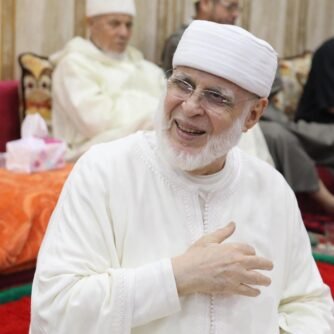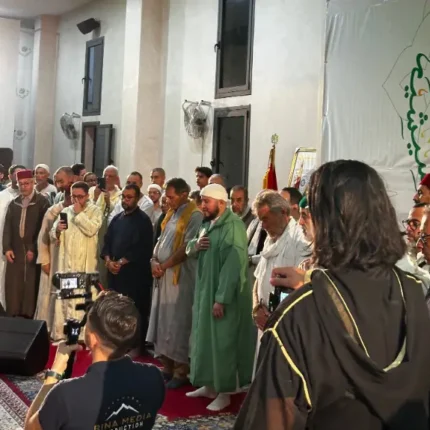
An opinion piece by Jean-Bruno Falguière, psychoanalyst and writer, based on an interview given in 2020 about his book ‘Scribe de Dieu : un voyage spirituel au cœur de la confrérie soufie Boutchichiya’ (Éditions Erick Bonnier). His words have been reorganised for the written page. The author’s voice has been preserved.
A psychoanalyst before the sacred being
The work of ‘L’Autre est une école’ was given to me many years ago, in a rather surprising, rather strange way. I will not dwell on that. What is certain is that when this opening was given to me, I was asked to wait two years before launching the first workshops. And, curiously, the moment I began them coincided exactly with my meeting with that magnificent master, Sidi Hamza al-Qâdiri Boutchich, may Allah sanctify his Secret.
I always had the intuition, the foreknowledge, that a therapy could not be carried through without taking the sacred being into account. In this I was very close to Teilhard de Chardin, who said: we are not human beings having a spiritual experience, we are spiritual beings having a human experience. ‘L’Autre est une école’ is something like that: a path that takes into account the whole psychological dimension of the creature and which, at a certain moment, opens up and questions itself from the standpoint of the spiritual being, that is to say the being of the human. A work that is psychological, and at the same time an opening.
The meeting: an ocean of mercy
The quest began very early, from the age of twelve or thirteen, with readings of the scriptures that simply came to me. Then came the encounter with psychology and psychoanalysis. I was fortunate to undergo my own analysis with a psychoanalyst who practised her profession from a perspective that took account of human spirituality. Little by little, I looked for things ever closer to what may be called a spiritual journey, and I had several mentors. Before meeting Sidi Hamza, I had another master, who was not a living being: I followed the teaching of Jesus, through an encounter with the Gospel of Thomas, translated and commented upon by Émile Gillabert and his companions. For years, morning and evening, I studied this teaching, which in the end became so alive that I found it again every day in the experiences of daily life.
Then one day I received a telephone call from a very close friend, whom I already regarded as a brother, and who belonged to the Tariqa: ‘Come quickly, three days at his house.’ We had never met, the master and I. I went straight away. The first time I met this man, in that very instant, I had the feeling that an ocean of mercy was pouring over me. The upheaval was immediate. I understood neither the ins nor the outs of it, but the shock was enormous. This meeting completely transformed my life: it brought to a single point all the years of work, all the encounters, all the questioning, all the psychological and spiritual experiences I had lived through. Everything was fixed at one point, and from that point we set out. The opening was an extraordinary adventure.
Sidi Hamza has since left this world, but he is still regarded as a very great Sufi master, and his knowledge is still extremely alive. He was a living master who, without needing to say so, through his teaching, set forth what is called gnosis: knowledge. He opened for us the doors to the possibility of reaching it. The foundation of this man’s teaching is love and beauty. He revealed to me as no one had ever done the quality of presence, the fragrance, the taste, the power of what love is in the living world. He recalled me to the ontological law of man: love is the law.
A book received, not written
It is important that I say it, even if it will seem strange, even unbelievable, to some people: this is how it happened. This book dropped into me all at once, the way a coin drops into a money box. I had already been going regularly to Sidi Hamza for two or three years and walking with him in the brotherhood. The book dropped one morning, in prayer, in the gardens of the master’s house, near a small village in Morocco called Naïma. That day, astonishingly, the title dropped too: it would be ‘Scribe de Dieu’. I say it all the time, and some people are shocked by it, no matter: I did not write this book. I received it, and set it down. Little by little. The adventure lasted several years. The whole book was written within the inner evocation of prayer. I could not have done otherwise.
One day I sent the manuscript, and it fell into the hands of a highly experienced publisher, a man who had always been in literature. He made me work enormously, and he was moved at once: he had himself met Sidi Hamza several years earlier. The perspective I have on this book today? It continues to be a very active and very living vehicle. I keep discovering that it is a teaching: it teaches me, myself. I find things in it that still astonish me, things my master taught me. I open it from time to time and look at it as an object I am discovering. It is a very living book. It has its life to live, and it will live it.
Love and fear
All human beings, whether they know it or not, are in reality faced with two emotions: love and fear. All the other emotions, whether described psychologically or poetically, are variations of these two. Close your eyes for a moment, in a little concentration, and imagine what it is for a tiny being to be expelled from its mother’s womb and confronted all at once with the physical power of this world: how can you imagine that the shock of fear does not exist? If we understand that, from the very start, a human life is an initiation, then we can understand that fear is part of the initiation. And it was fear that drove me to live the experience of love, because only in love did I find peace. All humans find peace in love. I am not an isolated case, I am very ordinary.
As for guilt, it is the river that feeds the ocean of fear. It is a scourge, overfed by the mind, nourished by beliefs we cling to. And this guilt, alas, is exploited: it is by way of making people feel guilty that one can not only manipulate them but root them in fear. The day I understood that it was impossible, truly impossible, to imagine God being guilty of anything at all, I immediately asked myself this question: how then could His creatures be so?
Love is neither a concept nor a feeling
You ask me to define love: that is something I cannot do. Love is not a concept. It is an entirely mysterious opening that you can create within yourself through a spiritual journey, with the help of masters who have the capacity, perhaps even the spiritual authorisation, to educate those who knock at their door. Love is a human experience to be lived. There is no limit to love. It belongs to the realm of the infinite and the eternal. Love is a law, the ontological law. It is probably the most powerful energy in the universe. It is the book of knowledge. Love is everywhere: in all the trees, all the flowers, in all the animals, in all the stones. Love dwells in the living. One night I woke with a start, in an opening, and a great cry came out of me. I was saying in the bedroom: I am not me, I am what animates me. That is perhaps one of the first very strong perceptions I had of love.
But it must also be said, to those who fear that loving will make them vulnerable: love is not a feeling, and love is merciless. Love demands truth. Not the truth that is opposed to lying, but the truth that is opposed to illusion. Truth is an act of love. Love is a sword. Love is the place of the real, the awakening to an absolute consciousness. Those who think that their compassion, their mercy, their kindness will make them look like fools must come out of that fear: it is the mind up to its tricks again. Decide to love, and you will adopt a way of behaving modelled on your decision. What the other thinks of it matters little. If he sniggers as he turns his back on you, let him snigger. What is important is that you cultivate the garden of love within you. We come from love, we are made of love, we are destined for love.
Cultivating the garden of the heart
Man possesses two treasures, which are two graces. The first, immense, is that he has the capacity to decide to love. The second is this possibility of meeting the garden of the heart through the gift of prayer. I am not speaking of a prayer to reassure oneself within a belief, whatever it may be: I am speaking of prayer as an initiatory path. And this journey will demand three things of you: assiduity, perseverance and repetition. You must never let go. My master gave me exercises, a dhikr, a prayer to be done in a precise way. He called them the medicines of the heart. It was magnificent. You must go into it without asking questions, and recall yourself every day to this presence, this light in the heart. Every day, what I call the cultivation of the garden of the heart. To connect, to connect, to connect with this presence that smiles on us all the time, that delights us, that illuminates us.
Let us not forget that we live in a world currently dominated by the mind and by the ego. Our perseverance must be very great. Another great spiritual master, Sri Aurobindo, said: the spiritual path is a battle. Of course it is one: a continual confrontation with the mind, which wants to dominate everything, understand everything, and which, alas, creates fear. As soon as you are afraid, the mind starts churning and imagining all sorts of scenarios, and these scenarios feed a fragmented vision of the world, which in turn feeds fear. The great power of the mind is its imaginary power, limitless because groundless. Yet changing the way we look at the world is not as complicated as we think: it is changing vantage point. If you look at the world with your mind, you will see a disjointed world. If you begin, through a certain practice, a certain initiation, to look at it from the vantage point of your heart, I assure you that you will not see the same world.
One day a vision came into my heart, during prayer. The voice of the heart said: ‘From today, every morning, find yourself an enemy. On the mornings when you find no enemy, pray for yourself.’ Try the experience: choose yourself an enemy, tomorrow morning or this evening. Sit in your heart, put yourself in prayer, and look at this enemy through prayer. You will see what happens.
What has changed in my relationship to fear along this path? By turning this laser gaze on the psychological condition of the creature, all psychological fears gradually faded away, because I began to disidentify from the propositions of the mind, the ego, the emotional body. One day, in the middle of a lecture before a large audience, my legs and arms began to tremble, while everything was going calmly. I understood that my creature was afraid. I carried on with the lecture, while reassuring my creature: don’t worry, all is well. The trembling subsided. And afterwards I was very moved by the self-evident truth that had just been revealed: the one who was speaking, who was exchanging with those people, was not in the least afraid. I had just lived something self-evident: I am not the creature. I offer you this for what it is worth.
One humanity: the universality of the Way
What drew me completely in the spiritual experience of Sufism is that Sufism is universal. I saw it very quickly: when I met Sidi Hamza and his teaching, after those years spent with the teaching of Jesus, I was on familiar ground. I found myself in exactly the same universality, the same opening. Religiosity must not be confused with spirituality: openness to spirituality is necessarily universal. The ego’s favourite playground, apart from fear, is separation. The mind has a dual vision of the world and is continually dissociating: good, evil, white, black, the Muslim, the Catholic, the Jew, the Buddhist. Any teaching that does not pass through an opening to universality will not be able to take you on an initiatory journey.
It is in this sense that the experience offered by Sidi Hamza, then by Sidi Jamal, may Allah sanctify his Secret, who at that time bore the charge of the Way, is to uphold universality: the universality of the Way, the universality of spirituality, the universality of love, of the path and of the heart, the universality of the human. I am going to tell you something that may make me look like a madman, no matter: in reality, there are not seven billion human beings on this planet. There is the human being, and seven billion fragments that make it up. Each fragment is a singularity. These seven billion points of light make up the human being, to be raised up and to be loved. The heart is able to give you that vision. And the secret of oneness lies in multiplicity: it is because we believe ourselves separate that we suffer.
I am sometimes asked whether there is a contradiction between walking an authentic spiritual path and being a citizen engaged in society. There is no separation, there is no conflict. Ideology, there is none in my life. My master told me with great insistence: do not get involved in politics, and I do not. Nor is there any opposition between the teaching of Jesus and the teaching of my master Sidi Hamza: I have never seen any. All the rest is the ego, the mind, fear.
The master, beyond distance
Meeting one’s master, being in a relationship of physical presence with him, is an important thing. It is very powerful to live, and very nourishing for the heart. But there is, in prayer and in the practice of dhikr, an attitude, a concentration, which is to turn towards the master, even ten thousand kilometres away. Very early on I lived this experience of orientation: calling up his presence within myself, within my heart, placing it in all my prayers and all my practices. I turn towards him, and he is there. Nothing cuts me off from the quality of this presence of love. And there is no orientation without love: it is impossible. When I tell you that I love my master infinitely, tell yourselves that I love you infinitely. There is no separation.
As for the balance between action and contemplation, I do not separate them. I am an extremely active man, and this action is sacred: I hold action as sacred as contemplation. All my activities are directed towards the service of love, and the times of contemplation are times when the experiences born of action ripen. It is a continuum: the continuum of the instant that follows the instant.
The station of the servant
A word, finally, on that much misunderstood term, submission, by which the word islam is often translated. I wrote in the book: it is through total and complete submission to Your will that I at last feel truly free, Lord. Submission means the adoration and service of God. I will shed light on it another way: humility is not kneeling before God. Humility is being proud to belong to His greatness. If you understand this, you will restore the word submission to its full dignity. Submission is far more than an adherence: it is an opening to the infinite love of the divine. There is no higher spiritual station than that of the servant.
If the acts you perform do not serve love, those acts are nothing but agitations that will be added to the agitations of the world.
Words of Sidi Hamza, as the author testifies he received them in the heart, in orientation
Perhaps we do not know it, but we are in the subtle all the time. It is the image of the fish swimming in the water and wondering where the ocean is. It is simply a matter of seeing it.
Based on a video-conference interview given in 2020, a few months after the publication of ‘Scribe de Dieu : un voyage spirituel au cœur de la confrérie soufie Boutchichiya’ (Éditions Erick Bonnier, 2020). Jean-Bruno Falguière is also the author of ‘La Voie du Cœur et la Voix de Dieu’ and ‘Tu as tant voulu le rencontrer’.