
The Quest for the Sirr
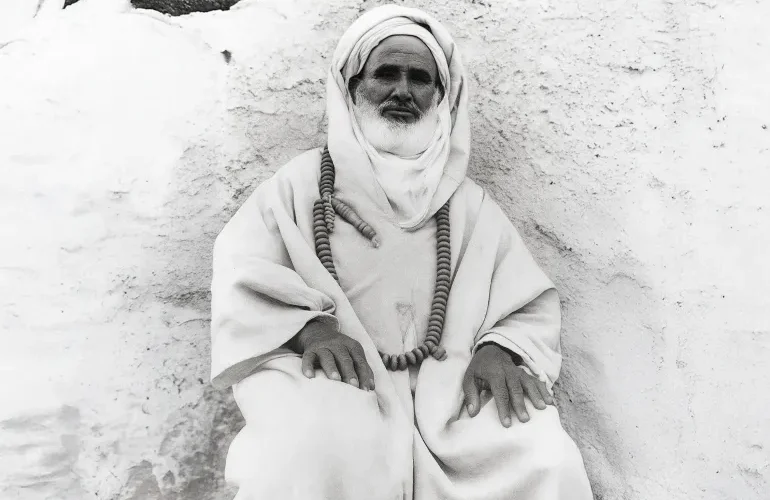
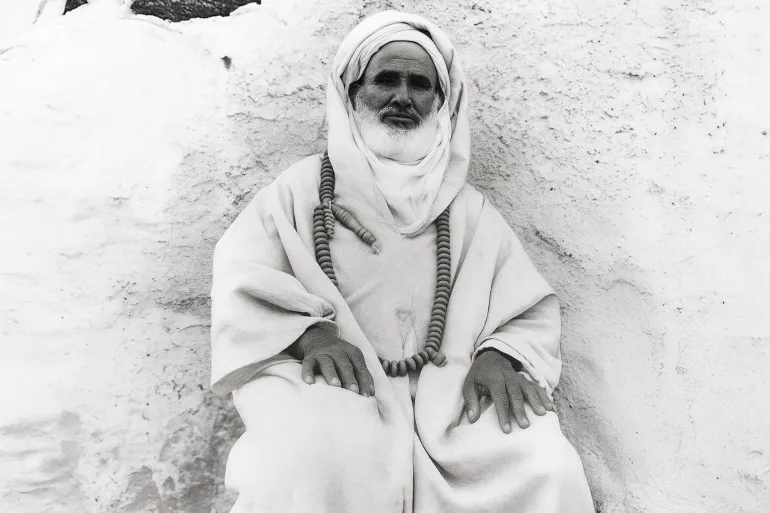
The recent history of the Qâdiriya Boutchichiya Way goes back to Sidi Boumedienne, born in 1873 near Oujda. He was a descendant of the Prophet and of Moulay Abdelkader El Jilani, and his family had settled in Morocco after coming from Iraq. Sidi Hamza explains that the “spiritual Secret” (Sirr) at times left the family, returning to it later according to the divine will. Until then, the Way was practised for blessing (Tabarouk), but without full spiritual education.
The Origin of the Name “Boutchich”
The name comes from an ancestor, Sidi Mohamed Kadiri. During a visit to a holy man, the guests were given a large dish of tchicha (roasted barley). Out of politeness or calculation, no one touched the dish except Sidi Mohamed, who, driven by immense hunger, ate the whole dish intended for ten people. The holy man then declared: “He is the one who has taken everything”, meaning that he had absorbed all the blessing. From then on, he was called “Boutchich”.
Resistance and Awakening
The Boutchich line produced great masters and resistance fighters, such as Sidi Mokhtar, who took up arms against the French troops in 1907. Sidi Boumedienne began with a classical, exoteric religious practice, thinking that his lineage was enough. However, through keeping company with simple but hospitable disciples, he became aware of his “spiritual sleep” and felt the need to find a true master.
The Quest for the Master
Sidi Boumedienne searched for a long time for a guide, placing himself in the service of anyone who seemed to possess wisdom. One day, a holy man named Sidi Mazouni interpreted one of his dreams as the sign that he would become the initiator of a path with distinctive spiritual fragrances. In the end, he was directed towards a man named Sidi El Mehdi Belarbi. To his great surprise, this man was his neighbour, whom he had until then regarded as a person of little importance.
The “Hidden” Master: Sidi El Mehdi
Sidi El Mehdi was a strange figure who passed himself off as a “buffoon” or a simple man before the notables in order to hide his sanctity. Under his direction, Sidi Boumedienne lived the experience of Fana (extinction in God). He practised with such intensity that he used onion to stay awake during his night-time invocations.
The Spiritual Heritage and Fez
Sidi Boumedienne travelled across Morocco to gather the heritage of several masters. A crucial stage was his meeting with Sidi Mohamed Lahlou in Fez. Following his teachings, he was seized by a state of intense ecstasy (Hal). His master confirmed to him by letter that these tremblings were the sign of divine love: “This is the way of lovers when they are spoken to of their beloved.”
The Doctrine: Rigour and Purity
The Way is a synthesis of the Qadiri, Tidjani and Chadhili heritages. Sidi Boumedienne was a master of extreme rigour.
Asceticism: The disciples slept on stones and lived on prickly pears.
Purity: He was obsessed with ritual cleanliness. He washed his own clothes, and even banknotes, saying that money was full of physical and spiritual “germs”. He preferred “a handful of bees to a swarm of flies” (few disciples, but sincere ones).
A Modern Sufism
Sidi Boumedienne adapted Sufism to the modern age. He taught that the Sufi must be “the son of his time”. He encouraged well-off disciples not to wear patched clothes in order to appear humble, but to live in comfort and beauty. For him, knowing God in Majesty and Beauty was higher than an ostentatious poverty.
End of Life
Sidi Boumedienne died in 1955. He passed on his spiritual authorisation to Sidi Hamza (who was young at the time) and to his father Sidi Hajj Abbas. He now rests in Madagh, which has become the world centre of the Tariqa Qâdiriya Boutchichiya.