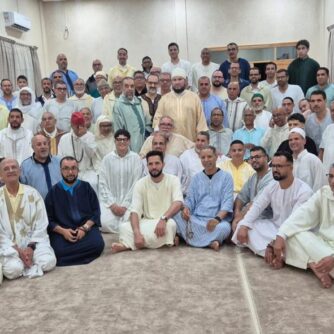
Address by the Cheikh of the Tariqa Qâdiriya Boutchichiya, “the servant in need” of “Allah the Rich”, Mouad ben Sidi Jamal al-Din ben Sidi Hamza
﷽

Praise be to Allah, and blessings and peace be upon our master the Messenger of Allah, the Truthful, the Trustworthy, and upon his family and all his companions.
My brothers, my sisters affiliated with the Tariqa Qâdiriya Boutchichiya:
Allah Most High said: {وَذَكِّرْ فَإِنَّ الذِّكْرَىٰ تَنْفَعُ الْمُؤْمِنِينَ} (and go on reminding [people], it is good for those who believe to be reminded) (الذاريات, The Scatterers, 55, Qur’an 51:55)
The Spiritual Legacy of Sidi Hamza: A Continuity Very Much Alive
On this noble commemoration of our Cheikh Sidi Hamza, may God sanctify his soul, we recall the life of a man who devoted himself body and soul to God. He made the spiritual journey (As-Sayr wa al-Suluk) towards Him an integral project, founded on solid bases and immutable constants, combining sincerity and discipline, striving against the self (Mujahada) and mercy. A project of building the human being, purifying the heart and awakening sincere aspiration towards the All-Merciful. He became, may God sanctify his soul (in the words of Sahih al-Bukhari), like those fertile lands that hold water, through which God has benefited people: they drank from it, watered their animals and cultivated the land.
His memory today is not the recollection of a bygone past, but the reminder of a continuing trust (Amana) and a permanent responsibility: to ensure that this legacy remains alive in conduct, constant in method, preserved in its purpose, merciful in the call (Da’wa) and sincere in its orientation. It is a fidelity to the very foundations of the Way, an active continuity and not a mere formal affiliation.
The Trust of the Mission: Foundations of the Succession
This is why I find myself compelled today to remind myself, and all of you, old and new disciples, of the realities of the Method (Al-Minhaj) on which our Tariqa Qâdiriya Boutchichiya was built in the era of our Cheikh Sidi Hamza, may God sanctify his Secret, and whose path our Cheikh Sidi Jamal, may God have mercy on him, followed. I wish to affirm that the foundation remains the same, that the essence is identical, and that companionship (Al-Suhba) on the path of God has always had, and still has, as its sole aim drawing near to Allah Most High, in accordance with what He revealed in His clear Book and what His trustworthy Messenger, blessings and peace be upon him, transmitted.
People, in Morocco and abroad, have borne witness that God honoured our Shuyukh by reviving the path of Sufism on the basis of commitment to the sacred Law (Sharia) and the pursuit of realising the spiritual courtesies (Adab) of the Way. The Way is founded on the ethics of virtue, ease, love and brotherhood in God. This renewed the sense of a pressing need for this spiritual education within the Moroccan nation and throughout the world, as the pious predecessors (Al-Salaf al-Salih) established it throughout history. As a result, the Tariqa spread (by the grace of God) to various horizons, and God made the signs of guidance and of spiritual neediness (Al-Iftiqar) towards Him appear upon its affiliates.
The disciples (Fouqara), who received the Way from our Shuyukh, have experienced that the rules of the path are immutable, without substitution or change, despite the difference in personality between the two Shuyukh. I was at their side, and I take God as witness to what I knew of each of them. I was a disciple in their hands although I am of their descendants, for the two bonds are distinct: biological lineage (An-Nasab al-Khalqi) and spiritual affiliation (An-Nisba al-Khuluqi). I sought nothing but God’s good pleasure through adherence to their way, and the state I was in during their era, and to this day, is not hidden from those who practise invocation (Dhakirin).
As everyone knows, my grandfather Sidi Hamza, may God have mercy on him, entrusted to me, during the last two decades of his blessed life, the same missions he himself carried out as a disciple, missions with which he had been charged by his Shuyukh Sidi Boumediene and Sidi al-Haj al-Abbas. He entrusted me with:
- First: the supervision of sacred chant (Madih) and spiritual audition (samâ’), surrounding me with his guidance and care, until this field became (by the grace of God, then his) a reference for chanters and listeners of East and West.
- Second: the management of the affairs of the mother Zaouïa in Madagh and of its residents.
- Third: taking charge of the affairs of the family and its needs.
- Fourth: he honoured me by delegating to me the coordination of the affairs of the Tariqa and its structures, as well as the direction of the councils of the Moqaddems and the senior figures of the Way, urging upon me the necessity of continuing his approach of the Lord’s servants and remaining faithful to his blessed “protection” (Tahnish).
These are the very missions I continued to carry out under the supervision of our Cheikh Sidi Jamal, may God have mercy on him, until he passed into the nearness of his Lord.
As everyone knows, Sidi Hamza, may God sanctify his Secret, called me “The Pilot of the Tariqa” (Rubban al-Tariqa). He would say to the disciples in dialect (Darija): “Wherever Mouad is, I am there; if you meet him, it is me you meet, and what he tells you, it is I who tell you.” He never began a visit without my being at his right, and he would say: “I want the disciples to open their eyes to him.” One day, he took my head and breathed into it three times, saying: “Rise, I have just poured into you all that I possess.”
Then God decreed that he should entrust to me, by explicit authorisation (Idhn), responsibility for the continuity of the spiritual direction (Machyakha) of the Way after my father. This was repeated many times. He informed me that this authorisation came from the Messenger of God ﷺ, and that the glad tidings announced by Sidi al-Haj al-Abbas had been fulfilled in me. God is witness that he ordered me to bring the adouls (notaries) to amend and record his will, but I preferred restraint, choosing humility and surrender to God, favouring the courtesy of the secret (Adab al-Sirr) over the display of rank.
My father said, while he was in the clinic during his last days: “The rank that the father (Sidi Hamza) gave you, no one can take from you except God,” then he added: “And I give you more.” He then handed me his prayer beads (Subha). Now, the handing over of the prayer beads, among the People of God, constitutes an explicit and confirmed authorisation, as is established in their biographies.
These facts and realities are known to a number of those in charge among the senior figures of the Way and to those who assiduously accompanied our two Shuyukh, may God sanctify their souls.
This arose from a wisdom they knew, and from glad tidings they received and believed in. The transmission of spiritual direction is not like the inheritance of material goods: it is an immense responsibility before God Most High. I was free of any personal desire in this regard, but when the announcements and signs of the Knower through God, Sidi Hamza, were fulfilled, I asked God, and I still ask Him, for His help in this matter, and for success in what He loves and is pleased with. All the more so as the two Shuyukh repeated, over the years, the heralding signs that this Tariqa would continue to spread and flourish, in the service of religion and for the benefit of all creation.
The Pillars of the Journey: Vigilance of the Soul and Oneness of Orientation
Through these words, I wished to recall the rules of the Way, so as to unite the concern of the disciples (men and women) around them, so that no one should think that these rules change when the Shuyukh change. They are immutable rules comprising five points: the first is the Aim of the Way, the second is the Means of reaching this aim, the third is the Condition for obtaining this realisation, the fourth is the reminder of the Adornment of the Lord’s servants required of the affiliate, and the fifth is the stipulation of providing the necessary Proof of the sincerity of the disciple’s will.
Before detailing these five rules, I mention two meanings that are inseparable from the Way and linked to the journey: “the Soul” (An-Nafs) and “the Orientation” (At-Tawajjuh).
- The Breath of vigilance concerning “the Soul”: this is the permanent fear of the soul that incites to evil (An-nafs al-ammara bi-su’), the soul that lies in wait for its owner. If he becomes heedless, it makes him fall into what is forbidden. This vigilance implies constant caution, a subtle sense that ordinary people do not perceive, and without which the journey cannot be upright.
- “The Orientation” (At-Tawajjuh): this means restricting the relationship of companionship to the person of the Cheikh himself, in order to avoid any dispersal of the disciple’s spiritual energy (Himma). It is this energy that the Cheikh, in the process of companionship or spiritual direction (Taslik), works to direct towards God Most High, especially in the stages of inner ascension. The disciple must then guard himself against the perils of associationism (Shirk) or of involvement in certain states of oneness (Ahwal al-Ahadiyya) that are outwardly disapproved, from which he might find it hard to emerge unscathed in order to reach the safe precincts of the Muhammadan Station (Al-Maqam al-Muhammadi), which is the most precious quest and the summit of perfection in realising the Oneness of God.
Orientation is a permanent recollection, also called “concentration of aspiration” (Jam’ al-Himma). This means that, in the Way, no one shares with the Cheikh the education (Tarbiyya) or the spiritual direction (Taslik). The disciple must not neglect this principle. Our Shuyukh repeatedly warned the disciples against the risk of becoming attached to someone who displays wonders (Karamat), or to someone admired for his eloquence or for his unveilings (Kashf) and visions. They also set aside those who unsettled the disciples with claims arising from states incompatible with the required discipline.
My brothers, my sisters,
I wish to remind you, in broad terms, of the five rules on which the counsel given to every beginner in the Way must rest, and on which even one who has journeyed long must reflect. These points are as clear as the sun: they are the essence and they suffice. Pausing on them is necessary for anyone who believes the Way to be something else, or who takes it as a means of satisfying a desire, of acquiring renown, leadership, or even wonders. If the disciple understands what we are about to set out, he can rectify his perception and his conduct. If he persists otherwise, it is more beneficial for him to leave and seek what he desires elsewhere than with us.
The Rule of the Aim: Purification of the Soul against Egoism
The first point to clarify is the “Aim” (Al-Qasd) of the Way: Sidi Hamza would say: “Always remind the disciples to renew their intention in the Way.” {وَمَا خَلَقْتُ الجِنَّ وَالإنْسَ إِلاّ لِيَعْبُدُون} (I created jinn and mankind only to worship Me) (الذاريات, The Scatterers, 56, Qur’an 51:56). The aim of the Way is to rectify worship and perfect its performance, while grasping its meanings and contents, and energising the limbs to carry it out correctly. It means acquiring these meanings, adorning oneself with them and building a firm disposition in the soul to embody the requirements of faith and to devote oneself consciously to good deeds. This disposition is called “the inner motive” (Al-Wazi’). It is obtained only through the education that the Qur’an expresses by the concept of “Purification” (Tazkiya), that is, protection against the avarice of the soul, as the verse explains: {وَمَنْ يُوقَ شُحَّ نَفْسِهِ فَأُولَٰئِكَ هُمُ الْمُفْلِحُونَ} (those who are saved from their own souls’ greed are truly successful) (الحشر, The Exodus, 9, Qur’an 59:9).
In contemporary language, this avarice of the soul corresponds to “egoism”. Hence the aim of the Way is to gather around an education that disciplines the soul through the invocation of God (Dhikr), until it frees itself from its egoism. Once freed, the soul devotes exclusive worship to God and avoids the worship of the “ego” manifested in the dominion of the passions, against which the Qur’an warns: {أَرَأَيْتَ مَنِ اتَّخَذَ إِلَٰهَهُ هَوَاهُ} (Think [Prophet] of the man who has taken his own passion as a god) (الفرقان, The Criterion, 43, Qur’an 25:43).
The Rule of the Means: Dhikr, the Disciple’s Remedy
The second point concerns the “Means” (Al-Wasila) by which the aim is reached: the Dhikr. Sidi Hamza would say: “With the Dhikr, everything comes from the disciple; without the Dhikr, nothing comes from the disciple.” The Dhikr is the means that leads to the aim and achieves the purpose of the Way. It is the pillar and the spirit of the journey. The believer’s spiritual success comes about only through it, for it is through it that the felicity of the heart is realised. This felicity is in proportion to the extent to which the believer is present to his own reality, knows the true worth of his Creator and is fully aware of the responsibility that this knowledge places upon him towards his Lord.
While grasping these intellectual realities is within the reach of every rational being, their internalisation (to the point of becoming an integral part of one’s being and a guide for conscience and conduct) comes about only through education, training and practice. This is what is achieved by entering the way of Tazkiya, the Qur’anic name for Sufism.
Journeying on the Way requires the companionship of a knowing Cheikh. The Cheikh does not use any foreign material for this education: he uses the Dhikr, a recollected Dhikr, in doses that may vary according to the needs of the soul and its ailments, like a physician prescribing a remedy. The influence produced on the invoker is the effect of the Dhikr prescribed by this knower of the paths of the Way to treat the disciple’s heedlessness, his forgetfulness of his reality and the avarice of the soul that results from it. The general Dhikr in our Way is “La ilaha illa Allah”, followed by the prayer upon the Prophet ﷺ. The Cheikh may indicate other invocations to the disciple if he perceives in him the necessary aptitude.
The whole Way revolves around the Dhikr and guiding companionship (As-Suhba al-Murshida), and nothing else. Gathering to invoke God is the means of exposing oneself to His mercy and of attaining a particular understanding of life’s situations, one of whose fruits is the tranquillity of the soul (Tumanina). Affiliates may carry out various useful activities (charitable works, spiritual audition, talks, lectures…), but these remain secondary to the Dhikr, which holds the absolute central place in the spiritual journey.
The Rule of the Condition: Rootedness in the Sharia
The third point is the “Condition” (Ash-Shart) without which affiliation is not valid: total commitment to the Sharia. Sidi Hamza would say: “Spiritual Reality (Haqiqa) is a dwelling, and the sacred Law (Sharia) is its door.” {وَأْتُوا الْبُيُوتَ مِنْ أَبْوَابِهَا} (So enter your houses by their [main] doors) (البقرة, The Cow, 189, Qur’an 2:189). The fundamental condition is the observance of acts of worship according to the constants of our Kingdom, chosen by our forebears under the direction of eminent scholars. To this is added probity in dealings, realising sincerity, justice, faithfulness and honesty, while adorning oneself with the noble traits of character advocated by the Sunna. I enjoin the disciples that their exhortations at gatherings should concern the life of the noble Prophet ﷺ and that of his companions, and that they should draw inspiration from the works of the Sufi masters, especially with regard to scrupulous piety (Wara’) and wisdom. It is a reprehensible impiety to think that a disciple could reach a state that exempts him from his religious obligations.
The Rule of the Adornment: Spiritual Neediness
The fourth point is the Adornment of the Lord’s servants (Al-Hulla al-Rabbaniyya) and the appearance that the affiliate must have. Sidi Hamza would say: “I am the master of the Way, and you (O disciple) are its concrete manifestation.” The affiliate must be distinguished by piety, restraint of the tongue, humility, gentleness, absence of pretension, avoidance of ambiguities and service to people. These are the signs of a sincere and manifest spiritual neediness. People’s testimony about one another has a basis in religion. Our established custom is that as soon as a person joins the Way, his brothers call him “Sidi so-and-so” or “Lalla so-and-so”, out of respect and good opinion, in the hope of his realisation in Oneness. Through this sincere adornment, the disciple becomes one who calls to the good by his mere presence and affiliation, reviving the hope that God’s grace is near.
The Rule of the Proof: Noble Character in the Service of Creation
The fifth point is the “Proof” (Al-Burhan) of having obtained the fruit of the Way. Allah Most High said: {قُلْ هَاتُوا بُرْهَانَكُمْ إِنْ كُنْتُمْ صَادِقِينَ} ([Prophet], say, ‘Produce your evidence, if you are telling the truth.’) (البقرة, The Cow, 111, Qur’an 2:111). Sidi Hamza would say: “The mark of nearness (to God) is seen upon us.” The disciple must know the real effect of the Dhikr on his soul through self-examination. For seven decades, our Way has produced fruits whose qualities people have praised. For those in whom these qualities do not appear, one must ask: is it neglect in the Dhikr? A mixture in action? A shortcoming in the Sharia? A dispersion of the mind? Or a forgetting of the aim, which is neediness towards God? The inner proof (Arrival or Knowledge) belongs to God’s knowledge. The disciple must not concern himself with it, any more than he should occupy himself with secondary phenomena such as unveiling (Kashf) or wonders. The outer proof must show itself in conduct: good character, absence of harm, self-giving and useful work for one’s relatives, the nation and all creation.
This is our Way, as we learnt it and lived it with our grandfather and our father. Anything else does not belong to the Way. It is an individual relationship, inner and outer, between the disciple and the Cheikh, and among the disciples themselves. It is the illustration of the hadith: “The likeness of the believers in their bonds of love, mercy and compassion is that of a single body: if one limb suffers, the rest of the body responds with sleeplessness and fever.”
The Educational Breath (Nafas Tarbawi) at the Heart of the City
My brothers, my sisters,
The Tariqa is a method drawn from our religion, aimed at reforming the human soul and therefore conduct. It is not an isolated activity, but an educational energy (Nafas Tarbawi) for reforming all of humankind. Speaking about Sufism at symposia is not Sufism itself: Sufism is a commitment of conduct and of the spirit. The call to the Way is not made through speeches, but through affiliates in whom people see ethical excellence and mastery in their work, whether in science, politics, trade or industry. It is a comprehensive method that the individual and the nation need for their uprightness.
Final Exhortations
My brothers, my sisters,
Place supplication for the Imam of the Nation, the Commander of the Faithful, at the top of your concerns. Put it before everything else in your gatherings and in the secrecy of your prostrations, as our two Shuyukh Sidi Hamza and Sidi Jamal recommended. Spread love among yourselves and towards all people. Avoid ostentation and the love of appearances. Seek help in trial through patience and prayer, confirm your words by your deeds, and fear God, He will teach you.
Peace, mercy and the blessings of God be upon you.
Done at Madagh, on Friday 10 Chaabane 1447 AH, corresponding to 30 January 2026.
Al-Haj Moulay Mouad ben Sidi Jamal al-Din ben Sidi Hamza al-Qadiri al-Boutchich.