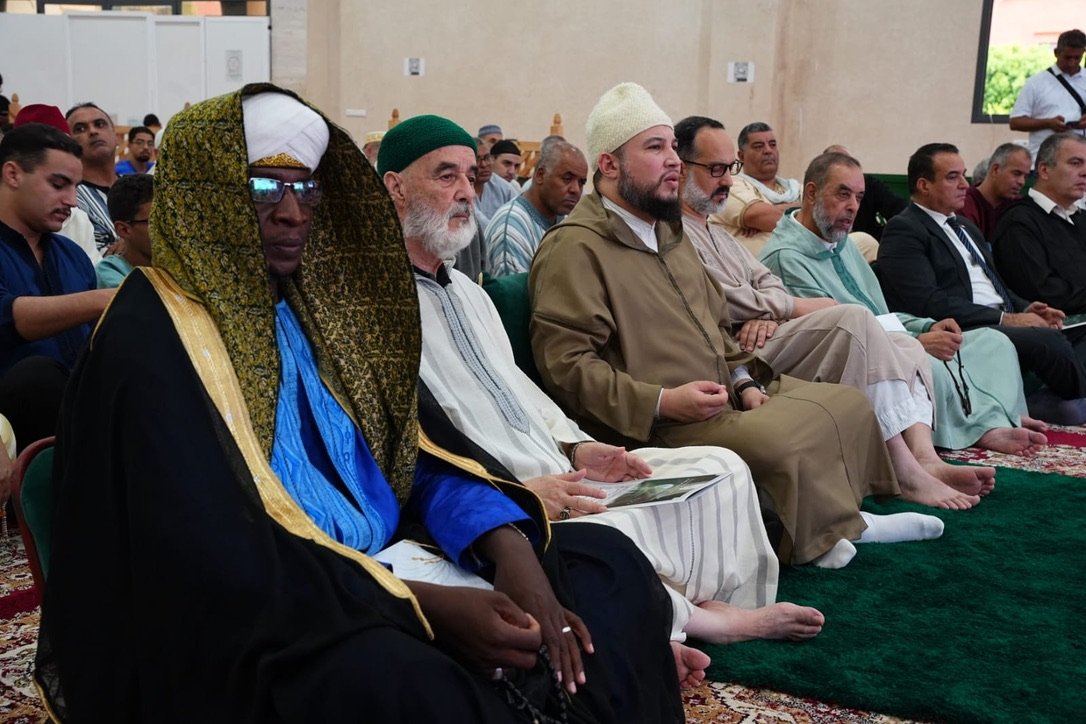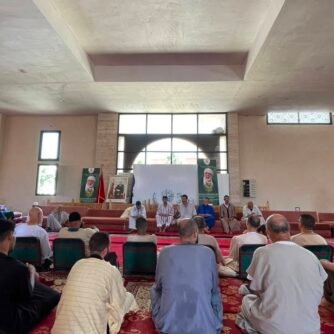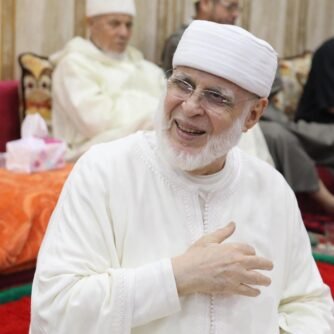
Second part of the lecture “The Teaching of Sidi Hamza” by Sidi Karim Ben Driss. After the withdrawal of the sacred and the three levels of religion, the speaker places confraternal Sufism in its history, then recounts the roots of the Tariqa: Madagh, the Secret that left and returned, and the young Sidi Hamza’s meeting with his guide. Adaptation: the editorial team.
There is not one Sufism, but several
When we speak of Sufism, we must first say that there is not just one. There is still today an ecstatic Sufism, the Sufism of trances, of walking on embers, of bodily prodigies, the one that anthropologists such as Doutté or Gellner studied as an anthropology of ecstasy or of magic in Islam. And the dreadful thing is that this is the Sufism you come across when you type the word into YouTube. That is not the subject. The subject this evening is confraternal Sufism, which is the Sufism of the balance of the three levels, the one that Sidi Hamza spreads through the confraternal experience.
The three ages of Sufism
Schematically, three moments. The first is the Sufism of the earliest hours, in the two centuries that follow the death of the Prophet ﷺ: a Sufism of renunciation, in reaction to the rise of an empire caught up in politics and the accumulation of wealth. Its great figures withdraw from the world. And sixty years after the death of the Prophet ﷺ there appears Râbi’a al-‘Adawiyya, who throws wide open the doors of the loving relationship with being: radical love, latent in the Qur’anic text, which she takes up to the point that the masters of her time such as Hasan al-Basrî learn from her fervour. The second moment is that of doctrinal construction, from Junayd to Imam Ghazâlî: after two centuries of lived experience, the Sufis write, to answer the rationalist theology that disparaged the third level, but above all to form the doctrinal corpus of Sufism, its relation to the life of the Prophet ﷺ and to the Qur’anic text. The third moment, which has run ever since over five or six centuries and up to today, is the confraternal period, born in Baghdad around Moulay ‘Abd al-Qâdir al-Jîlânî, whose sons exported the organisation: a mother zaouïa where the guide lives, and branches as far as Fez, Andalusia, Asia, Africa, according to the master’s influence.
The médersa and the zaouïa: the school of the intellect and the school of the heart
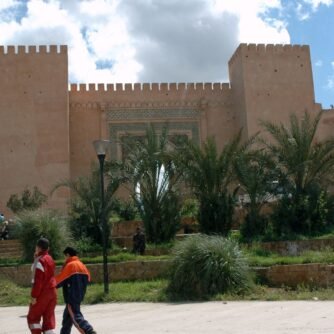
This organisation opened spiritual experience to all, in a society where two educational systems lived side by side: the médersa, primary, secondary and university, where one perfected one’s theological studies, the school of the intellect; and the zaouïa, the school of the heart. Zaouïa means the corner: in the mosque, when the people of obligation had made their prayer and were leaving, those who aspired to the third level stayed in a corner to invoke, until the next prayer. One day, historically, this corner left the mosque and built its own walls. There a spiritual guide appears, and an organisation around him, in which, from the very beginning, the place of women was important: this affinity between women and Sufism goes back a long way.
Madagh: the Secret that left and returned
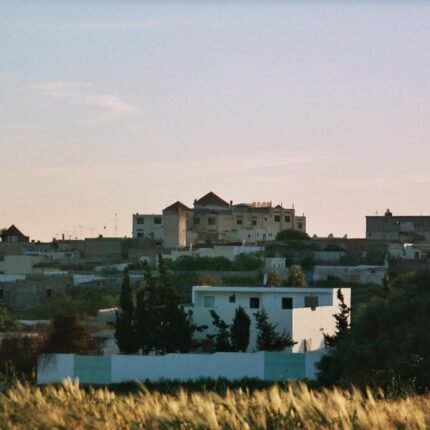
The ancestors of Sidi al-Hajj ‘Abbâs, who are those of Sidi Hamza, came from Iraq in the seventeenth and eighteenth centuries to settle in Madagh, in the region of the Beni Snassen. They came with the spiritual trust and the authorisation to give education. Now one of their ancestors, before dying, sought someone to whom he could pass on the authorisation and the Secret, as is done in all the paths. He found no one. To his son he said: you are not able to take the Secret, and there is no one here to take it. This Secret will return from where it returns, and the status of the Way will change: it will no longer be a path of living spiritual education, but a path of blessing, of tabarruk, until the day someone comes to give it new vigour.
That someone is Sidi Boumediene (al-Qâdiri Boutchich). Thirty-five years before he knocked at his door, Sidi al-Hajj ‘Abbâs was looking for a guide to lead him to inner knowledge. He went everywhere, even to one enraptured, a majdhûb. This figure, which the land of Islam recognises, needs to be defined anew: someone who has experienced divine proximity, but alone, without guidance, and who has not known how to return to the common world of responsibility. He remains enraptured, and the law itself exempts him. Foucault described the madman, he did not describe the enraptured one, for want of knowing him. So to the enraptured one, Sidi al-Hajj ‘Abbâs said: guide me to God. The enraptured one laughed: “Have you ever seen an enraptured man guide anyone to God?” And the other replied: “Have you ever seen anyone go to God guided by his ego?” Then the enraptured one laughed again and said: “Go home, look after your lands. A day will come when the guide himself will knock at your door.” Thirty-five years later, Sidi Boumediene, come down from the mountains of Tarjit, knocked at his door. He recognised him and took him as his guide, at the age of forty.
The father then entered ecstatic states so extraordinary that the young Hamza wondered: who is this man who has come to settle in my father’s house, to whom my father gives his lands and his goods, and who has come to drive him mad? One day when the three of them were together, the father asked: I have a vision to tell you, may I tell it in front of my son? And Sidi Boumediene: “Tell it. He is one of us.” Once the vision was told, the guide asked the young man to leave them, then kept him back alone with him. What happened between them no one knows, but when they parted, Sidi Hamza was transformed and had taken the pact. The pact is, in modern terms, enrolment in the school of the heart: I choose the guide who will lead me to spiritual knowledge, before realising, later, that it was he who had chosen me. And this detail is already a sign of the renewal: Sidi Hamza takes the pact at nineteen, when classical Sufism opened its door only after the age of forty, after trials, the patched robe, seclusion on stale bread. The disciple will even soften somewhat the rigour of his guide: with this renewal comes a passage from a teaching of rigour to a teaching of beauty.
From extinction to subsistence: the journey
The speaker then reads a passage from Sidi Hamza: “From 1942 to 1955, I stayed very close to Sidi Boumediene. I loved him very much. I was in admiration before the majesty of his deeds, his gestures and his words. Following the teaching of Sidi Boumediene, I lived the state of fanâ’, of extinction, then that of baqâ’, of subsistence. I also tasted extraordinary things of which I cannot speak, out of respect for the Law.” A very simple passage, worth its weight in gold for understanding the spiritual journey.
For this journey is a series of awakenings of consciousness. The first is discriminating consciousness, that of the man in the street, described as early as Junayd and Ghazâlî: I see a man, a woman, a glass, a tree, and I discriminate, superior, inferior, at best equal, but always fixed in my subjectivity. Through the guidance of a master and his tools, this consciousness is transformed and dissolves in the divine presence: this is the alchemy of the ego, bronze becoming gold. Sidi Hamza puts it in his own way: “The spiritual path is like a cabinetmaker’s workshop. The disciple enters it as rough wood and leaves it carved.” Echoing the sacred saying: My servant does not cease to draw near to Me through supererogatory acts until I love him, and when I love him, I am the hearing by which he hears, the sight by which he sees, the hand by which he grasps, the foot by which he walks. This is fanâ’, dissolution: what was lived by that saint of Algeria, Sidi Hadda, who called every visitor Sidi Hadda, man, woman, child or old man, so dissolved was his consciousness in the presence. It is also what al-Hallâj lived, even to the point of ecstatic utterances. And this is the limit that Sidi Hamza, a man of respect for the Law, marks: “I tasted things of which I cannot speak, out of respect for the Law.”
Then comes the third moment, which completes the journey: the consciousness of subsistence, baqâ’. I return to the world of differentiation, I recognise the man, the woman, the glass, the sky, but differently: God subsists in my inwardness, in my heart, and I am in the outer world. I can pay my taxes, take care of my family. The states and the stations, hâl and maqâm, are infinite: ‘Attâr made them the valleys of “The Conference of the Birds”, Moulay ‘Abd al-Qâdir al-Jîlânî described seven, Al-Semnouni ninety-nine, but they are without number. And whoever completes this journey may receive the authority to guide in his turn. As was the case with Sidi Hamza.
Sumnun al-Muhibb (also known as Al-Semnouni) was a celebrated Sufi mystic from Baghdad in the ninth century, called “the Lover” (al-Muhibb) because of his profound teachings on divine love. He was an eminent figure of early Islamic mysticism, associated with the tradition of asceticism and the path of pure love for God.