From the Meanings of the Spiritual Heritage to the Event of Fez
Sufi paths pass through delicate moments that reveal the essence of the Way and make its truth manifest. These are moments in which the meaning of Spiritual Support (Sanad) emerges as the Masters of education (Tarbiyah) inherited it, in which inner lights unveil themselves in those whose hearts have been purified and whose intentions have proved sincere, and in which the truthfulness of affiliation is put to the test, beyond mere formal belonging.
{أَحَسِبَ النَّاسُ أَنْ يُتْرَكُوا أَنْ يَقُولُوا آمَنَّا وَهُمْ لَا يُفْتَنُونَ} – (Do people think they will be left alone after saying ‘We believe’ without being put to the test?) (العنكبوت – The Spider, 2)
At such turning points, the scale rests neither on names nor on positions, not even on recommendations or allusions. It refers the wayfarer (salik) to a deeper and truer criterion: the Educational Breath (Nafas Tarbawi) that becomes established in hearts, and the Rectitude (Istiqama) that authenticates this breath and reveals its substance.
For spiritual heritage is not granted to the one who excels in speech, but to the one whose deeds bear witness. And the one whom Rectitude has not established at God’s door is not fit to carry the Secret (Sirr), even if words abound around him.
It is on this horizon that the station of Sidi Mouad Al-Qadiri Al-Boudchichi emerges, as heir to an educational breath that took shape in the presence of the grandfather, Sidi Hamza, that was confirmed with the father, Sidi Jamal, and that became manifest in his rectitude and his service, even before spiritual events and outward decisions came to attest to what had been established in the inner being over the years.

The Meaning of Spiritual Heritage in the Way
Spiritual heritage, among the people of Sufism, is neither a genealogical succession nor an organisational extension: it is a Secret transmitted through predisposition, purity and sincerity of wayfaring.
It is a gift of the heart whose reality is obtained neither through outward affiliation nor through material proximity, but through what the wayfarer prepares within himself by way of purity of intention, nobility of aim and excellence of conduct (Adab).
{إِلَّا مَنْ أَتَى اللَّهَ بِقَلْبٍ سَلِيمٍ} – (… the one who comes before God with a heart devoted to Him.) (الشعراء – The Poets, 89)
The more the heart’s predisposition grows and the soul is purified, the more its capacity increases to carry this Secret, which descends only upon the one who is truthful with God, inwardly as outwardly.
Spiritual Support (Sanad), according to the Sufi masters, is measured neither by number nor by visibility, but by what the Cheikh leaves in the hearts of the aspirants by way of light, serenity and rectitude.
What matters, then, lies not in the number of followers nor in the bustle of presence, but in the educational impact that takes root in hearts: a light that steadies, a serenity that reshapes and a rectitude that bears witness in favour of the one who holds it.
This impact is the sign by which the true Heir is recognised, for it is a trace that pretension cannot produce and that speech cannot fabricate.
When interpretations multiply and troubles (fitan) intensify, the wayfarer needs a scale to distinguish fleeting emotional brilliance from the true Light. This scale can only be the Educational Breath, inner purity and practical Rectitude, which express the sincerity of the journey.
Indeed, the Educational Breath gives the wayfarer the capacity for discernment, inner purity preserves him from confusion, and practical Rectitude makes his conduct a witness to his sincerity, so that he is deceived neither by a passing brilliance nor by an allusion that does not rest on a solid educational foundation.
The Education of Sidi Mouad in the Fold of the Chain (Silsila)
Sidi Mouad grew up at the heart of the Boudchichi experience, close to his grandfather Sidi Hamza and his father Sidi Jamal, may Allah sanctify their Secrets, amid the gatherings of dhikr (invocation), education and service (Khidma).
From his earliest years, he lived within the spiritual atmosphere in which the meanings of the Way were shaped, surrounded by the ambience of collective dhikr, the scenes of practical education and the presence of the Chuyukh from whom meanings are received before words.
He saw with his own eyes how obedience is given precedence over speech, how the unity of hearts is preserved despite differences of temperament, how disputes are kept silent and not reported, and how the fakir (the disciple) is educated in humility, good conduct and service of the Way in silence.
These daily scenes were so many living lessons planted in the soul with no need for explanation, for he learned there that the truth of the Way is a conduct that precedes the tongue, and a service that precedes speech.
This upbringing was an education through companionship and not through hearsay, a conduct of action and not of slogans: an education that the wayfarer receives from the states (ahwal) of the Chuyukh before their words, and from their constancy before their guidance.
That is why the Educational Breath and Rectitude became two intrinsic parts of his spiritual formation, not acquired later, but formed in the depths of his first experience within the presence (Hadra) of the Grandfather and the Father.
The Event of Fez… The Decisive Sign in the Course of the Sanad
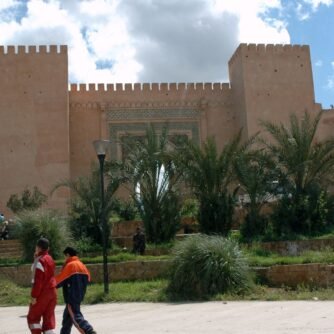
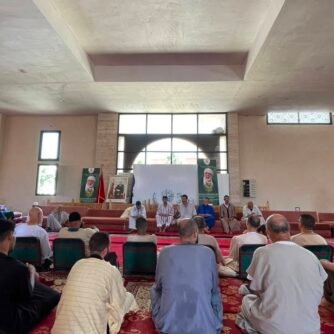
The event of Fez is considered one of the most important stages in which the meaning of the Sanad in the Way became manifest.
Sidi Hamza had travelled to that city in particular circumstances, seeking to remove all ambiguity, and the concordant testimonies after his return confirmed that he had come back with a new certainty concerning the station of his grandson, Sidi Mouad.

This event was not a formal proclamation, but a clear inner sign for whoever knows the Cheikh’s method of allusion (Ishara). Indeed, he disclosed only what had become established as light in his heart, and gave a sign only to the one in whom he saw purity, constancy and rectitude.
Since then, many disciples (fouqara) have considered that this event constituted a turning point in understanding the course of Spiritual Support within the Tariqa.