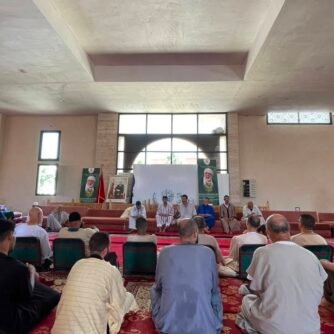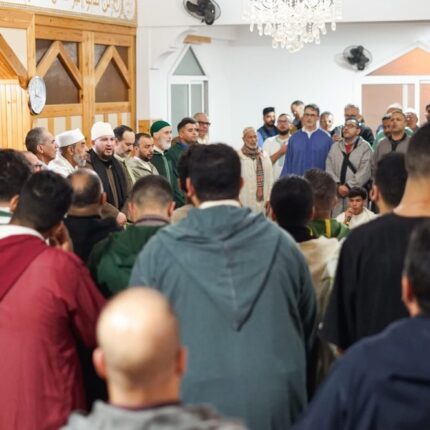
If samâ’, or “spiritual audition”, or “Sufi chant”, or again “qasâïd”, is a wine from which spirits drink, the ears are so many cups serving this divine intoxication. The prophet Abraham, to whom the angel brought the announcement of his acceptance into intimate friendship with God, danced for joy and above all from spiritual intoxication. Through this prophetic model, the tradition grounds this practice in that immemorial gesture which followed the visit of the Angel.
The hadîth of ‘Aïsha reported in the Sahîh al-Bukhârî is also cited, in which the Abyssinians sang and danced in the presence of the Prophet (peace and blessings be upon him). He merely asked “what are they saying?”, and was told: they are saying “Muhammad is a righteous servant”.
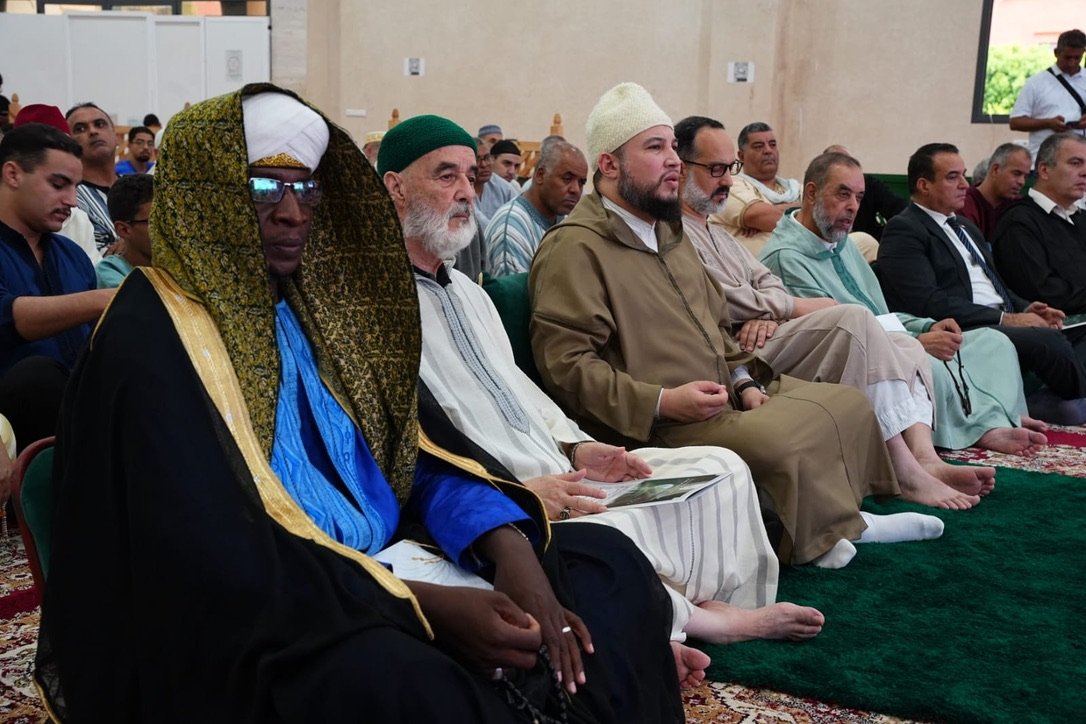
Sufi chant (qasîd) is a body of poems and songs composed, generally by way of inspiration, by the greatest saints of Islam throughout history. It is a sincere expression of the purest states of the heart. Its themes revolve around the love of God and of His prophet, trust in God, the utter need for Him and the various noble values that make up Sufi ethics. It is human expression, intoxicated with divine wine, in its purest and soundest image. It is generally sung in groups in mosques or in the brotherhoods. Sufi chants always carry educational messages for the wayfarer.
Asked about samâ’, Dhû-l-Nûn the Egyptian, an eminent Sufi master of the 3rd century of the Hijra (9th century), gave the following reply: “it is a messenger of truth (rasûl haqq), come to urge hearts towards God. Whoever listens to it as is fitting realises its truth, but whoever listens to it with his carnal soul is in heresy”. The temptation is great to retain from these poetic recitatives only a grasp quite external to the sacred trust that the poetic shorthand is meant to carry.
The practice of samâ’ is historically bound up with Sufi circles, energetic defenders of its collective use. The authors who set down in writing certain aspects of this tradition rely mainly on the authority of “the people of the Way”. Such is the case of the faqîh al-Hâyek of Tetouan: he bequeathed to us a collection, “Kunâch al-Hâyek”, in which he blends mystical poetry and music. From the prologue onwards, al-Hâyek evokes the wholly inward delight and the reward enjoyed by whoever does honour to samâ’. Moreover, he says, the good health of bodies is in turn dependent on its spiritual influx.
The cities of old tradition in Morocco, Fez, Marrakesh, Rabat, Salé, Tetouan, have managed to preserve this living practice to this day. Smaller towns such as Essaouira or Ouazzane take part in the same way and enrich the gatherings with the recitatives of mussammi‘s and musicians of talent on a national scale.
Samâ’, always regarded as a “noble knowledge”, is handed down by oral teaching. Assiduous attendance at the zaouïas (Sufi orders) within one city, and long journeys through the various regions of the Moroccan kingdom in search of those who hold the secrets of the art, confirm the aspiration to its craft. Despite the great heat of summer, there are some gatherings one could not miss: the great annual ceremony held at the end of July each year at the mausoleum of Moulay Idriss, on Mount Zarhûn near Meknes, is the rallying sign of the finest voices Morocco has, which vie in brilliance to celebrate the Mawlid of the Prophet in the form of samâ’ and madîh, recitatives in homage to the Muhammadan prophetic model.
In ordinary times, ceremonies are held regularly in the zaouiyas and at the tombs and mausoleums of the Awliyâ’ in Morocco. Furthermore, every Friday, it is not unusual to see a samâ’ group plan its day according to a precise spiritual topography of its city. The members of the group join the ceremonies held in different spiritual places of a city. For one who walks the medina of Marrakesh as a connoisseur, for example, the land of sainthood par excellence, the beautiful voices “that draw the bridle of the gaze” ring out from different places in the old city and accompany his steps.
We have mentioned the spiritual fervour that grips the medinas and their urban practices. Things are similar in the countryside: its inhabitants honour to this day an Islam that is broadly traditional. The moussems held annually in Arabic-speaking and Berber-speaking regions present themselves above all as the occasion to celebrate the venerated memory of the Sufi masters buried in a given region.
The poems sung within the brotherhood often come from periods very distant in time. Declaimed in the musical mode of a Moroccan-Andalusian nouba or in an Eastern mode, the theme of pure Love set against mercenary love can unite the luminous face of the great woman saint of Islam Râbi’a al-‘Adawiyya (9th century, Baghdad) with the throes of ecstatic rapture of Omar Ibn al-Fârid (Cairo, 13th century), known as the Sultan of Lovers.
A few verses further on, in the same didactic impulse, Abû Madyan (Tlemcen, 12th century). Performed by a choir in unison in the zaouiyas, this poetic material, with its originally profane accents, undergoes a radical transmutation. The newly acquired spiritual force is instantly absorbed into the general flow of the recitative. Nevertheless this poetry, whether of Sufi origin or not, in fact serves to adorn the customarily recited framework formed by the two poems: the Burda and the Hamziya of Imâm al-Busayrî. These two poems, composed in homage to the Prophet, have had an exceptional destiny in the Muslim world since the 13th century.
Terminology and Different Types of samâ’
In Sufi poetry one distinguishes:
- The poems known as “al-hadra” or “khamriyya”: poems of ecstasy, or of meanings (al-ma’nâ), or again of presence (with Allah). These are poems (qasâïd) that do not follow the rules and norms of Arabic poetry and are the pure fruit of Inspiration. Each poem (qasîda) corresponds to a state of intoxication or of presence with Allah. They are the speciality of the Sufis.
- The poems of “al-ahadiyya”, “Oneness”: these too are a Sufi speciality. Their subject is above all the love of God in the deepest senses and His beauty. They may be inspired or thought out, that is, belonging to the “san’a” (ingeniously woven on the basis of the rules of the art in the field, or of the ancient repertoires).
These two types of poetry are the fruit of a very high degree in the stations of divine Love. They are addressed to initiated Sufis who have tasted the savours of the divine presence. They carry subtle messages, of an educational order, which can only be understood and fully decoded and interpreted by Sufis.
- The poems known as “qasâïd muhammadiyya”: the Burda and the Hamziya of al-Busayrî are the two most famous examples in the Muslim world. They deal with the love of the Prophet, his beauty and his lofty rank. They may also be composed by gifted poets who love the Prophet.
- The poems known as “qasâïd madhiyya”, “in praise of the Prophet”: they form the most popular repertoire in the Muslim world, to which all the poets of Islam have contributed. They are not specifically the work of the Sufis, although the latter lie at the origin of the spread and popularity of this type of poetry. The “qasâïd madhiyya” proper to the Sufis are called “mawludiyya”. They refer to the birth of the Prophet of Islam and to the miracles concerning that great day. They are sung everywhere in the brotherhoods and the mosques throughout the month of the Prophet’s birth (the third month of the Hijri calendar, “Rabî’ al-awwal”). The night of the twelfth day of this month, corresponding to his birth, “Laylat al-mawlid an-nabawî”, is especially celebrated within all the brotherhoods of Morocco, with Sufi chants and “mawludiyya” sung by the finest voices of the kingdom.
Extracts from Sufi Poems
“An ecstasy whose fire is never quenched…”
Praiseworthy is my intoxication, lawful is the nectar
Al-Jîlânî — Roger Du Pasquier, Découverte de l’Islam, Paris, Seuil, 1984.
In which the vine and its fruit have had no share.
At the divine cup to which I raised my lips,
The single drop I drank stirs up in my soul
An ecstasy whose fire will never be quenched.
Love! When it reaches the heart of a lover
It makes the dark night become brightness for him…
Ibn Arabî
To your heart is revealed the One who has never ceased
to dwell in the inscrutable mystery of the Beginningless!
But it was you yourself who were the veil over your eye,
though this was by the very virtue of your divine likeness.
Then it appears to the heart that the One it sees
has never ceased to call it towards Him!
Thus came a Word, containing every Speech,
and its glory was made manifest by the Messenger of the Supreme Region!
O you who aspire to the degrees of the Abdâl
Yet give no thought to the works required,
Do not covet them in vain, you will be worthy of them
Only by vying with them through ascetic states.Silence your heart, and withdraw far away,
Far from all that keeps you from the Beloved Lord!
Keep vigil and endure hunger. Thus you will reach their rank,
And you will be like them, whether staying at home or setting out afar.The House of Sainthood has firmly established “corners”!
Our masters who dwell there are Abdâl.
Between Silence, Solitude, Hunger and Vigil,
Rises the summit of the Pure Transcendent.
Divine Love among the Sufis
For You I feel two kinds of love:
Râbi‘a al-‘Adawiyya
That of the passionate, and another because You are worthy of it.
The first, to call upon You apart from all else;
The second, to lift the veil that hides You from my eyes.
Tomorrow, when man and woman enter the assembly of judgement, faces will be yellow for fear of the reckoning. I shall come before You, holding my love in my hand, and I shall say: “my account must be judged by it”.
Jalâl al-Dîn ar-Rûmî
I scattered incense while uttering His Name,
Muhammad al-Harrâq (d. 1845)
Out of distraught love, in homage to His glory.
A breath arose, and made me know
That through the fragrance dwelt His essence.
Then I touched certainty
That in the universe there is none other than He.
Divine Intoxication
A sun, scarcely does it shine in the drinker’s mind,
Muhammad al-Harrâq (d. 1845), Moroccan Sufi master and jurist (faqîh) of Tetouan, known for his Andalusian noubas.
It makes him pure essence, with beings for names.
When the cup is clothed in its golds,
When bubbles make it a pearled necklace, the whole robe sparkles.
By experience, the Initiated know its burning.
From outside the jar not yet unsealed,
They can be made tipsy without breaking its seal.
Men of sense, in intoxication, know how to keep their grace.
None of them, in company, has shattered the cup nor yielded to straying.
And if others at times betray the secret,
The face and the reverse keep them from a misstep.
This lower world weighs on us when You are absent from us,
Abû Madyan, known as “the Succour” (Andalusian Sufi master).
And, moved by desire, our soul reaches out to You.
Death is Your distance, and life Your presence.
Should You leave us a while, at once we would perish.
You depart, we die; You come, we live;
And if there comes to us from You a promise to see You, at once we are reborn.
Failing to see You, we live on Your remembrance.
Yes, the memory of the Friends is our comfort.
Are Your signs absent, our heart perceives them,
Whether we be awake or given over to sleep.
The Beloved has unveiled my heart,
Chushturî (great Sufi, flower of Andalusia).
Imposing Himself, from within my being, upon my eyes.
He has removed from me the veil that I was,
And the world, my friend, has faded away for me.
None but I bore witness to His beauty;
None remained in my sanctuary but Him, contemplated.
Beauty appears only to the one
Who has thrown these two worlds into the bundle of his reason.
It is a living flame which, but for the mingling,
Chushturî
The Magi would never have worshipped.
Its purity is of a time
Before the vine stock and the grape.
It has no other half, and yet, in communions,
It reveals itself, as the bride is unveiled.
To it I was united in the first hour of time,
Before the page was blackened.
They have called it nectar, but it is also breath
Quickening souls with its exhalations;
And if its cupbearers stand in the customs,
Its lovers could not remain seated.
Behold, the fires of Laylâ appear,
‘Âïsha al-Bâ‘ûniyya
To lose your reason, friend, prepare.
The pure lover is the one who succumbs at a stroke,
Not the one who is stolen away little by little.
When beauty appears, lay your brow on the ground,
For thanksgiving is a duty, companion.
He saw the lightning in the East and fell in love with the orient;
Had it shone in the West, his heart would have chosen the occident.
For my love clings to that blaze;
To places and lands, it does not cling.
By Dr Tarik Abou Nour. Source: doctrine-malikite.fr.