Bismillâh ar-Rahmân ar-Rahîm, wa-s-salât wa-s-salâm ‘alâ sayyidinâ Muhammad wa ‘alâ sahbihi wa âlihi ajma’în.
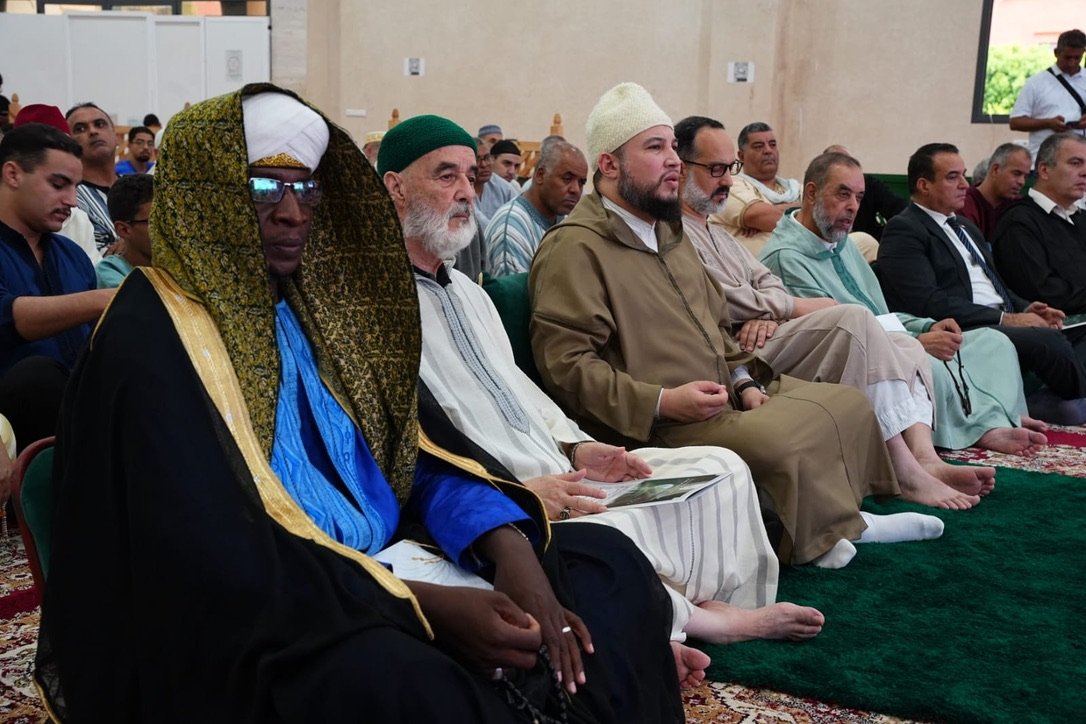
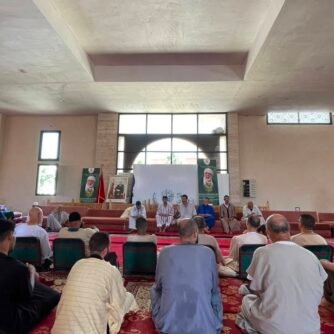
Lecture given by Daniel Abdel Haq Roussange during the month of Ramadan. First part. The second, devoted to the exchange with the audience and to questions of exegesis, is published separately. Transcript edited for reading by the editorial team.
It is Ramadan: welcome to you all, and I am glad to have an exchange with you. I hope you will ask questions, do not be afraid: monologues are always a little tedious. All the more so as we are going to speak of a living thing, the divine kalâm: one must oneself be alive to receive this thing. The Qur’an is not a text. We speak of sacred texts, but it is not a dead text, it is a text that lives and gives life. It is in this sense that the Holy Scriptures cannot be likened to other books or to other writings.
The subject is very vast: the question of the descent of the Qur’an, its revelation, that of the Qur’anic miracle, the i’jâz, that of the recension of the suras and their arrangement, the Qur’anic sciences, which are very numerous, tafsîr, the commentaries and exegeses, and the eminently important question of the link between the Prophet Muhammad, peace and blessings be upon him, and the Qur’anic word. Let us follow a plan so as not to lose our way.
A living and uncreated word
The divine word was the subject of a debate: was it created or uncreated? The word Qur’an comes from qara’a, to recite, to read. Some etymologists also relate it to a root that evokes the act of gathering. This debate of the third and fourth centuries of the Hijra ended in a consensus: the Qur’an is uncreated. The opposite opinion was discussed, then marginalised, and it fell into oblivion.
Second point: the Qur’an bears a multitude of names, and one also speaks of kitâb, the Book. But in its primary sense, al-kitâb does not necessarily designate a book as we think of it today: it is also prescription. The Qur’an says, God speaking of Himself, that He has prescribed mercy for Himself towards His creatures (Qur’an 6:12 and 6:54): in this sense, kataba does not designate a book at all. The proof is that the material gathering of the hundred and fourteen suras, in written form, bears another name: the mushaf, the gathering of the leaves. This mushaf has its own sacredness: in principle one should touch it only in a state of ritual purity, unless it is a part, a hizb for example, or a work of study on the text and its grammar, which is something other than ritual reading.
Ritual reading: light precedes understanding
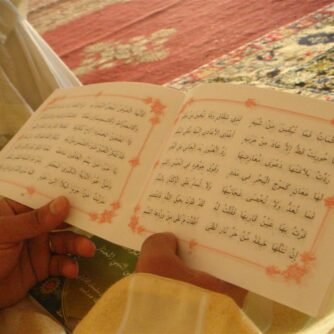
It is ritual reading, the tilâwa, that constitutes the principal act: the Muslim is nourished by this word through daily recitation, and it is prescribed to use verses of the Qur’an in the ritual prayer. The believer’s life is immersed in this reading. In the past one used to see people reading the Qur’an for hours on end, and this is still practised in the Sufi brotherhoods. Why does this ritual reading come before the understanding of meaning? Because a body of traditions teaches us that the Qur’an is a light, and that each letter is a light. Hence the need to respect each letter and give it its value. In a certain respect, the Qur’an can be likened to the first piece of music ever written down in history, and that is why it is chanted in accordance with the rules of the art of recitation, tajwîd, a science that is taught, to which is added the art of psalmody. Light precedes understanding: to recognise what is in a room, one switches on the light, and one makes things out.
That is why it must be said: telling believers who do not speak Arabic ‘do not read the Qur’an like that, you do not understand it’ is a serious matter. I have known Pakistanis who read the Qur’an a great deal without understanding it: one sees on their faces how this reading revives them, how it illuminates them. On the other hand, there is real presumption in wanting to say ‘I understand the Qur’an’. One does not understand the Holy Scriptures straight off. If one wants to understand the theses of an astrophysicist, one needs training, a background, a vocabulary. For the Scriptures, it is the same. Yet a number of people, without knowing the Qur’anic sciences, of which there are eighty-six according to Imam Suyûtî, claim to bring together the interpretation of the Qur’an and impose it on others, or hold it against the Qur’an. When a philosopher, who does not stand on the side of Islam, sweeps aside in three words centuries of exegesis, of scholars and of theologians, it is extremely serious for our time: it plunges into darkness and disorder, and fundamentalism feeds precisely on this vein. All understanding is made to be surpassed: what one understands one day is no longer true the next, and it is by nourishing themselves on the Scriptures that believers reach that degree of inner perception called basîra, the clear sight of the heart.
A universe: nothing has been left out of the Book
Those who have living experience of it, the Sufis in particular, say that the Qur’an gathers all the divine and cosmic truths and realities: the Qur’an is a universe, the ocean of truths.
“All the creatures that crawl on the earth and those that fly with their wings are communities like yourselves. We have missed nothing out of the Record- in the end they will be gathered to their Lord.”
Qur’an 6:38
The Qur’an is perceived, and this is how it must be understood overall, as the very universe made manifest. That is why it is said to be the second revelation, the first being the creation of the world, sometimes envisaged in Islam as a divine breath that produces beings and the degrees of the universe through the very production of letters. The Qur’an is made up of âyât, a word that means both verses and signs: the verses can be likened to individual beings, the letters that compose the words to the constitution of beings, the suras to worlds. God Himself describes Himself as Rabb al-‘âlamîn, the Lord of the worlds, and the Qur’an itself is the universe.
The tanzîl: a descent in two stages
The descent, the tanzîl: more than three hundred occurrences derive from the verb nazala, to descend. It truly is the term that keeps recurring, and this insistence speaks of the richness of this descent. According to the commentators, Ibn Kathîr among others, the Qur’an descended from the Preserved Tablet, al-lawh al-mahfûz, to the house of might, in the heaven of this world: a descent described as single and synthetic, jumlatan wâhidatan. Then it was revealed again, over a period of twenty-three years, according to circumstances, in response to the requests and needs of the nascent community: these are the asbâb an-nuzûl, the circumstances of revelation, knowledge of which is necessary for all exegesis. The Preserved Tablet symbolises the place where God inscribed the knowledge of all beings and the whole of the realities of the universe. There the Qur’an is called Umm al-Kitâb, the matrix of the Book, which is with God.
What is very important is to understand that the divine discourse is not an abstract discourse: it is set within the human reality it addresses, for God speaks to people through a prophet who shares their constitution. The Qur’an itself indicates this: every community has had its messenger, no one has been forgotten. An anecdote recalls this with humour: missionaries who had come to China to announce that God is infinitely good and merciful were answered by the emperor: if your God is infinitely good, how is it that he left us so long in darkness? All the monotheisms affirm that every people has received a message, and one tradition even speaks of a hundred and twenty-four thousand prophets. It may simply be that this message, in the modalities of its reception, is other than what I have called a tanzîl.
The role of mediator is held by the angel Jibrîl. The first revelation is an absolute cataclysm: the angel fills every horizon and communicates the first verses of the famous sura that begins with:
“Read! In the name of your Lord who created.”
Qur’an 96:1
Now the Prophet does not know how to read: and here a first word alludes to reading, and above all to writing, a considerable novelty in the world of a people of complete orality, who do not know writing. Revelation, when it is given to a messenger, must be understood as a cataclysm that overturns the entire inner being. Faced with this cataclysm, the Prophet was distraught. His doubts were real, because he is also human: is this the divine word, or something else? The revelations were sometimes announced by the vision of the angel, sometimes by the sound of a bell that was very painful to him. The companions saw his weight increase, phenomena out of the ordinary. He shared his doubts with his wife, he had only one wife at the time, Khadîja, who was convinced of his prophethood, just as it had been recognised by that relative of Khadîja versed in the Scriptures, who knew the signs of prophethood. And here, an essential idea: nothing happens without human beings taking part, for they are the receptacles of what descends. Khadîja suggested to him: let us withdraw and enter into intimacy. If you still perceive these presences, they are not angels. If they are angels, they will withdraw. Beings of light, all civilisations say so in their own way, leave places of conjugal intimacy. This is how she offered to reassure him: from the very beginnings of revelation, the members of the community play their part, and the divine discourse is set within human realities. This is important for exegesis.
The names of the Qur’an: the Reminder, the Discernment, the Imâm
To say what it is, a clear proof for people and a mercy, the Qur’an has a great number of names. Tradition has counted fifty-five, and more can be found: al-Karîm, the Generous, al-Majîd, the Glorious… Others are of the utmost importance for exegesis. The Qur’an is called adh-Dhikr, the Reminder:
“We have sent down the Qur’an Ourself, and We Ourself will guard it.”
Qur’an 15:9
Dhikr means to remember, but also to recite, to invoke: a direct allusion to recitation and to the ritual use of the text. In the Sufi brotherhoods, all the invocations have a Qur’anic origin. And the Reminder alludes to an original state: the Qur’an explains that all beings, before they were created, while still pure spirits, were brought to bear witness to the divine Lordship:
“[Prophet], when your Lord took out the offspring from the loins of the Children of Adam and made them bear witness about themselves, He said, ‘Am I not your Lord?’ and they replied, ‘Yes, we bear witness.’ …”
Qur’an 7:172
The Reminder, in this very strong sense, is what has been given to man so that he may recover his original state, his true Adamic status: divine proximity. Hence this other name, al-Hudâ, the Guidance, and the Qur’an as a mercy for people. Another name of the utmost importance: al-Furqân, that which separates, the Discernment between the things man must follow and those he must avoid, between the true and the false even more than between good and evil. The Furqân accompanies the prophetic mission: there are those who answer the call and those who do not, and this is the aspect of rigour, jalâl, always included within mercy. Finally there is this extremely curious name: al-Imâm al-Mubîn, the evident Imâm. The imâm is the one who stands in front and leads the prayer, the one whose advice is followed: the Qur’an is an imâm, and this name establishes the link between this text and life, between this text and man. For the Qur’an contains the whole of realities, and the universe in its totality is conceived as having a brother, the perfect man: this is the correspondence between the macrocosm and the microcosm, which the monotheistic traditions cover when they speak of man made in the image and likeness of God. Let us not forget this famous hadith: when ‘Â’isha was asked, after the death of the Prophet, what his character was, she answered: his character was the Qur’an. Some scholars have interpreted it thus: the Messenger was the brother of the Qur’an. The Prophet is said to be ummî: he can neither read nor write, untouched by any human knowledge, receiving absolutely everything from God, a pure receptacle of the divine word, so that this word should run no risk of being tainted by prejudices, preconceived ideas or passions.
The Qur’anic miracle: the language
The revelation of the Qur’an has a medium, a language:
“We have sent it down as an Arabic Qur’an so that you [people] may understand.”
Qur’an 12:2
One must always take into account the milieu into which revelation descends: a Bedouin milieu, organised along tribal lines, with a strong centre, Mecca, its oligarchy, its pilgrimage rites around the Kaaba, which goes back to Abraham, its idols, its lucrative caravans between Yemen and Syria. The first Qur’anic message reaches the Meccans, who understand at once: it is the destruction of the established order, the return to oneness, the dismantling of the tribal order. Hence a very strong hostility. Now among these Bedouins, the first value is language, which is oral: they have an unimaginable mastery of their own language, they cannot be mistaken. They organise contests where the notables of each tribe come to declaim poems, and pre-Islamic poetry, the mu’allaqât, is of a level of language that is truly unheard of. It is in this respect that the Qur’anic miracle imposes itself, just as in the time of Moses Pharaoh’s magicians had to be confounded on their own ground. The Qur’an itself issues the challenge:
“If you have doubts about the revelation We have sent down to Our servant, then produce a single sura like it…”
Qur’an 2:23
“Say, ‘Even if all mankind and jinn came together to produce something like this Qur’an, they could not produce anything like it, however much they helped each other.’”
Qur’an 17:88
A people proud of its language, which cultivates it as its essential value, finds itself confounded, convinced in the etymological sense, by the degree of perfection, harmony and boldness of this language. Those who do not yield do so because they are thinking of their interests and of the business they will lose. Attempts will be made to take up the challenge: they are doomed to failure. An important point, rarely stated: in one hadith, the Prophet alludes to his lineage and to the purity of his language. But in another, he indicates that revelation was accompanied for him by a descent of language itself, as if the Arabic language had been given back to him with the Qur’anic word, in a genius that had become entirely new. That is the Qur’anic miracle: a people who know their language better than anything find themselves before something unheard of, which convinces them.
Lecture by Daniel Abdel Haq Roussange. The second part, devoted to exegesis and the exchange with the audience, is published separately.