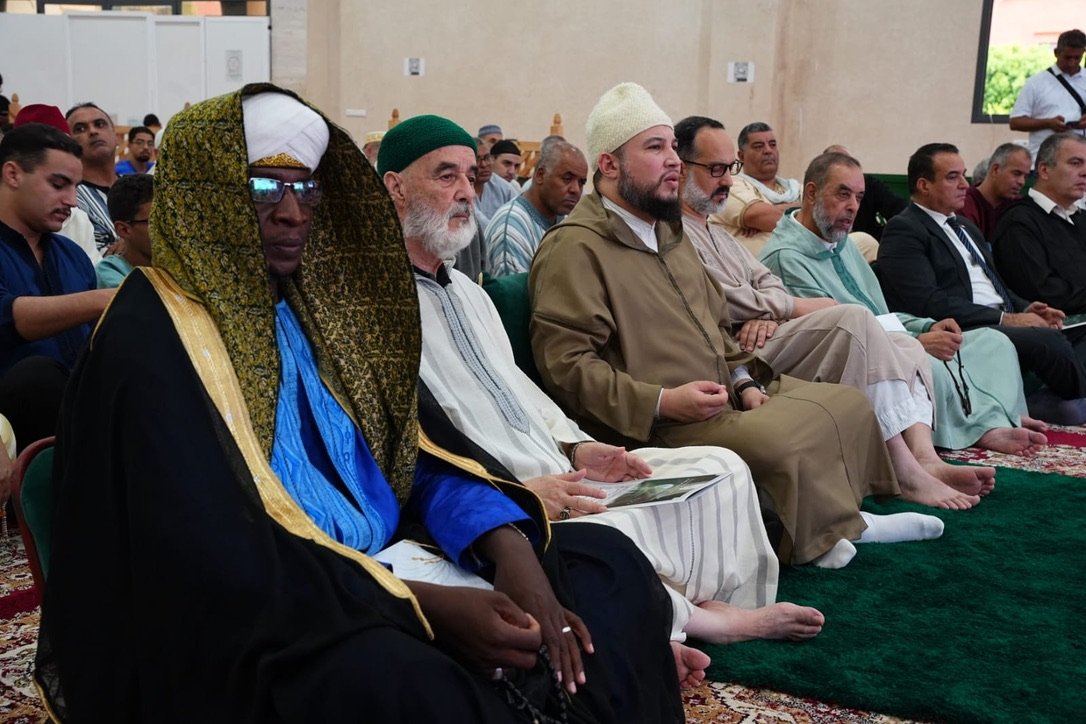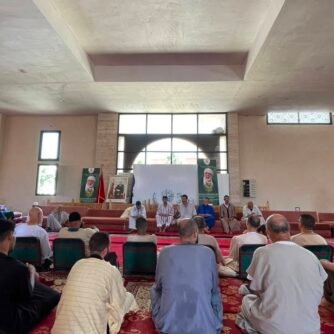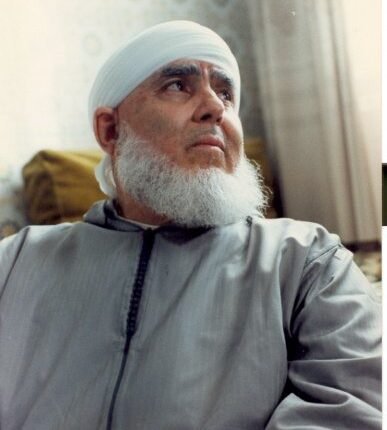
Transcript of the lecture “The teaching of Sidi Hamza” given by Sidi Karim Ben Driss, sociologist, director of the Institut Soufi de Montréal and author of the reference study “Sidi Hamza al-Qâdiri Boudchich, le renouveau du soufisme au Maroc”. These words were spoken during the lifetime of Sidi Hamza, may Allah sanctify his Secret. This part, the heart of the lecture, presents the three fundamental aspects of the renewal. Further parts will follow. The text follows the speaker’s living word. Adaptation: the editorial team.
First aspect: the reversed quest
The Sufis of the earliest times created a science out of their experience: the mahabba (love), the unveilings, the station (maqâm), the spiritual state (hâl). And at the centre of this vocabulary, a fundamental pair: the murîd, the disciple who aspires, in quest of the murâd, the Goal, that is to say God Himself, towards whom the quest tends. This pair was crystallised according to the quest of the time, then set down on paper. Yet modern conditions are different, and Sidi Hamza, in his drive for renewal, reverses the pair: instead of the disciple going to seek the guide, it is the guide who goes to seek the disciple. It is not you who come looking for me, he says, it is I who will go looking for you.
The classical corpus of Sufism abounds in accounts of the old quest: the man or woman with a bundle, a bowl and a staff, going from village to village in search of a spiritual guide, until a stranger, in Mecca or in a distant mosque, mysteriously tells them to return home, for their guide is there. But about the reversed quest, which only begins with the renewal, almost nothing has been written: until 1972, it did not exist. Its traces lie in the living testimonies of those who experienced it. I was asleep, I saw someone calling me. I was sitting down, someone came and took me by the hand to bring me to an evening of invocation. There would be, the speaker notes, a real field of study here: asking people how they met this guide who, for his part, had come to seek them.
Second aspect: the three levels open to all
In classical Sufism, the first two levels of religion, practice and doctrine, were taken for granted: society carried them, and whoever aspired to more sought the third. This is the whole story of Imam Ghazâlî: having perfected his intellectual and rational level, he falls into an existential doubt that leads him to seek this third level. He leaves behind honours, the chair at his university, his family and his possessions to find a spiritual guide, and returns ten years later, transformed, leaving the community his “Revival of the Religious Sciences”. Yet, says Sidi Hamza, today we have lost all of this structure: the first level, the second and, of course, the third. So he opens the doors and rebuilds everything from the beginning.
The Way has thus become universal, kawniyya, which may be translated as cosmic: the doors are open, to the Muslim and the non-Muslim alike, to rebuild everything from the start. Rebuild what? My relationship to the Law, my relationship to thought, my intuitive experience. And the Law that is then revealed is an interiorised law, made to measure, not the off-the-peg garment of Mr Everyman. Without even speaking of law, the guide calls to invocation in order to purify the heart, and the purified heart becomes sensitive to the world like a radar. It becomes that freshwater fish which, as salt water approaches, moves away from it of its own accord: when my heart senses things contrary to my inner being, I move away from them, and when what I eat is not of the order of the lawful, my body senses it. It is through this interiorisation that one rediscovers what is called the sharî’a, over which so much ink is spilt today precisely because it is perceived from the outside. Perceived from the outside, is it still the Law we are speaking of, or a figment of the mind?
Third aspect: the tastes before renunciation
In classical spiritual education, the guide placed the aspirant in seclusion: five or six years of renunciation, and only at the end did he give him the invocation, and his heart was illuminated by the tastes. For there are spiritual tastes: just as the unlawful world has its own, the world of the divine Presence has its own, simply veiled until one experiences them. Sidi Hamza reverses this pair too: he puts the tastes first. As soon as the disciple enters the Way, he receives the dhikr, what the other type of guide gave at the end, and he is seized by the tastes from the very entrance.
The adage says that the Sufi is the son of his time, and Sidi Hamza is so even in his language, woven from daily life. Even in the name he gives his disciple: the faqir, the faqira, the poor one, not materially but in God, the state of inwardness and humility towards which one journeys. Each path names its disciple after the state to which its guide leads him: with Jalâl ad-Dîn Rûmî, the dervish, humility. In the Tijaniyya, the murîd, the ardent desire for knowledge. Here, the poor one in God.
Illumination first, then, and Sidi Hamza puts it with an image: when you want to tidy a room, the least you can do is switch on the light. With the light on, you see what is in disorder and what needs to be done. From the entrance, a little invocation, and one feels this illumination through the tastes: things one feels, sees, hears, or simply an energy, the nashât, this well-being. Then one goes out, it lasts a day or two, it fades, and one comes back to seek the Presence: it is in this coming and going between the outer and the inner that spiritual education takes place. Renunciation comes all the same, at the end, but ripened by experience: like the child who has put his fingers in the socket and never does so again, it is my own experience of the Presence and of its loss that guides me, with no one standing over me with a stick to tell me what to do.
Sidi Hamza teaches it through another image. When you invoke, together or alone, you go in search of Presence, and this Presence, Sufism symbolises by honey. Your body is the vessel of this honey: if it is split open, you lose it. So seal your vessel. This is a work of vigilance: I am clear, happy, in an extraordinary state of well-being, then three days later I feel unwell. Why? I retrace my journey: where was I, with whom, what place? And repeated experience makes me certain: I no longer go back to that place, I go where I keep the Presence.
These are the three fundamental aspects of what is called the renewal of Sufism: the reversed quest, the three levels open to all, the tastes before renunciation. The tools of this renewal, invocation, spiritual audition and companionship, will be the subject of the next part.