Bismillâh ar-Rahmân ar-Rahîm, wa-s-salât wa-s-salâm ‘alâ sayyidinâ Muhammad wa ‘alâ sahbihi wa âlihi ajma’în.
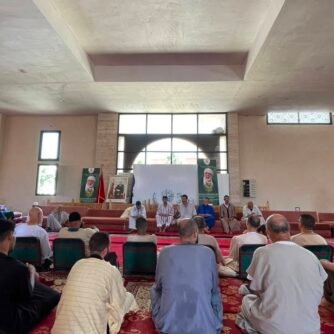
Lecture given by Daniel Abdel Haq Roussange under the title “The spiritual master”. Transcript revised and edited by the editorial team. The speaker’s voice, his line of thought and his examples have been faithfully preserved.
A living reality
Dear friends, I am glad to share this moment with you. As I say every time, I am not the one who knows, facing those who listen: we all need to learn, every day. The subject that brings us together, the spiritual master within Islam, can be a contentious one, and it is not usually broached so easily before an audience. But it must be addressed today, perhaps precisely because masters are rare.
What matters to me first is this: the living path in Islam, whose heart is the spiritual master, the murshid, the guide, is a living reality. Sufism itself, tasawwuf, is a living reality, and not merely a spiritual science belonging to a time gone by. Everything in Islam is founded on the shahâda, on lâ ilâha illâ Llâh: both the outer aspects of the religion, represented by the law, the Sharia, and its inner aspects, represented by the science of Sufism. It must still be understood that Sufism is not merely a science: if science is its theoretical aspect, it is also an experience, what the Sufis called a taste, the dhawq. In the Islamic universities and the madrasas, the ulema themselves, those who had to deal with questions of jurisprudence and to derive legal norms from the Qur’anic rulings through ijtihâd, also received this teaching: in Morocco, many ulema bear witness to this in different periods.
Read on this subject: Ash-Shâtibî’s readings on Sufism and the Sufis
The idea that the Way will always remain alive rests on a considerable number of traditions. In the authentic collection of Muslim, in the chapters dealing with the fitan, those events and signs heralding the end times, there are hadiths that answer an objection often heard: Sufism and spiritual masters belong to the past, they no longer exist. Yet the tradition says, according to one of its versions:
A group of my community will not cease to be upon the truth, in the Maghreb, until the command of God comes.
Hadith reported by Muslim
There are a good ten versions of it, some of which mention the Maghreb, the West, and others not. And Imam al-Qushayrî, one of the founders of the Sufi science, in any case the first to have set it out explicitly in a famous Risâla, writes that at no moment in human history will a spiritual guide be lacking. Why? Because to imagine that the spiritual path ceases to be followed, or ceases to be possible, would amount to setting a limit on divine mercy, a limit on divine power, even if present conditions, and many events of recent decades, may lead some to think that all this is over. It is absurd to set such a limit: limitation lies on the side of creatures, not on the side of the Lord.
The law opens, it does not close
Tasawwuf is the science of tawhîd, of oneness, on which everything is founded: all the practical modalities as well as all the spiritual modalities given to the believer for the journey. And the law, this Sharia that is so much talked about, so much debated and unfortunately not always understood, itself has as its fundamental vocation to guide the believer on this path. Through the rites, the ‘ibâdât, it creates in us a disposition to return to our original nature, our first nature, the fitra. Such is the very function of the rites in our tradition: a bringing into conformity with what is ours. The law is something that opens and does not close, that includes and does not exclude.
The spiritual path, the tarîqa, can then be defined simply: outwardly, conformity to the law, and inwardly, conformity to the prophetic model, for the Messenger of God is, as such, the first spiritual guide of the community. Its end is purification: tazkiyat an-nufûs wa tasfiyat al-qulûb, as the Sufis said, the purification of souls and the clarifying of hearts. The organ of knowledge, in Sufism, is the heart: the principial reality of man, a subtle reality, behind which stands an immense science. It is this heart that must be purified, and this purification in itself constitutes the journey and spiritual realisation. Everything in the universe, moreover, has a heart. According to a reported saying, the Qur’an itself has its own: Yâ-Sîn.
This purification is expressed by a Sufi poem in a single line: are you seeking Laylâ, when she is manifest within you? You take her for another, and yet she is none other than you. Laylâ, in Sufi poetry, symbolises the Truth. The line alludes to the fact that purification is in reality a stripping away: a stripping away of supposed knowledge, of bad habits of mind, and of all the ills that afflict the soul, greed, jealousy and the like. The state aimed at has a name: ‘ubûdiyya, servanthood. According to a famous hadith, the angel Gabriel asked the Prophet whether he wished to be a servant-prophet or a king-prophet, as Solomon was, and he replied that he wished to be a servant-prophet. Servanthood does not designate here a mere outward conduct of service: it is also the spiritual degree, the maqâm, that goes with this attitude, and it requires a journey, an effort, a concentration. It is at the end of this purification, if one can speak of an end for a path that truly has none, that Laylâ rises in the heart of the believer, of the wayfarer, as the sun rises on the horizon.
The three conditions of a verse
Before coming directly to the master and his function, a Qur’anic verse sums up both what has just been said and what follows:
Believers! Fear Allah and seek the means to come near to Him, and strive hard in His way; maybe you will attain true success.
Qur’an 5:35, tr. Maududi
This verse indicates the indispensable conditions for following a spiritual path. First, taqwâ: fear God. Elsewhere the Qur’an speaks of “the garment of God-consciousness”, libâs at-taqwâ (Qur’an 7:26): an allusion to a commitment in deeds and in spirit, carried by strong determination, an intention, a motivation, as for any project one wishes to bring to completion. Second, seeking the wasîla: the “means” that connects you and allows you, literally, to arrive, the one called in Morocco mûl al-waqt, the master of the time. Third, striving in His way: the jihâd in question here is the struggle against the passions of the soul. As for the “perhaps” at the end of the verse, it introduces no uncertainty: it alludes to the fact that it is God who gives. The path requires effort, concentration and struggle, but no result is acquired in it except as a divine favour. The Sufis say it: this Way is that of the spiritual state. You do not understand it through reason, you do not attain it through deeds. It is a divine favour.
Who is the wasîla? According to a certain way of interpreting the verse, it may designate the cheikh. It designates of course, first and foremost, the Prophet peace and blessings be upon him, and it is legitimate, from the point of view of the scholars of the law, for it to designate the Qur’an. There is no contradiction in any of this.
Is a master needed? An old controversy
The question of the master has always been a subject of controversy. A famous controversy took place in Andalusia, in the time of Ibn Khaldûn. I mention it without going into detail, for it would take us the whole afternoon. Its interest is twofold: it took place within the spiritual paths of the time themselves, among fuqarâ’ (disciples), and the question asked was exactly ours: is it necessary to have a cheikh to follow the Way? Several answers were given, including that of Ibn Khaldûn himself, who was not a Sufi, in a book now translated into French, the Shifâ’ as-sâ’il. But the most authoritative answer is that of Ibn ‘Abbâd of Ronda: for the prestige he enjoys in Morocco, for his presence in certain initiatic chains, the salâsil, and because he was a master of considerable influence, in spiritual education as well as in teaching.
Ibn ‘Abbâd distinguishes two types of master, which were a source of difficulty at the time: the cheikh of teaching, cheikh at-ta’lîm, and the cheikh of education, cheikh at-tarbiya. Only those who carry out tarbiya are masters in the sense we understand today. Tarbiya comes from a verb one of whose nouns is Rabb, the Lord: it expresses bringing a thing to its perfection, refining it, but also making it grow, building it up as one builds a building. The symbol is important: if, according to the hadith, Islam is built on five pillars, to educate a man is to build him.
This cheikh of tarbiya, he and he alone, truly holds the keys of knowledge. For true science is not in books, perhaps it is not even in verbal teaching: it is in the breasts of men. This science is called the science of unveiling, ‘ilm al-mukâshafa, and it is expressed outwardly as a science of conduct, ‘ilm al-mu’âmala: this is the degree of ihsân, the degree of tasawwuf. Abû Yazîd al-Bistâmî would say, provocatively, to scholars who had come to see him:
You took your science from a dead man who had it from a dead man. We took our science from the Living One who never dies.
Abû Yazîd al-Bistâmî
It is here that the necessity of the master asserts itself: one can learn tasawwuf from a theoretical point of view, but if one wishes to experience it from within, one must follow a guide. The Qur’an alludes to this in a verse often cited in this connection: “The Beneficent! Ask anyone informed concerning Him!” (Qur’an 25:59, tr. Pickthall). If you wish to know Him, turn to the one who knows, to the expert, as one would say in modern language, to the one who is well informed: al-Khabîr is also a divine name.
The physician of hearts
The first general designation of the master is that he is tabîb, physician: tabîb al-qulûb, the physician of hearts. A knower who has the capacity to guide, and who knows the diseases of the heart, all those things that settle in it and veil divine reality from us. Saint Râbi’a al-‘Adawiyya says in a qasîda: He is apparent to us, but it is our soul that hides us. Divine truth is apparent, the obstacle is our soul. The master knows these diseases, these infirmities, these afflictions, all these terms are used. He has the capacity to give the remedy, and he also knows the means that preserve, all along the journey, the balance and integrity of the wayfarer, for the spiritual path is a difficult road, with, as for the travellers of old, its traps, its dangers and its obstacles.
In this connection, our master Sidi Hajj Abbas, the father of Sidi Hamza, may Allah sanctify their Secrets, one day received a visit from great scholars. He was old, his head bowed, and he almost never spoke. Hundreds of people came to him, and these scholars said to one another: what can they possibly find in this man? Sidi Hajj Abbas, who had not heard what they said, then raised his head and addressed them directly: dawâ’ al-qulûb, the remedy of hearts. That is what they come seeking: the healing of hearts.
This healing of the heart is nothing like a wonder to be understood as an exceptional phenomenon: it is a journey. As in the order of outward medicine, each has his difficulties, and each must receive an appropriate treatment. A disciple once said to his cheikh, after fifteen years: Cheikh, I see my brothers, they have progressed, I see the fruits of their journey, but I have not moved from my place. And the cheikh replied: you, if you changed in an instant as much as in these fifteen years, you would not bear it. On this path, we cannot judge for ourselves where we truly stand. If one were able to judge one’s own journey, one would have no need of a master. It is a well-known trap.
The educator: the himma, the gaze, the bringing to life
The second quality of the master is the function of tarbiya, of education. Educating masters are called murabbî and ma’dhûn: educators and authorised, we shall come back to this. The educating master has an exceptional quality: he is the Muhammadan heir, the truthful, as is said of Abû Bakr as-Siddîq. Truthfulness, sidq, is the spiritual degree of this inheritance.
No lordship without servanthood, and no servanthood without lordship. This saying also alludes to what spiritual realisation in Islam properly is, described as adorning oneself with the divine qualities. The servant is clothed in them when he is perfectly established in the station of ‘ubûdiyya: falsehood is then covered by truthfulness, hypocrisy by sincerity, greed by generosity, ignorance by knowledge, and so on. There is, as it were, a permutation of attributes in man. The Sufis said: the attributes of the Beloved exchange places with the attributes of the one who loves. As in a couple where love is strong, the qualities of the one pass to the other, each of course keeping his own identity. It is not a fusion, it is this exchange. Every human quality, truthfulness, loyalty, generosity, is truly such only if it is the reflection, in the human world, of a divine quality. And this is what the saying of the Prophet makes explicit: I was sent to perfect noble character. These qualities were put into practice, and borne in the most excellent manner possible, by the Messenger of God, sallâ Llâhu ‘alayhi wa sallam.
The modalities of this education are endless. The first is the exercise of what is called the himma: the spiritual energy proper to the cheikh, which he has the faculty of projecting onto his disciple, whether in his presence or not. Just as a schoolteacher, in the order of school matters, had the faculty of motivating his pupil and making him better by giving him the energy for effort, so the master works, but in the subtle and spiritual order. What makes this himma effective is that it emanates directly from the Spirit: every spiritual master is bound indissolubly to the Muhammadan spirit, the source and origin of this energy. That is why it is said that a cheikh is an educating cheikh not because he has great mental skill, nor even a penetrating intelligence, but because he changes beings subtly, quite simply through his presence, or even more through his gaze, the nazra, for the gaze is very important. When one is in the presence of the true cheikh, a peace spreads, fills us, drives all worries away from us. A peace that is neither made explicit nor expressed, and behind which lies hidden the fact that hearts, in that instant, are illuminated.
A Sufi of the East said, to show this power of bringing to life: if the master taught a dry branch, buds would be seen to appear on it and green leaves to burst forth. That is the whole difference between the cheikh who teaches and the one who educates: the one who teaches does not have this grace. A contemporary master compared this bringing of hearts to life to irrigation: the master is the water, he said, this water of the Secret that brings hearts to life, and this water, in the manner of irrigation channels, needs people to conduct it and spread it, as far as they are able, to the four corners of the earth and to the most distant lands. These are the disciples: there is no cheikh without disciples, and the disciples extend outwards, in a certain way, the function of the cheikh.
Father, mother, elder brother
Let us come to the relationship between master and disciple, from a perhaps somewhat surprising angle. The first face of this relationship is spiritual fatherhood. It is found in the model of ancient India, where the guru exercises this same function, and it has the same meaning in Islam: to exercise a spiritual fatherhood.
What does this mean? Spiritual fatherhood is a sowing, an engendering, what is sometimes called the second birth. This engendering has a beginning, as when one puts a seed in the ground: the moment when the cheikh gives his hand to his disciple, and it matters little whether it is the hand or not, communicates to him the spiritual influx and attaches him to the path of which he is the representative. This may happen through a simple gaze, and it may even be that the disciple is not fully aware of it at first, but there is generally a formal rite: giving the hand, and taking the path, as they say. This role continues in the irshâd, guidance: the cheikh, through his real or subtle presence, holds as it were his disciple’s hand all along the road, and exercises over his states a still more subtle oversight, a preservation.
A very simple image: God holds the tea, the cheikh plays the role of the teapot, and the disciples receive the tea each in his glass, each according to his capacity. The gift is made in the measure of the vessels, says a famous saying. The disciple cannot receive this light directly from God: a mediator is needed, who moreover has the same role as the Messenger of God when he says: I am only a distributor, and it is God who gives. Such is the cheikh: he receives, and he transmits. Cheikh Hamza once said: the cheikh is like the porcupine. The porcupine is an animal with a strange reaction: when presences come around it, it swells up, then sends out its quills. A surprising image, but a telling one: the one who fills himself with what he receives, and projects it around him.
But the cheikh also has, in many authors, a maternal function, directly linked to tarbiya: educating is compared to suckling. The cheikh is like a mother suckling her child. This is moreover one of the derived meanings of the term tarbiya (spiritual education), and it touches on a known question of sulûk (the journey), seldom spoken of, that of the râbita (bond) and of orientation, the tawajjuh. At the same time, this tarbiya is a weaning of the soul: the milk that feeds the disciple must take the place of everything he used to turn to before, the things of the world, the milk of the world, tainted milk. And the cheikh says: take my milk, none other than I can educate you. The Burda says it in a famous line:
The soul is like a suckling infant: if it is left to itself, it will want to suckle into adolescence. If it is weaned, it gives it up.
Al-Busîrî, the Burda
This weaning, in both senses, is linked to practices more or less institutionalised in Sufism, including the khalwa, the spiritual retreat: one withdraws, in nature in the past or in a cell, one cuts off relations with the world as far as possible, for retreats of seven, nine, twenty-eight days, at most forty.
Cheikh Hamza, in his youth, at a time when his practice of the Way was already very advanced, had a vision one night: he saw beside him a woman dressed all in black, bound with ropes, unable either to speak or to move. Astonished, he reported the matter to his cheikh, Sidi Boumediene, may Allah sanctify their Secrets, who said to him: these are the angels announcing to you that from now on your soul will be like this woman in black, it will be bound, it will no longer be able either to move or to express itself.
The cheikh is also, towards his disciple, like the big brother or the elder brother: he always positions himself in a certain way according to the state of his disciple. It may even happen that the disciple, in a state of great weakness and in need of support, perceives him as placing himself beneath him, in total humility, as if he were the carpet on which he walks or the earth that bears him. Al-Junayd has this famous phrase: the Sufi is like the earth; it receives all that is thrown upon it, and gives back only gold.
The dhikr bestowed, and the proprieties
All these faces, paternal, maternal, fraternal, are so many aspects of spiritual guidance, which has no other aim than to instil education subtly in the disciple, in particular the spiritual proprieties, day after day, and to assist him in the struggle he must wage. This struggle has its specific means: the dhikr, given and bestowed by the master upon the disciple. Many people can transmit formulas, which come from the Qur’an, generally the divine names to be pronounced, but take care: they must be authorised, they must be masters, otherwise it will have no effect. What is transmitted on the path, in this domain, is always the same thing: these adhkâr, these awrâd (litanies). What makes a person a master is that in his hands these things have an operative power: they heal the heart. And that is why it requires oversight, discipline, effort, concentration.
The spiritual proprieties are, on the road of the path, rather like the road map or the GPS: if one has neither map nor GPS, one gets lost. On the spiritual path, one is in the company of God, and one cannot behave just anyhow, it being understood that mercy is always there, and that it covers: it veils and it effaces, and that is an immense grace. The model of this education, of this companionship, is that of the Prophet peace be upon him with his companions, who remained by his side, growing ever more numerous over time, for twenty-three years. Hence the importance, in this regard, of the Sîra, the life of the Prophet: through it, one glimpses many things that touch precisely on spiritual education and on these proprieties, adab. ‘Abd al-Qâdir al-Jîlânî, may Allah sanctify his Secret, said moreover: whoever is in the company of the master is in the company of the Lord. And this companionship is, like everything in Sufism, founded and supported on the Qur’an and the Sunna:
You who believe, be mindful of God: stand with those who are true.
Qur’an 9:119
The truthful are, first and foremost, the Chuyûkh, the guides. Companionship is therefore prescribed. In it, one is imbued with the qualities of the fuqarâ’ and of the cheikh himself, and one is gradually cut off from our natural tendencies, those of the soul, the nafs. A master of the Way gave the tightest definition of it: the conviction, among the people of tasawwuf, is that the soul is the bad thoughts. Those blameworthy thoughts that invade us like low clouds, and over which we have no hold. The cheikh, through this companionship we are speaking of, gradually frees us from them, and one can observe this, experience it: in the presence of the master, the bad thoughts are suddenly absent. They come back afterwards, they have to come back, they are also the trials, and one cannot really fight them head-on: in some cases, even if one tries to fight, one strengthens them, rather as in the martial arts, where fighting against a thing strengthens that thing.
The wasîta and the Secret
The truthful one, the Muhammadan heir, thus introduces the disciple into what is called the divine presence, for he himself is totally and completely immersed in it. And here we touch on an aspect of the function of the master that is essential, but harder to grasp, and which creates even more controversy: this truthful one, whose spirit is always bound to the Spirit, can be perceived as a mediator: the wasîta. Cheikh Hamza used to say: orientation, the tawajjuh, is towards the wasîta, and the mediator is unique. This question of the wasîta has raised controversies in the literature. The last took place in Egypt, some thirty years ago.
If one wishes to approach what the wasîta is, one must refer, among many possibilities, to a prayer upon the Prophet which is one of the most famous and most perfect: the Salât al-Mashîshiya, of the pole ‘Abd as-Salâm Ibn Mashîsh, may Allah sanctify his Secret. In it we read, speaking of him:
Nothing is, that is not suspended from him; for without the mediator, as it is said, all that depends on it would vanish.
Salât al-Mashîshiya (lâ shay’a illâ wa huwa bihi manût, idh lawlâ l-wâsita la-dhahaba, kamâ qîla, l-mawsût)
This is an essential light on the function of the master: the mediator, also designated by other terms, the barzakh, the isthmus, or again the depositary of the Secret. This Secret is the ultimate source of all spiritual life: everything comes from there, and all the spiritual paths, however numerous they may be, converge upon it, as rivers, streams and great rivers converge towards the ocean, which is one. It is said, moreover, that there are as many paths to God as there are sons of Adam.
This Secret is defined by a divine election, which at this degree is exceptional. But this must be known: this Secret can only be transmitted by authorisation, the idhn, of God and of His Prophet. No master is a master unless he has received this trust, with the authorisation bound to it. Without it, he can neither spread nor distribute. And there are men whose spirituality is considerable, of unimaginable degrees, but who are hidden, who do not give, who engender nothing, like barren ground: this belongs to divine choice and to authorisation.
Ibn ‘Atâ’illâh, in his collection of wisdoms, where he in fact speaks of the cheikh in an extraordinary manner, set it down in the hundredth of his Hikam:
Glory to Him who has hidden the Secret of election by manifesting in it the human condition, and who has manifested Himself through the immensity of Lordship in the bringing to light of servanthood.
Ibn ‘Atâ’illâh, Hikam no. 100 (Subhâna man satara sirra l-khusûsiyya bi-zuhûri l-bashariyya, wa zahara bi-‘azamati r-rubûbiyya fî izhâri l-‘ubûdiyya)
Daniel Abdel Haq Roussange. Lecture transcribed and edited by the editorial team.