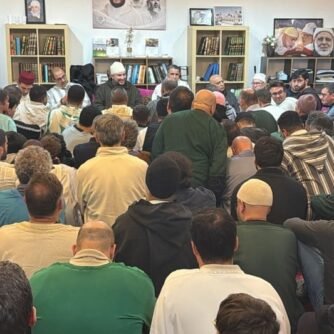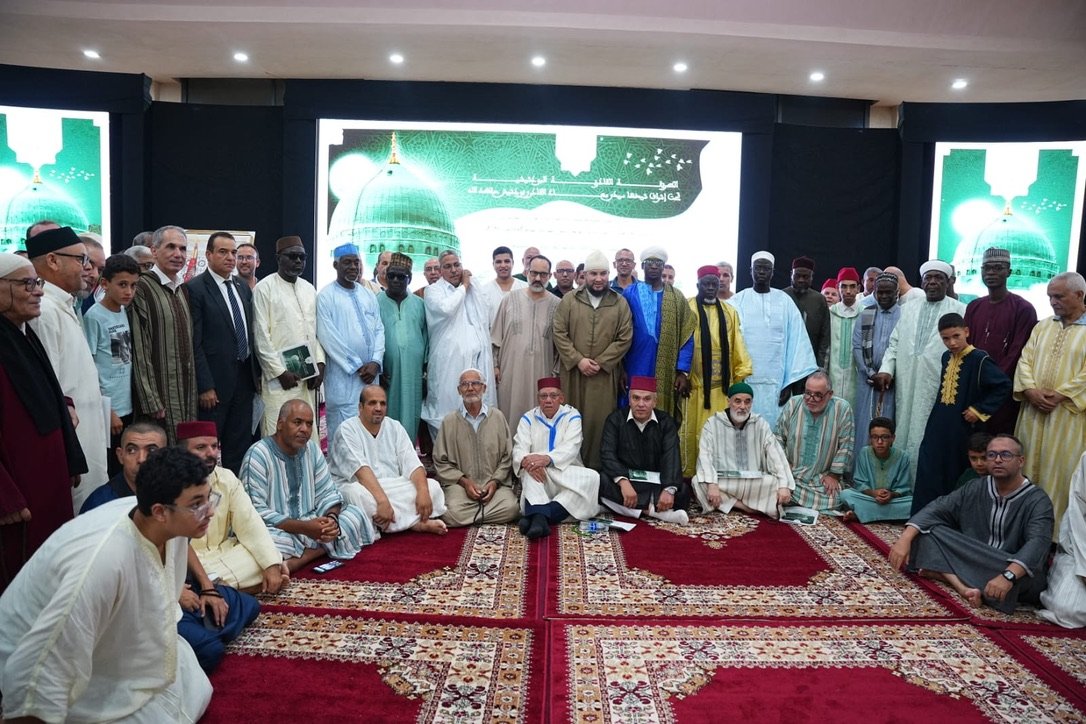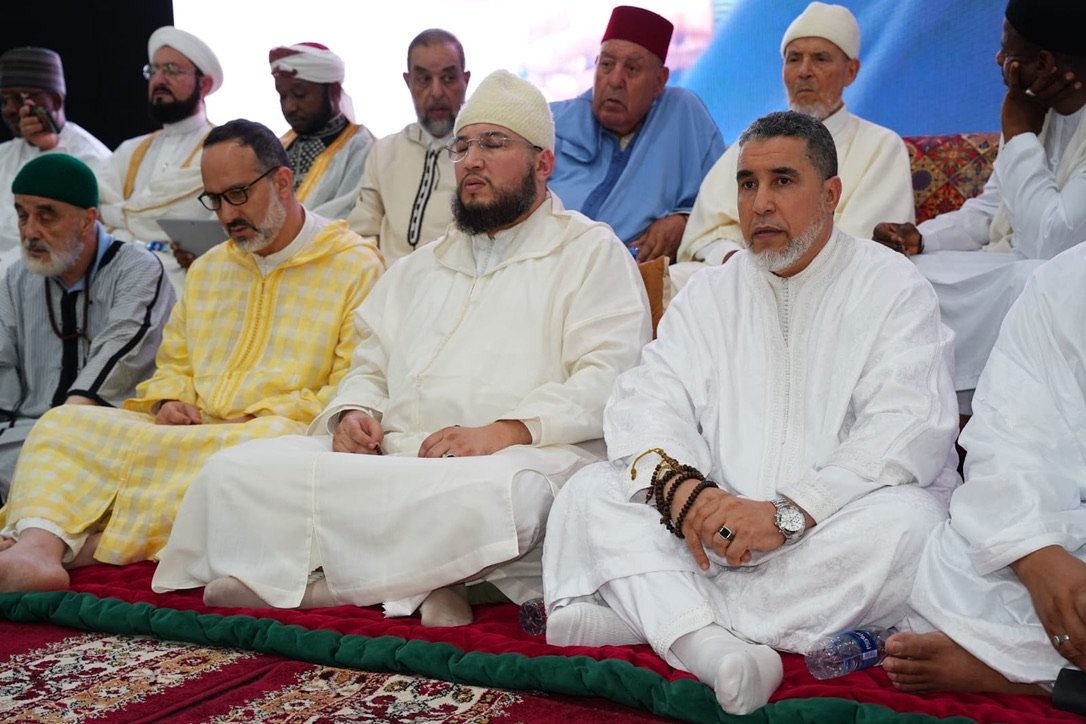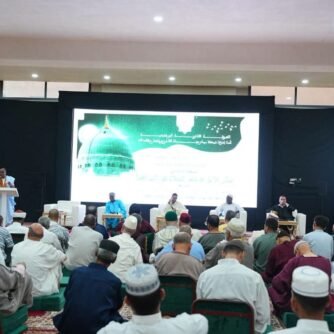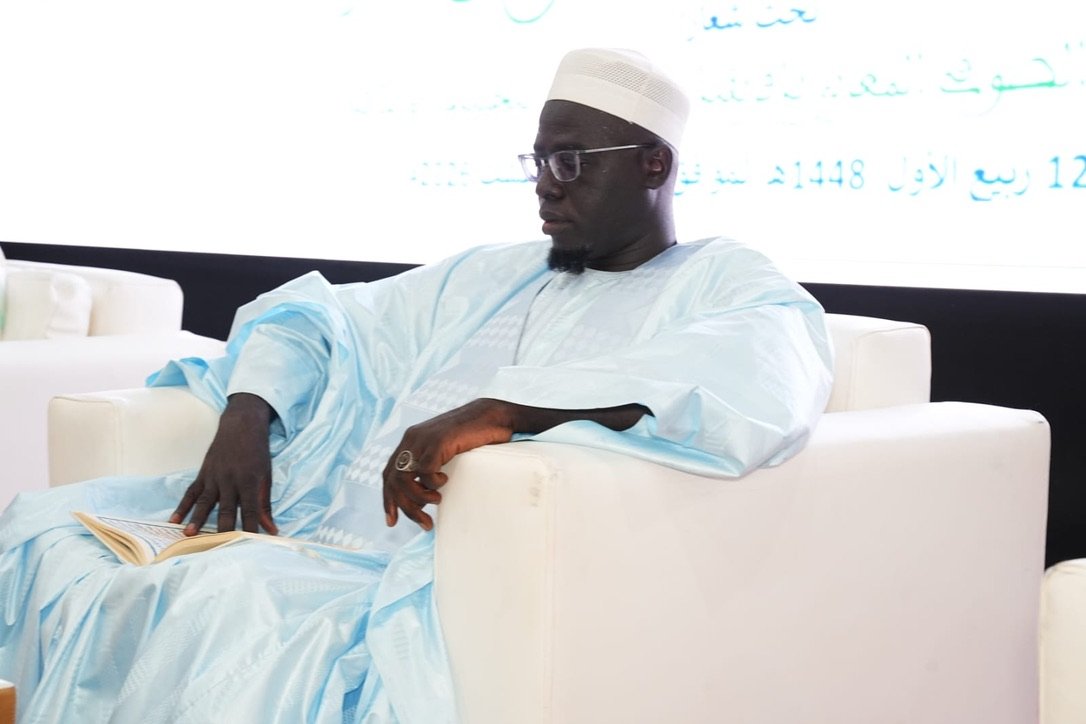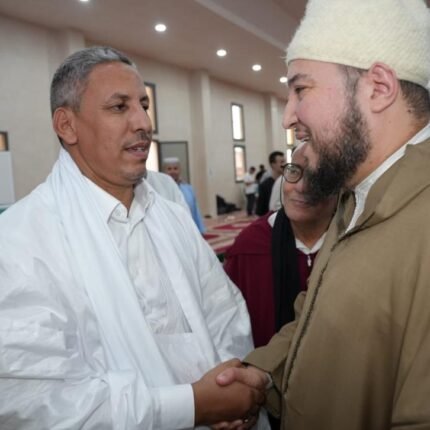
On 27 August 2026, the Mauritanian website El Mouritany published the testimony of the researcher Ahmed Bab Ahmed Ham al-Amine, president of the Cheikh Sidi al-Mokhtar al-Kounti Islamic Cultural Complex in Mauritania, who came to visit the Qâdiriya Boudchichiyya zaouïa in Madagh, to be with Sidi Mouad on the occasion of the commemoration of the Mawlid1. We give here its full translation, without cuts or summary.
By Prof. Ahmed Bab Ahmed Ham al-Amine, president of the Cheikh Sidi al-Mokhtar al-Kounti Islamic Cultural Complex, Mauritania
The Qâdiriya Boudchichiyya zaouïa, under the guidance of its present cheikh al-Hâjj Sidi Mouad al-Qâdiri Boudchich, a beacon of radiance, a picture of uprightness and virtue.
Among the favours, beyond counting, that God, Mighty and Majestic, has bestowed upon me, He granted me a visit to the Qâdiriya Boudchichiyya zaouïa2, at its seat in the commune of Madagh, Berkane province, Oriental region, in the Kingdom of Morocco. It was a visit in which the baraka3 of the time met the baraka of the place: the time, because it was the commemoration of the fifteen centuries that have passed since the birth of the Chosen One, blessings and peace be upon him. The place, because these are the noble precincts of this ancient Qâdiriya zaouïa, attached to the constants of religion, “the fiqh4 of Mâlik, the creed of al-Ash’arî and the way of Junayd the wayfarer”. God also granted me a visit to the mausoleums of the cheikhs of this zaouïa, beginning with the cheikh Sidi al-Abbâs ben Sidi al-Mokhtar Boudchich, then his son and successor the cheikh Sidi Hamza Boudchich, then his grandson and successor the cheikh Sidi Jamal Eddine Boudchich, may God sanctify their Secrets5, grant us the benefit of their blessings and count us, by His mercy, among those with whom He is pleased.
God also bestowed on me the grace of meeting the cheikh of the Qâdiriya Boudchichiyya zaouïa, the heir to the Secret of his forebears, the illustrious cheikhs, His Eminence the venerable cheikh Sidi Mouad al-Qâdiri Boudchich, may God preserve and protect him. I observed in his face serenity and dignity, education and lights. I perceived in him the continuation of the chain (sanad), the attachment to the source (mashrab), the rootedness in knowledge and education, and I knew that he is an unbroken succour and a firmly rooted knowledge. We ask God to assist him without wearying him, to strengthen his resolve and his certainty, to realise his sincerity and his establishment, and to let flow through his hands the good and the reform that benefit the country and the servants of God.
Being myself a researcher in the field of Sufism in general, and of the Qâdiriya Way in particular, I have written these few pages, a tiny portion that might spare long expositions, to bring to light certain characteristics of this zaouïa and of its venerable cheikhs, wishing to share them with readers, researchers and those with an interest, as well as with the lovers of this zaouïa and its fuqarâ’6, in the hope that they may be a testimony of fairness and a light shed on part of its spiritual, scholarly and educational radiance.
Preamble
No observer of religious life in the Kingdom of Morocco can fail to see that the source of the Qâdiriya Boudchichiyya zaouïa was, and remains, praise be to God, a purely spiritual and educational source, founded on the unbroken chain going back to the best of the prophets and messengers. This zaouïa has been a beacon of radiance, a garden of virtue and a landmark of civilisation for the acquisition of the sciences and their practice, following in the footsteps of the pious predecessors among the saints and the virtuous, and out of attachment to the Commandery of the Faithful embodied in the Sharifian Alawite Throne.
The cheikhs of this zaouïa were rabbâniyyûn7 Sufi masters, who by their effort and diligence helped to strengthen religious thought and to make known the Islam of the middle way in Morocco and beyond, which had a profound effect in the guidance of many people and their discovery of the essence of Islam, as well as in improving the conduct of many Muslims, by filling the spiritual void and inhabiting hearts through assiduity in dhikr8, and by purifying the soul of its whisperings and its stains, so as to reach the rank of uprightness (istiqâma): the tongue of the murîd9 is set right by uttering wisdom, his heart by sincerity of aspiration, his soul by the beauty of service, his spirit by reverence for the sacred, and his innermost being (sirr) by attention turned towards the Benefactor rather than towards His benefits.
Taken together, these meanings make Sufism, in the conception of these masters, a complete project for building the human being, in which knowledge is not separated from action, nor worship from ethics, nor spiritual education from service to society and the homeland.
The meaning of Sufism for the cheikhs of the zaouïa
The cheikhs of the Qâdiriya Boudchichiyya zaouïa have given proof of their Sunni Sufi thought, free of all dross, innovation and deviation. This is shown in the words of the cheikh Sidi Jamal Eddine al-Qâdiri Boudchich, in an address given on the first anniversary of the death of his father the cheikh Sidi Hamza Boudchich, may God have mercy on him. He said: “That is why whoever has accused Sufism of withdrawal, fatalism and seclusion, and of wearing patched garments, was mistaken. More precisely, Sufism is pure Islam: it is its marrow, it is the station of ihsân10, of purification (tazkiya), of truthfulness and of sincerity in all works. It is the effective remedy for all the diseases of the heart and the soul, held to be incurable, which physicians have been unable to overcome. The Sufis are the true pious predecessors: they are the servants of the Book and the Sunna. I heard my grandfather, on many occasions and in various majâlis11, say that Sufism is: ‘accept whatever the Messenger gives you, and abstain from whatever he forbids you.’12 And my father, may God have mercy on him, also spoke his famous words: ‘Sufism is tastes, impulses and virtues.’” End of quotation.
It is a conception that condenses the essence of the Sufi experience in the joining of following (ittibâ’) and tasting (dhawq), of the Law (sharî’a) and the Reality (haqîqa), of purity within and uprightness without, so that Sufism is not a departure from Islam, but a deepening of its meanings in the soul and in conduct.
The work of the cheikhs, as model and as guidance
These cheikhs were known for their annihilation in the love of the Prophet, blessings and peace be upon him, of his family and of his companions, may God be pleased with them, and for their utmost attachment to his Sunna and its defence, so much so that the Prophet, blessings and peace be upon him, became powerfully present in their innermost being, shaping their conduct and their method. They never tire of invoking blessings upon him, of singing his praises and of glorying in his noble qualities, in the hours of the night and at the ends of the day.
As proof of the strong presence of the Prophet, blessings and peace be upon him, in the form and the essence of this zaouïa, here is what I have related from trustworthy people among our illustrious Kounti cheikhs and the masters of our Qâdiriya Way. I recall that more than ten years ago I had resolved to visit our forebear the cheikh Sidi A’mar al-Cheikh, buried at Oued Draa, near the town of Akka, in the province of Tata. I stopped in the town of Guelmim and stayed within the precincts of the zaouïa of the virtuous saint and combatant the cheikh Abidin ben Sidi Amhammad al-Kounti ben the cheikh Sidi Muhammad al-Khalîfa ben the cheikh Sidi al-Mokhtar al-Kounti, through the generous care of its cheikh Moulay ben Chayykh ben the combatant the cheikh Abidin, may God preserve him. He is a man known for his valour and his uprightness in religion and chivalry, with a great knowledge of scholars, a sincere love for the virtuous and the saints, a high esteem for the chorfa13 of the Ahl al-Bayt and great regard for people of merit and goodness. He was faithful in transmitting facts and events, relating only what he had seen with his own eyes or received from upright and trustworthy people.
Once, he told me about precious aspects of the daily life of his uncle, the virtuous saint the cheikh Sidi Boubker ben the cheikh Abidin, who was counted among the accomplished masters in the sciences of tastes and Secrets, and among the elite whom God has favoured with knowledge of His supreme Name, the one by which, when He is invoked, He answers, and when He is asked by it, He gives.
The cheikh Sidi Boubker is the cheikh of the Qâdiriya Kountiyya Mokhtâriyya zaouïa, located in the caïdat of Aïn Oulad Jerrar, Tiznit province. He died, may God have mercy on him, in 1999. The cheikh Sidi Boubker had a relationship of particular affection and friendship with the Moroccan general, the late Mohamed Belarbi, from the time when the latter was serving in Agadir. Later, several posts were entrusted to him, the last being the directorship of the Royal Institute of Territorial Administration in Kenitra, before he retired in 2011. He died, may God have mercy on him, in 2023.
The cheikh Sidi Boubker recounts: The officer Mohamed Belarbi was a generous and modest man, of noble qualities, who loved the people of God and His elite. He showed me esteem and respect. One day he invited me and insisted that I come to see him in Rabat. I accepted his invitation, and when I entered the guest room of his house, there it was, full of a large crowd of people of knowledge and virtue, as was customary at his gatherings. Among those present was the venerable cheikh Mâ’ al-‘Aynayn ben the cheikh Hasanna ben the cheikh Mâ’ al-‘Aynayn, may God have mercy on him, as well as generals and other leaders whom I knew. This was around the year 1968.
The cheikh Sidi Boubker adds: Mohamed Belarbi asked those present: which of you sees the Prophet, blessings and peace be upon him? Some began to say that they saw him, relating accounts and stories about it. As for the cheikh Mâ’ al-‘Aynayn ben the cheikh Hasanna, he did not utter a word. I venerated and respected him, and out of great respect for him I avoided speaking in his assembly, out of courtesy and deference. In the midst of this conversation about seeing the Prophet, blessings and peace be upon him, my mind wandered for a moment without my realising it. And given what some of those present were saying and their long digressions on the subject, I collected myself and said quite spontaneously: O people, let no one weary our ears with such talk! The supreme Messenger, blessings and peace be upon him and his family, no one sees him today in Morocco but one man, and he sees him only at the opening takbîr of the prayer (takbîrat al-ihrâm), appearing before him on the right side, fleetingly. Mohamed Belarbi said: who is this man, O cheikh Sidi Boubker? I replied: it is al-Hâjj Sidi al-Abbâs ben Sidi al-Mokhtar Boudchich, the cheikh of the Boudchichiyya zaouïa in Madagh, in the province of Berkane.
Mohamed Belarbi said: that is precisely what we were looking for. He immediately contacted the command of the city of Oujda, capital of the Oriental region, put it in contact with the command of Berkane and asked it to transfer the line to the cheikh of the Boudchichiyya zaouïa in Madagh. The cheikh picked up the receiver, saying: welcome, Mohamed Belarbi. Belarbi said: who told you my name, O cheikh? The cheikh replied: you are the officer Mohamed Belarbi, you are now in your house in Rabat, you are wearing such and such clothing, and with you in your assembly are cheikh so-and-so and cheikh so-and-so, general so-and-so and general so-and-so, and with you are the cheikh Mâ’ al-‘Aynayn ben the cheikh Hasanna ben the cheikh Mâ’ al-‘Aynayn and the cheikh Sidi Boubker ben the cheikh Abidin, and so on. Belarbi said to him: you have spoken the truth, O cheikh! The cheikh Sidi Boubker whom you named is the one who directed us to you and told us of the special standing you have with God. What do you know of him, O cheikh? The cheikh said: what I know of the cheikh Sidi Boubker is that I have seen him since his childhood playing on the backs of the saints and the virtuous. But tell him, may God reward him with good, that we ask him not to inform anyone of these states of ours from now on.
Conclusion
Through this remarkable story, it becomes clear, according to the account transmitted and the testimony of its narrators, that this zaouïa was founded on a piety pleasing to God, that its cheikhs made love of the Prophet, following and spiritual education the foundation of their reforming and educational project, and that their bond with the Prophet, blessings and peace be upon him, is present in their innermost being, their conduct, their praises (madâ’ih) and their awrâd14. Thus the Qâdiriya Boudchichiyya zaouïa appears, in its historical and educational course, as the continuation of a Moroccan Sufi project joining dhikr and purification, knowledge and action, love of the Prophet and attachment to his Sunna, with attachment to the constants of the Kingdom of Morocco and to the Commandery of the Faithful. It was truly a beacon of spiritual radiance, a space of education and virtue, and a bridge of religious and civilisational communication within Morocco and beyond.
Among the finest words summing up this rank are those of the imam al-Busîrî, may God have mercy on him, in his Burda15:
Muhammad, lord of the two worlds, of men and jinn, of Arabs and non-Arabs.
He is the Beloved whose intercession is hoped for in every trial, among the trials that befall us.
Attribute to his person all the honour you wish, attribute to his worth all the greatness you wish,
for the merit of the Messenger of God has no limit that a speaking mouth could express.
Do not deny the revelation that came from his vision, for he has a heart that, when the eyes sleep, does not sleep.
Whoever has the Messenger of God as his succour, if lions meet him in their thickets, they freeze.
Every saint is victorious through him, and every enemy ends broken.
Notes
- Mawlid: the commemoration of the birth of the Prophet ﷺ. ↩
- Zaouïa: the place where a Sufi way teaches, educates and receives people, at once school, house of dhikr and refuge. ↩
- Baraka: the influx of grace and blessing that is transmitted through blessed places, people and acts. ↩
- Fiqh: Islamic jurisprudence, the science of the practical rules of religion. ↩
- Secret (Sirr): the most intimate spiritual reality that God entrusts to His saints and that the Way transmits from master to master. ↩
- Fuqarâ’ (singular faqîr): literally “the poor” in God, the name taken by the wayfarers of the Way. ↩
- Rabbâniyyûn: accomplished educators, men of God who lead others on the path towards Him through knowledge and example. ↩
- Dhikr: the invocation and remembrance of God, the central practice of the Sufi way. ↩
- Murîd: the disciple committed to the way, literally “the one who wills” God. ↩
- Ihsân: spiritual excellence, “to worship God as though you saw Him”, the third degree of religion after islâm and imân. ↩
- Majâlis (singular majlis): assemblies, sessions of knowledge or of dhikr. ↩
- Allusion to the Qur’anic verse al-Hashr 59:7: “Whatever gains God has turned over to His Messenger from the inhabitants of the villages belong to God, the Messenger, kinsfolk, orphans, the needy, the traveller in need, this is so that they do not just circulate among those of you who are rich, so accept whatever the Messenger gives you, and abstain from whatever he forbids you. Be mindful of God: God is severe in punishment.” Translation of the verse: M.A.S. Abdel Haleem. ↩
- Chorfa: the descendants of the Prophet ﷺ, the nobility of the Prophet’s family (Ahl al-Bayt). ↩
- Awrâd (singular wird): the daily litanies proper to each way. ↩
- Burda: the famous poem by the imam al-Busîrî (7th century AH) in praise of the Prophet ﷺ. ↩
Source
🇲🇷 El Mouritany (Mauritania), 27 August 2026, under the signature of the researcher Ahmed Bab Ahmed Ham al-Amine. Full text consulted and archived on 28 August 2026.