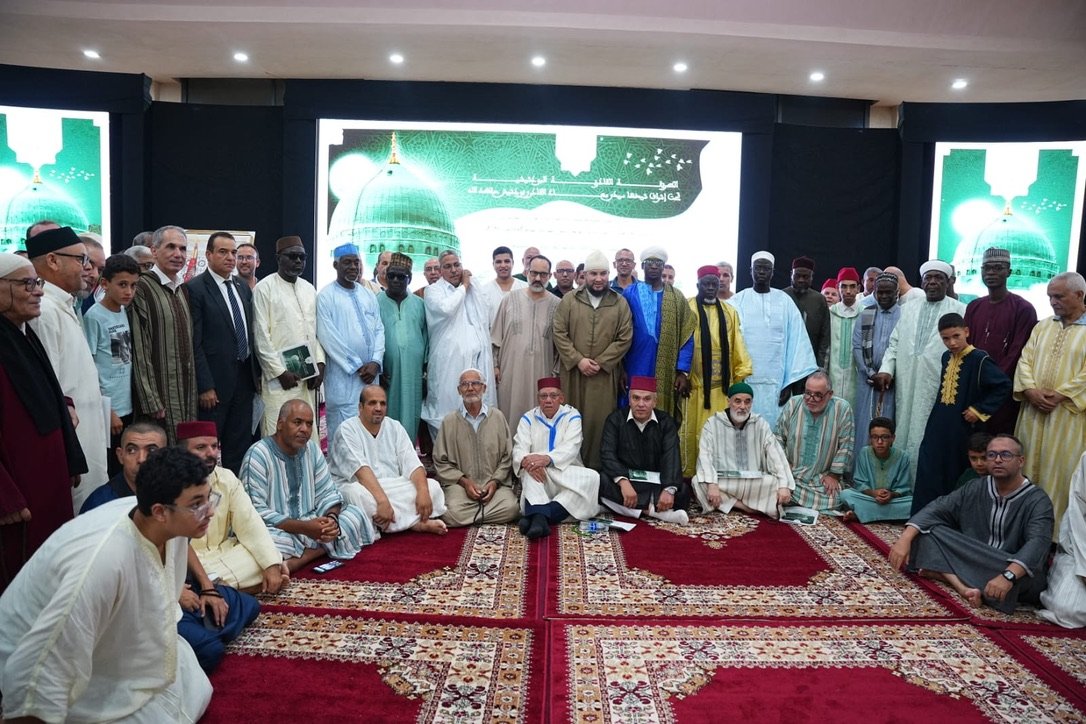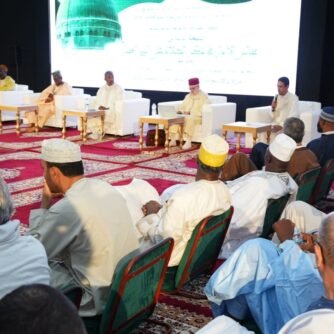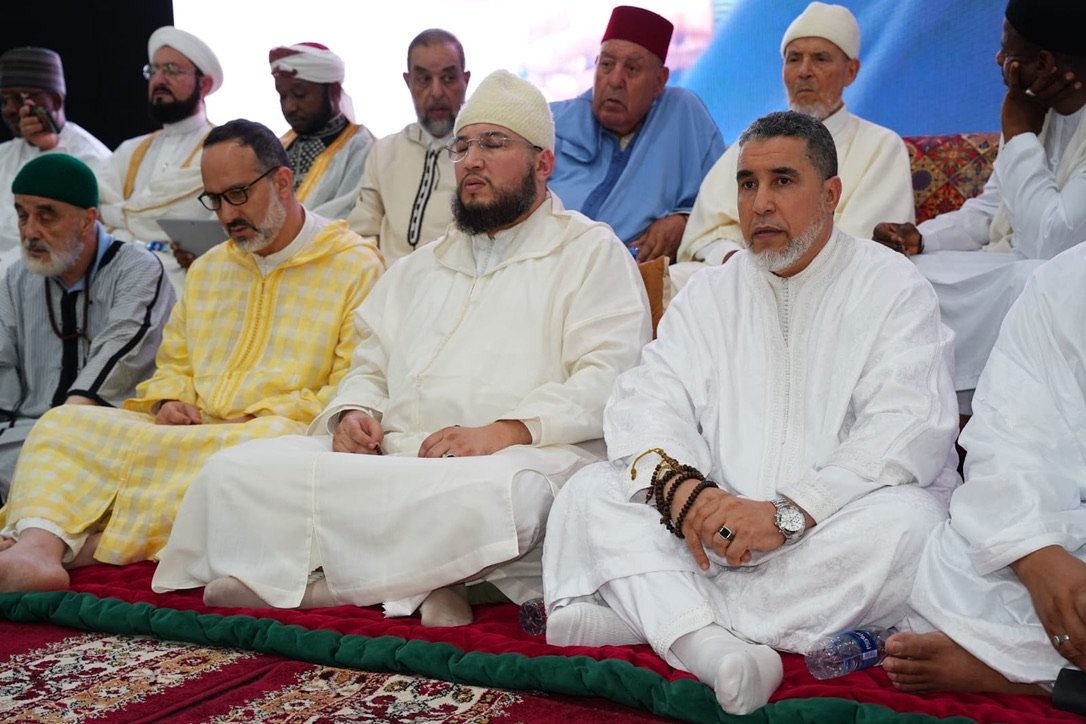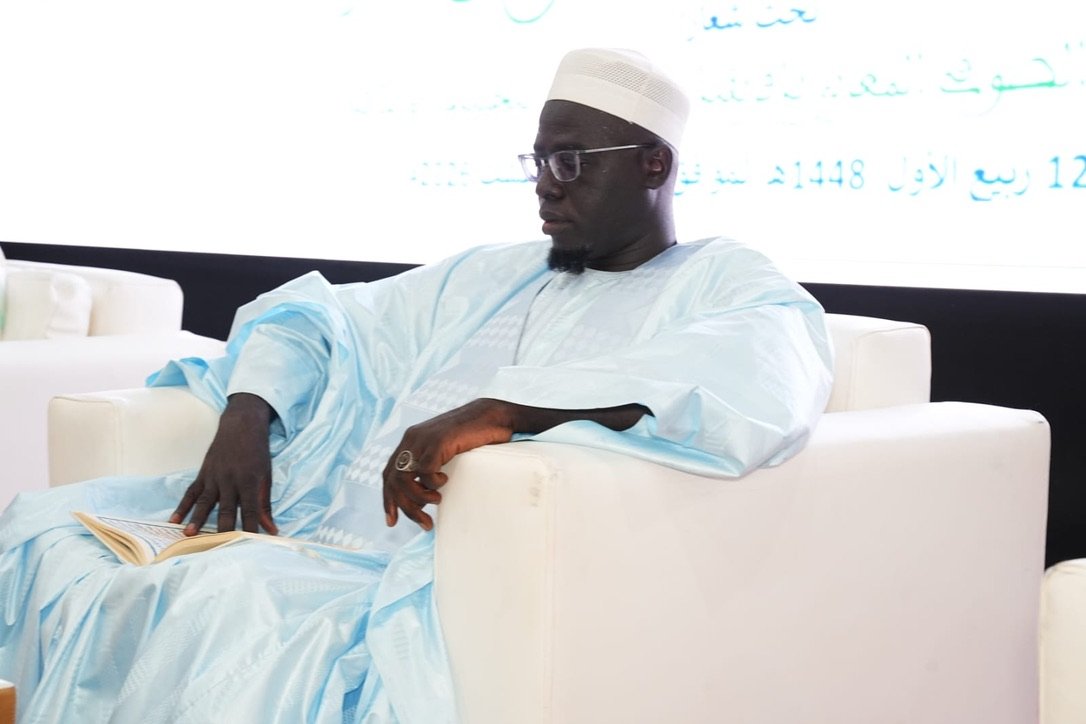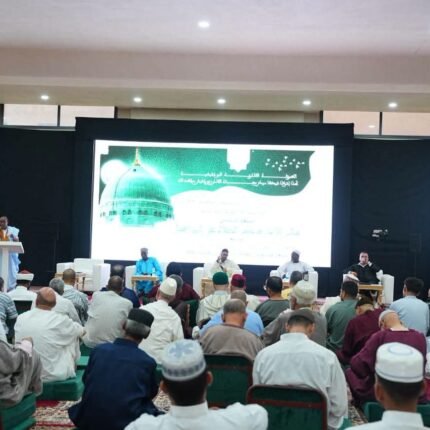
At the Assemblies of Light of Madagh, held under the supervision of Cheikh Sidi Mouad al-Qâdiri Boudchich, the fifth scholarly session, devoted to “Moroccan Sufi paths and networks of African spiritual communication”, hosted a scholarly lesson by Dr Ibrahim Hadki, former president of the Scholarly Council of Guelmim and researcher in Islamic studies: “The care of the scholars of the Moroccan Sahara for the Muhammadan Shamâ’il and the landmarks of the African extension”.
The Shamâ’il, a reference for education and conduct
The researcher showed that the Shamâ’il, the description of the qualities and virtues of the Prophet ﷺ, hold an eminent place in Moroccan religious consciousness. Their presence was not limited to books and devotional assemblies: they formed a reference in education, morals and conduct, both individual and collective.
The scholars of the Moroccan Sahara taught and studied them through three major works: the “Shifâ” of Qâdî ‘Iyâd, the “Muhammadan Shamâ’il” of Imam at-Tirmidhî and the “Dalâ’il al-Khayrât” of Imam al-Jazûlî. To these they added a form proper to the people of the desert: the versification of the Shamâ’il and of the Sîra, which made them easier to memorise and to circulate in a setting marked by nomadism, before these poems travelled, with the scholarly caravans, to the lands of Shinqît, Senegal and Mali.
Scholarly families in the service of this heritage
Dr Hadki presented examples of Saharan scholarly families who served this heritage: the family of Cheikh Muhammad Mustafâ Mâ’ al-‘Aynayn, the Majlisiyya family, the family of Ahl Bârak Allâh, alongside other scholarly houses of the Oued Noun. He spoke of the scholars who carried the sciences of the Shamâ’il and Sufi knowledge to West Africa, among them Sidi al-Mukhtâr al-Kuntî, Cheikh ‘Umar al-Fûtî, Cheikh Ibrâhîm Niasse and Imam ‘Uthmân Dan Fodio.
He insisted on one point: this scholarly and spiritual extension across the Sahara was never one-way. It rested on interaction and exchange between the cities of Morocco and the lands of Shinqît, Timbuktu and Walâta, through the circulation of books, of ijâzas and of knowledge linked to the Sîra and the Shamâ’il.
The researcher concluded by calling for the assemblies of the Shamâ’il and their teaching to be revived in scholarly institutions, and for their manuscripts to be catalogued and edited: a work of documenting the shared heritage, in the service of scholarly and spiritual communication between Morocco and the countries of Africa.
Source
🇪🇬 Al-Ahram Gate (Egypt), 25 August 2026, supplemented by the report on the fifth session published by an-Nahar (Egypt). Texts consulted in full.