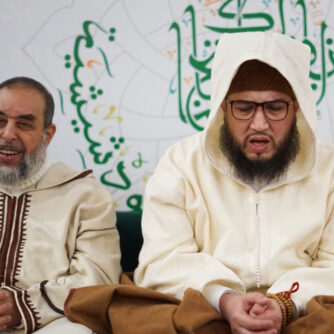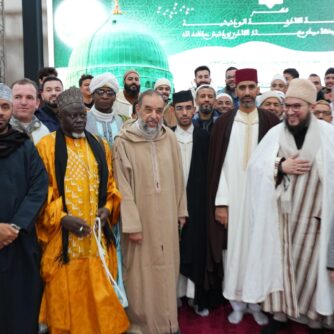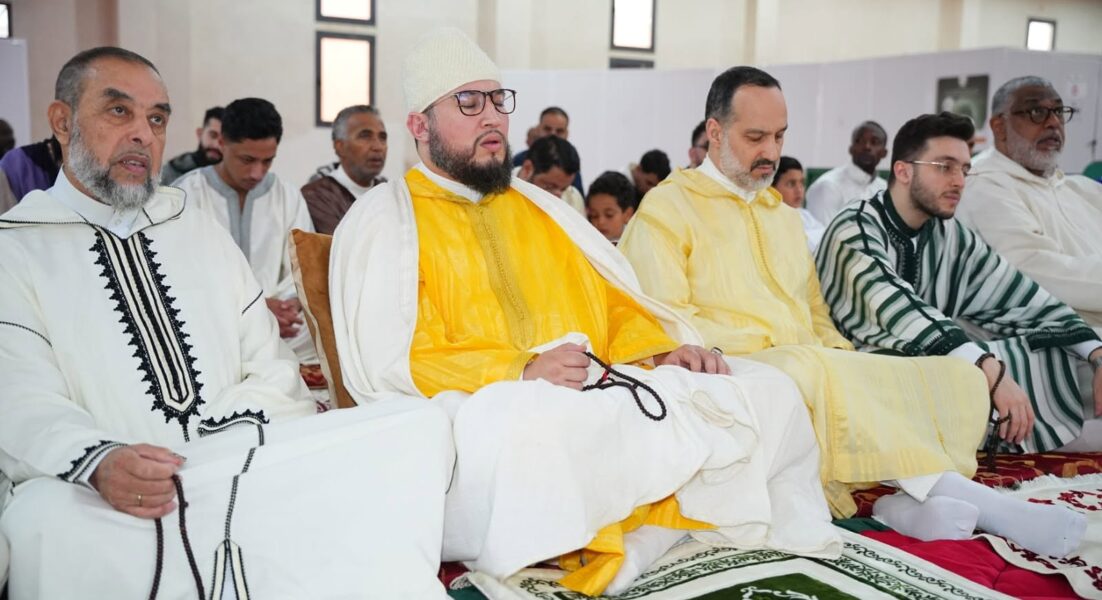
Translation of an excerpt from a talk given by Sidi Mouad al-Qâdiri Boutchich (may Allah preserve him) at Madagh in May 2025. The text below renders the teaching passed on orally by the Cheikh, in faithfulness to his words and to the spirit of the Way.
The only thing we know how to do
Whoever stays at the zaouïa does not know how to do politics, does not know how to do propaganda. We know how to do only one thing: invoke lā ilāha illā Allāh (there is no deity but God). That is all there is.
The true opening is that of the heart: that my heart should open to my Lord. The other opening, that of appearances, is not ours. It is God who determines the radiance of religion and of Islam.
Correct yourself, O my brother. Radiance or no radiance, what have you to envy? Radiance is what illuminates your heart, purifies it, removes rancour from it, preserves it from envy and hatred.
God has showered your brother with blessings. Your brother is a faqir, like you. God has poured goodness and provision upon him: let us rejoice for him. God has poured the Sirr (the spiritual Secret) upon him: let us rejoice for him. God has given him children who succeed, an easy life: let us rejoice for him. And whoever God has not yet given to, may Allah give to him. Why should we not rejoice? Why should we go on envying one another?
If my brother possesses something, it is as if I possessed it myself, for we are one. Why then hate one another? Good is good, and everything that comes about is wisdom from God, exalted be He.
God lets Himself be found in His creation
Who established Dhū al-Qarnayn on the earth? Our Lord. Who gave him power? He entrusted him with treasures, and so many other gifts, then he was sent from one place to another.
The well-known story is told of the master who was asked: “Show us God, there, above, on the platform.” But have you not seen Him in creation? When a man drawn to God (majdhûb) met him in the market, he took him along and fed him.
The master used to say: the path towards creation is light. It is the door.
Those who asked to see God “on the platform”: God is in creation. And how, when God is in creation, can you despise that creation?
Despise no one. Whatever state you are in, even the hardest, despise no being. A person despises no one.
Let each one watch over himself, without drifting away, and let God’s command be fulfilled in His servants. It is God who created the servants and He who leads them. We do not have charge of the servants. Let each one attend to his own soul.
If we want to journey, in this time: my soul, my soul. Not selfishness, but the precious soul, the one that must be purified through trial.
Turning away from appearances, turning towards God
Let us hold fast to God, return to our Lord, and leave aside ostentation and clamour. We have no vanity nor anything of the kind: we want only our Lord. We do not know politics. All that is far from us. And let us pray for our sovereign, may Allah prolong his life and make him firm upon the earth.
The world passes. How many have gone. Only yesterday we were with the beloved (Sidi Jamal). Eighty, ninety years went by in the blink of an eye, as if nothing had been. Sidi Hamza likewise, nearly ninety years, as if nothing had been. And we too shall be struck in our turn, as if we had never been.
Let a person stand turned towards his Lord. In every act he wishes to carry out, let him remember God.
We do not want the fouqara to turn away from the qibla, which is our Lord. Let a person turn towards his Lord, so that God may open the doors of good for us. This life is hard, hard. We have no business digging into anything. Let us leave the devil behind us, and keep only what is essential.
Entrusting oneself to God (the tafwîd)
What God has given us: whoever rejoices in it, God showers him with more and grants him more good still. But a person sometimes persists in denial, and says: “I worked and He gave me nothing.” That person is calling his Lord to account. Yet a person does not call God to account. Entrusting oneself to Him (tafwîd) is Him, that is all.
This is not easy. Putting it into practice is difficult day to day. We all go through it. As soon as the reckoning begins, as soon as one enters into these calculations, the matter becomes hard.
But God, exalted be He: let a person hand his affair over to Him, and he will fear nothing. All it takes is a firm resolve in God. And God does not abandon him. Even when trial strikes you, even when you tell yourself “it is over”, God gladdens you again through another door.
When a person is cornered and says “by God, I will not give You up”, God shows mercy. Is there any door other than Him? He opens, He opens. He never betrays.
We learned with Sidi Hamza through the gaze alone. Even with the beloved (Sidi Jamal), through the gaze alone. There were no long speeches. He would look at you, and that was all. That is the Way.
The oil
(Translator’s note: “the oil” returns like an ironic refrain throughout the talk. The Cheikh uses it to mean material interest, the profit some come looking for instead of looking for God. Several passages play on this image, with laughter from the gathering.)
Whoever comes only for “the oil” is in the wrong.
Whoever carries a request, may Allah grant it to him. All this, in theory, seems difficult, and yet it is simple. But in practice it is hard: the soul, the devil, worries, other people. We ask God, exalted be He, to let us enter into the Secret.
We are solid, not numerous
We are not few. We are not few. We are solid. Only, we are discreet, veiled.
We are solid and we do not want glitter. Glitter is of no use to us. We did not come in to make a show of strength. We want the Way to be solid, and everything to be directed towards God. If our intention is not turned towards God, I have no use for any of it.
If we do not direct one another towards our Lord, what is left? You come to God’s door and you turn to social media: “Let’s take a photo, there were lots of us.” That is not service.
Service is for the faqir to have certainty (yaqîn) in his Lord. And God spreads baraka (blessing). He spreads it where He wills. A single man can be worth a thousand.
“Few of my servants are truly thankful” (Qur’an 34:13). Few indeed. God has let us lack nothing, everything is there. History repeats itself. See what our master Muhammad ﷺ, our master Moses, our master Joseph went through. All of them passed through these trials.
The trial (fitna) is not easy, but it holds a sweetness. When a person begins to feel the sweetness of what he is living, he rejoices. When he succeeds before God through patience and steadfastness, a deep joy unites him with his Lord.
God’s fear for His servant
God watches over His servant even more than a mother watches over her child. Understand this meaning. When a person reflects on it and becomes certain of it, he finds rest. Where does the mother appear for you, where does the father? God fears for you more than all of them. And we paint things black. Yet our Lord forgives us and spares us, again and again. See His grace.
There are people whose invocation (duʿâ) God simply loves to hear. They are tried, overwhelmed, and He simply wants to hear that invocation. “Invoke a little more. Leave him a little longer, he is invoking.” That voice of humility at His door, God rejoices in it. This poor servant, overwhelmed. May Allah grant us to stand at the door of our master, humble and accepted, if God wills.
We read a Secret to one another. We dwell here, may Allah guide us. We sit face to face in joy. This, if one does not find it in this world, one will not find it in the next. Whoever is swept up by this lower world instead of this gathering will be in distress in the next world.
Patience and anchoring
The hardest thing for a person is great despair. Sidi Hajj Abbas used to say to Sidi Hamza: “You, say nothing. Leave the fouqara: let this one see, let that one speak.” The Sirr shows itself in the fouqara. If you want to see the Cheikh, look at the fouqara: if they are at peace, that is the sign.
That is why the fouqara must hold fast to patience. Not to retort, but to be patient. It will pass. And there will come, if God wills, a fine time when God will pour out good. Still, one must know where to place that good. Let the good not turn back upon you to deceive you. God’s good comes from Him and returns to Him.
Those who have come through our trials will also come through the trial of grace. For grace too is a trial. If God pours grace, good, money upon you, and you rush headlong into it, that is another fitna, more formidable still than the one we are in. Being patient under insult is one thing. But when you have the means to go here and there, and you say “no, this I give to God”, to tear that from yourself and place it in Him, that is difficult.
Being a single body
To come out of this, we must be a single body, a single entity. Will you separate the hand from the body and tell it “move”? It must stay connected, with the veins plugged into it, with everything plugged in. When everything is connected, should a single vein become blocked, the ailment appears: “this one is numb, it no longer works.” Then the vein must be freed, the obstruction removed, so that it comes back to life. Such is the role of the people of God: removing here, freeing there, so that everything works, so that everything is in motion, of one piece.
We lived alongside the people of God, we lived alongside Sidi Hamza. God gave us a gift we shall never forget. If we went to our Lord empty-handed, it would be a disgrace: “I was with Sidi Hamza and I grasped nothing. I was with Sidi Jamal and I grasped nothing.” Is that not a disgrace?
The sieve of trial
That is why this sieve exists, this sifting: so that we may see clearly. Sidi Hamza taught you to be patient, to bear wrong and be patient. The master tested them through patience: “This is how to be patient with your brothers, this is how to be patient with the one who works beside you.” And still today, when we have difficulty with our brothers the fouqara, people say “be patient, that is how the matter is.”
It is a sea overflowing with blessings. The sea overflows, and everything is in it.
Being a mountain, not a bird
You think it fixed, and it passes as the clouds pass: “the handiwork of God who has perfected all things” (Qur’an 27:88). The sea, when you look at it, seems as still as a carpet. You say “there is nothing there”. And yet it is at work, and in the sea there are wonders.
Let a person never be deceived by agitation. The things that bear good are those that remain anchored: “And We put firm mountains on the earth” (Qur’an 21:31). That is what holds. We must be mountains, not birds.
This is the time of rootedness (rusûkh). Whoever has grasped something from Sidi Hamza or from Sidi Jamal, let him anchor it deeply. For the inner realities must take root. This is not the time for discord or for racing about. As for the brothers to whom God has not yet given this understanding, leave them. The child fidgets and fidgets, then you find him asleep in a corner.
We must be rooted, firm. Our compass is the rosary (subha), and we turn towards our Lord. Then we fear nothing any more. Whoever turns towards his master, “Quickly, turn to God” (Qur’an 51:50), whoever turns towards his Lord fears nothing. Our weapon is the true one: it is God.
Sidi Hamza used to say: “If I were given the choice, I would give up everything, and keep only al-Latîf (the Subtle, the Kind) and almsgiving.” Al-Latîf al-Kabîr (the Subtle, the Great). That is what we need.
Building, not arguing
God raised up this gathering so that hearts may find rest. We have shaken no one, neither by insult, nor by slander, nor by lies, nor by anger. They only pile grievance upon grievance. We have no time to think about anyone: we are building. For a moment the trial unsettles us, but reason remains. Know that we must stand firm in order to know God.
Are we going to keep following social media, who wrote this, said that, did this, raised such a banner, made such an announcement? That is a fitna. If someone wants to take something in hand, let him take the rosary. If he wants to lift something, let him lift the Book. We have the Mushaf (the Qur’an), the Dalâ’il, the Dhakhîra, the Shifâ, the Bukhârî. Here, read for yourself, and take the rosary.
Let no one despair. God created you and He sustains you. By God, He abandons no one. He brings your provision right here. The person who frets over his provision is like one who associates others with God. Whoever despairs, God adds despair upon despair for him. If you say “I will do this”, you enter into your own management and you abandon God’s management. But if you let God act, He arranges everything for you.
You kicked, and now you are drowning: that is what happens, in the sea. As long as you want to swim by yourself, you keep floundering. But if you let go, the current carries you, and you move forward.
Talk by Sidi Mouad al-Qâdiri Boutchich at Madagh, translated from Arabic. The original words are kept in our archives.