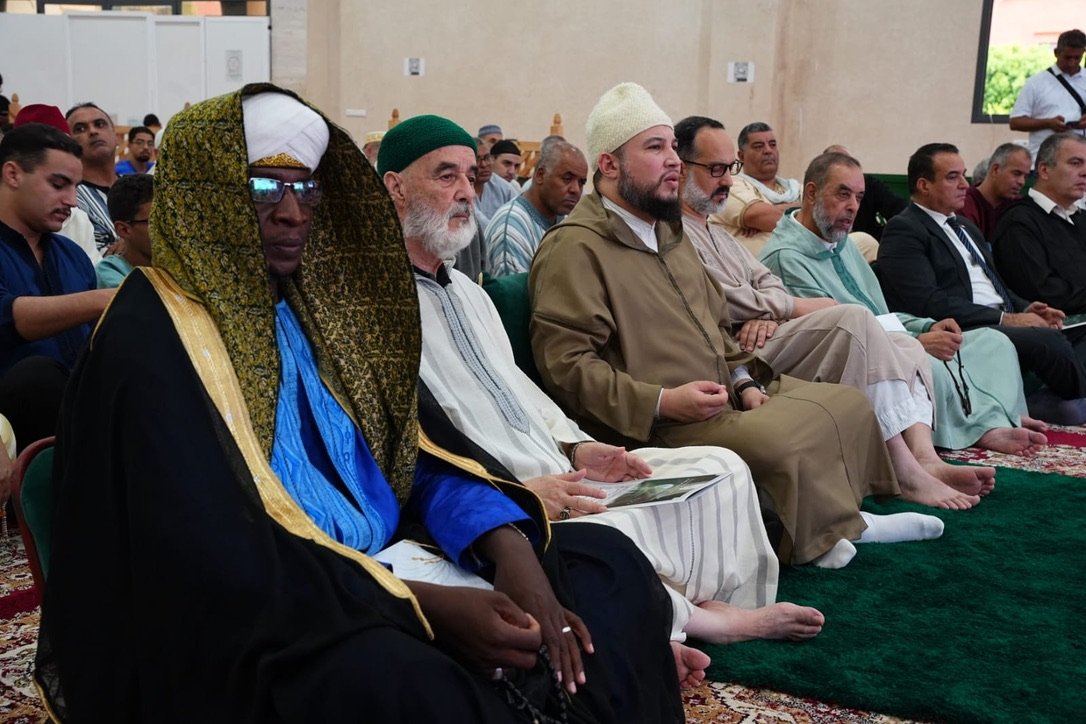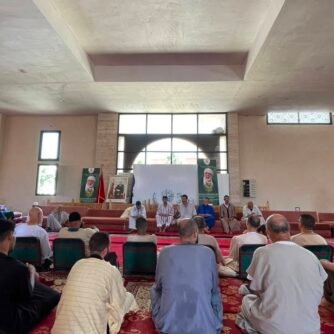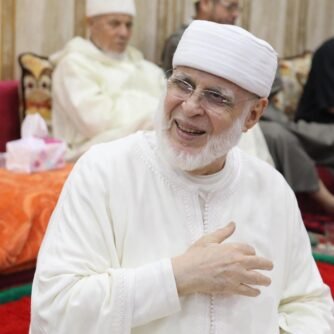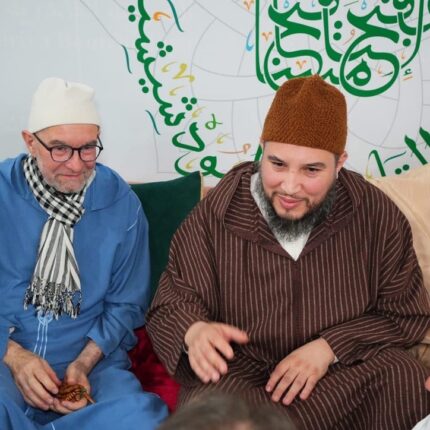
Opinion piece by Daniel Abdel Haq Roussange, based on his lecture “The Inner Transformation”. Third and final part: the audience’s questions, reworded for the written page, while the answers remain faithful to the speaker’s words. The first part dealt with purification, the second with the alchemy of the virtues and servanthood.
The question session moved back and forth between Islam and Christianity, as the lecture itself had done. The speaker recalled the Qur’anic call addressed to the People of the Book: “let us arrive at a statement that is common to us all” (Qur’an 3:64). It was in this spirit that the exchanges below took place.
What is the link between water and divine mercy?
The link is given by the Qur’an itself. On the one hand: “We made every living thing from water” (Qur’an 21:30), and on the other, God says of His mercy that it “encompasses all things” (Qur’an 7:156). The role that water plays in creation, mercy plays in being: that through which all things live. And just as spring water reaches the gardens only through irrigation channels, mercy and the Secret reach hearts only through living channels: the spiritual masters, who carry them and dispense them.
Did rites of purification by water exist in Christianity?
They did, in the monastic tradition in particular, among the Cistercians for example, before being abandoned. Over the centuries, the Christian West developed a spirituality centred on suffering, whereas the Christian East remained more turned towards light, the light of the Transfiguration. These are two orientations of one and the same tradition, and the second is closer to what Sufis mean by the illumination of the heart.
The soul, the heart and the spirit: one and the same thing, or distinct degrees?
One single subtle reality, but nested like Russian dolls: the soul (nafs), the heart (qalb), the spirit (rûh), the Secret (Sirr). Each person knows it only according to the degree at which they stand. The ignorant person sees only the first doll and believes that the whole human being is there. The spiritual journey is precisely this elevation from one degree to the next, from the soul to the heart, from the heart to the spirit, from the spirit to the Secret.
Why centre the whole path on the heart?
Because the heart, in Sufism, is not the muscle: it is the organ of knowledge, consciousness itself. A hadith says so with unequalled force: “My heavens and My earth do not contain Me, but the heart of My servant contains Me.” Yet one should not pin it down to a place in the body: this heart is not a point in the body that one could point to, it is the centre of being.
Is there a symbolism of elevation, as in Christianity?
Yes, the symbolism of elevation exists in Islam as elsewhere: one speaks of degrees, of ascent, of what is high and what is low. But one must beware of systematising it, for God is everywhere. The symbol orients, it does not locate.
Generosity in daily life: how far should one give, where should the limit be set?
The question put was a concrete one: by dint of wanting to give to everyone, a simple metro journey becomes endless. The answer lies in discernment: one does things only in the measure of what one is, of one’s degree. One must put things in order: know whom one can help, how, and why, and above all keep what is essential, that the act be done in orientation towards God. Sometimes, for someone one can no longer help materially, there remains prayer: this is the example reported of an exhausted person whom the cheikh advised to pray for those she could no longer help, rather than give beyond her strength. And perhaps, at some point, one must give up believing oneself generous: truly generous is the one who has contemplated the Generous One, knowing that it is God who acts through the human being.
What role does speech play in purification?
Speech does not purify by itself: it only reveals what is in the heart. That is why the work is done within, not on words. And that is also why the spiritual guide speaks of what is in hearts: his words reach each person where they are, because they come from deeper than words.
End of the series “The Inner Transformation”, based on the lecture by Daniel Abdel Haq Roussange.